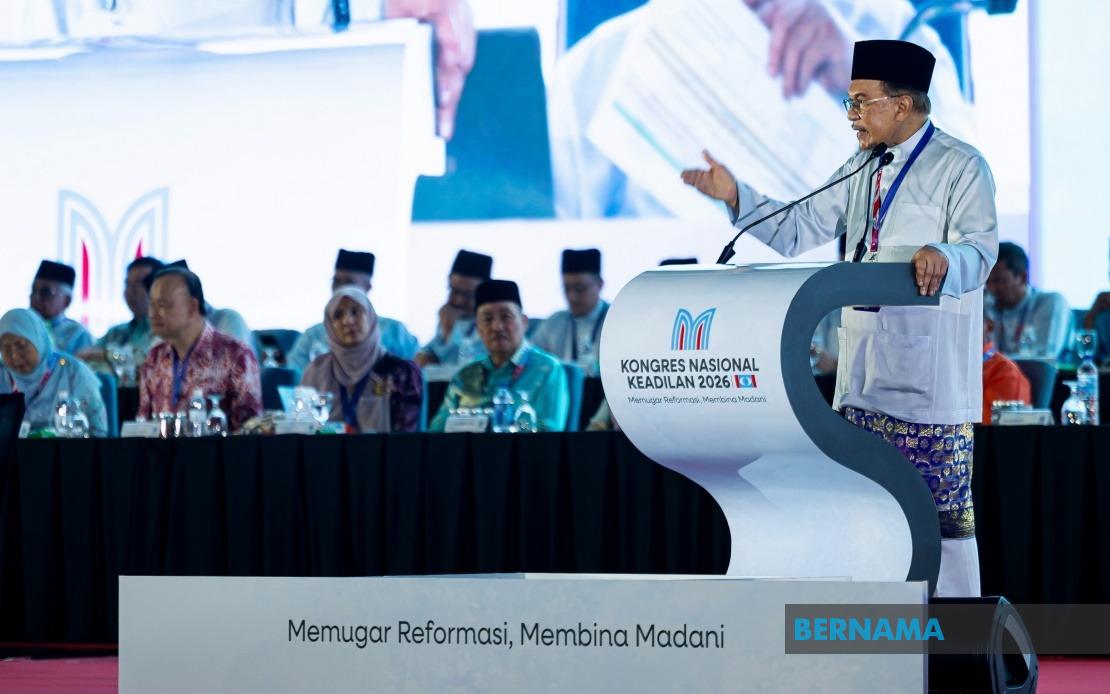
Prime Minister Datuk Seri Anwar Ibrahim moved swiftly to quash suggestions of a deepening rift with Deputy Prime Minister Datuk Seri Dr Ahmad Zahid Hamidi, insisting that their working relationship remains solid despite mounting speculation about coalition tensions. Speaking in Melaka on Thursday after addressing the PKR National Congress, Anwar characterised former Rembau Member of Parliament Khairy Jamaluddin's assertion that trust between the two leaders had eroded to its lowest point since 2022 as merely a subjective interpretation rather than an accurate reflection of government dynamics.
Khairy's public claim, made a day earlier, alleged that deteriorating relations between Barisan Nasional and Pakatan Harapan had precipitated the supposed cooling of ties between Anwar and Zahid. The former UMNO Youth chief specifically pointed to BN's recent decision to align with Perikatan Nasional during the Negeri Sembilan state election as evidence of fracturing consensus within the Unity Government. Such allegations carry weight in Malaysia's delicate political ecosystem, where coalition government stability directly impacts legislative passage and policy implementation across federal and state levels.
Anwar's rebuttal employed a philosophical framing, contrasting his approach to governance with Khairy's analytical lens. He suggested that while Khairy habitually interprets political situations through a lens of confrontation and conflict, he himself prioritises consensus-building and diplomatic resolution of differences. This distinction reflects broader ideological divergence between the two figures—Anwar, as head of the reformist PKR and coalition chief, has consistently emphasised inclusive dialogue, while Khairy, now operating from the backbenches of UMNO, has adopted a more combative posture towards the sitting government.
Notably, Anwar deployed his address at the 2026 PKR National Congress in Melaka as a platform for reaffirming appreciation of Zahid's contribution to the coalition arrangement. By publicly thanking both the Deputy Prime Minister and UMNO more broadly for facilitating the Unity Government's formation following the 15th General Election in November 2022, Anwar sought to reinforce narratives of partnership rather than antagonism. This ceremonial acknowledgement served multiple functions: it addressed Zahid directly with public validation, signalled to PKR delegates that coalition stability remained paramount, and implicitly rebutted Khairy's narrative of irreparable trust deficit.
The timing of these exchanges matters considerably within Malaysia's political calendar. The PKR congress, a significant gathering for the party's grassroots membership, represents an opportunity for Anwar to consolidate his leadership position and chart the coalition's direction heading into the coming years. Khairy's intervention, by contrast, reflects the position of an opposition voice within UMNO itself—he remains a senior figure within the party's institutional structure yet increasingly critical of the party leadership's coalition commitments, mirroring broader ideological tensions within Barisan Nasional between those invested in the status quo and those advocating for alternative political arrangements.
The Negeri Sembilan state election that Khairy referenced constitutes a tangible flashpoint in coalition relations. When BN opted to collaborate with Perikatan Nasional—a development that caught many Pakatan Harapan leaders off guard—it illustrated how state-level calculations can diverge from federal coalition discipline. For Pakatan Harapan, such outcomes generate anxiety about long-term coalition viability; for Barisan Nasional, they demonstrate continued political flexibility and leverage. The fact that Anwar felt compelled to address these tensions publicly suggests they carry sufficient currency in political circles to warrant explicit rebuttal rather than dismissal through silence.
Anwar's assertion that differences within and between coalition parties remain resolvable through dialogue and peaceful methodology points toward his preferred governance model. He has consistently championed this approach since assuming the premiership, arguing that Malaysia's stability depends on competing political forces finding common ground rather than escalating confrontation. This philosophy underpins his entire coalition management strategy—maintaining sufficient cohesion among disparate partners (PKR, DAP, UMNO, MIC, and others) while accommodating legitimate differences in tactical approach and policy preference across state and federal domains.
However, the very fact that Khairy felt emboldened to make such claims reflects underlying structural vulnerabilities within the coalition arrangement. The Unity Government, forged initially in response to post-election instability and maintained through calculated mutual interest, lacks the organic cohesion of administrations built upon clearer electoral mandates or unified ideological platforms. BN's conditional participation depends on tangible benefits—ministerial positions, financial allocations, policy influence—and any perception that these benefits are diminishing or inequitably distributed risks triggering precisely the kind of friction that Khairy has attempted to weaponise.
For Malaysian observers tracking government stability, these public exchanges function as barometers of coalition health. When coalition partners feel compelled to issue clarifications about their mutual relationships, it signals that trust—despite formal institutional arrangements—requires active maintenance and public reinforcement. The fact that Anwar must periodically reiterate appreciation for Zahid's role suggests that such acknowledgements do not flow naturally from the partnership structure but rather represent consciously calibrated political messaging aimed at sustaining the arrangement.
Looking forward, the coalition's durability will likely depend less on periodic public reassurances and more on substantive outcomes: economic performance, progress on anti-corruption initiatives that commanded public support, and equitable accommodation of coalition partners' competing interests. Zahid's position as Deputy Prime Minister and UMNO president makes him the linchpin of the entire arrangement—any genuine fracture between him and Anwar would threaten the entire structure. Conversely, Khairy's positioning as a voice within UMNO advocating for alternative alignments represents an ongoing pressure point that Anwar must manage through combinations of democratic openness and strategic political maneuvering.
Ultimately, Anwar's dismissal of Khairy's claims attempts to project an image of stable, functional governance despite underlying coalition complexity. Whether this narrative withstands ongoing state-level political developments and the incremental bargaining dynamics characteristic of coalition government remains an open question for Malaysia's political observers.

