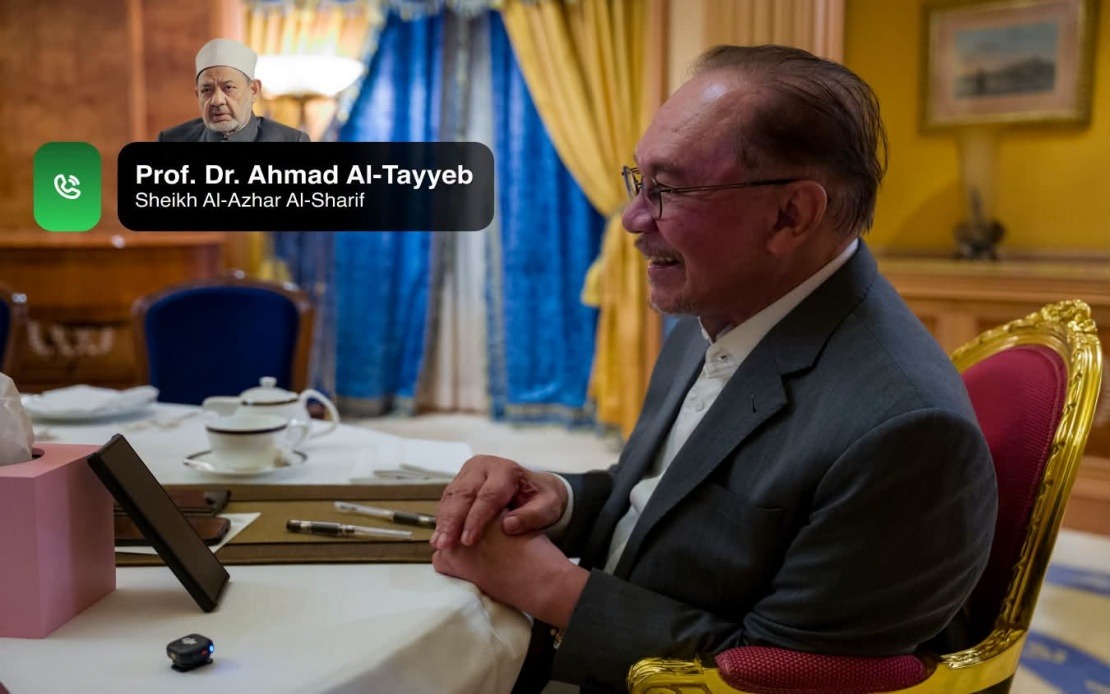
Prime Minister Datuk Seri Anwar Ibrahim has engaged in substantive discussions with one of Islam's most influential religious authorities, Sheikh al-Azhar al-Sharif Prof Dr Ahmad al-Tayyeb, focusing on coordinated efforts to deepen Islamic understanding across communities. The conversation, conducted by telephone on August 22, reflected both personal courtesies and strategic dialogue on matters of religious scholarship and Islamic outreach that carry implications for Malaysia's positioning within the global Islamic framework.
The prominent cleric initiated contact to inquire about Anwar's health status and extend prayers following the Prime Minister's recent surgical procedure. In his response, Anwar conveyed gratitude for the gesture whilst confirming that his operation had proceeded without complications and that his recovery trajectory remained positive. This exchange underscored the significance Malaysia attaches to maintaining cordial relationships with leading figures in the Islamic scholarly establishment, particularly al-Azhar University in Cairo, which commands considerable influence among Muslim-majority nations and religious institutions.
Beyond the courtesy aspects of their interaction, the two leaders turned attention to the substantive matter of continuing dakwah—the Islamic concept of inviting or calling people towards religious understanding—alongside broader Islamic educational initiatives. Anwar emphasised that these collaborative endeavours serve to broaden comprehension of Islamic teachings throughout society, extending benefits across all communities within Malaysia. The focus on expanding religious literacy rather than narrower sectarian concerns reflects an approach consistent with Malaysia's multi-religious constitutional framework and its aspiration to position Islam as intellectually sophisticated and inclusive.
Anwar specifically referenced Sheikh al-Azhar's previous visit to Malaysia, characterising it as having made a profound impression upon the Malaysian Muslim population. This acknowledgment speaks to the symbolic importance of high-level religious exchanges in reinforcing Malaysia's credentials within international Islamic circles whilst simultaneously strengthening domestic Islamic institutional capacity. The experience of hosting such a figure appears to have generated momentum for expanded cooperation on knowledge-sharing and scholarly collaboration.
Looking ahead, both leaders expressed optimism about future in-person meetings, with Anwar suggesting that Cairo or Kuala Lumpur could serve as venues for continuing their dakwah efforts and advancing Islamic knowledge expansion. This reciprocal framework—alternating between the headquarters of Islamic scholarship in Egypt and Malaysia's national capital—suggests a conception of partnership based on mutual respect and shared responsibility for Islamic educational advancement. The willingness to host or visit signals Malaysia's ambition to position itself as a centre for contemporary Islamic thought rather than merely a recipient of religious guidance.
Parallel to his engagement with Sheikh al-Azhar, Anwar also conducted separate discussions with Mohamed Abdelsalam, Secretary-General of the Council of Muslim Elders (Majlis Hukama Muslimin), another influential figure in Islamic institutional networks. These coordinated interactions with multiple Islamic leaders within a compressed timeframe suggest deliberate effort to strengthen Malaysia's relationships across the spectrum of contemporary Islamic intellectual and institutional leadership. The breadth of these engagements demonstrates the Prime Minister's personal commitment to matters of religious education and interfaith understanding.
Their conversation with Mohamed Abdelsalam similarly encompassed inquiries about health and personal welfare, with Anwar demonstrating concern regarding Abdelsalam's wife who was undergoing hospital treatment. This attention to personal circumstances reflects diplomatic norms that humanise official interactions and build foundations of mutual regard extending beyond transactional exchanges. The Prime Minister's prayers for her recovery conveyed both sincere compassion and acknowledgment of shared values around family and wellbeing.
The discussions also touched upon Sheikh al-Azhar's expressed desire to return to Malaysia for another visit, indicating sustained interest in deepening engagement with Malaysian religious and political leadership. More significantly, the conversations encompassed exploration of initiatives designed to strengthen Malaysia's institutional relationship with al-Azhar University itself, potentially opening avenues for expanded scholarly exchange, joint research ventures, and collaborative curriculum development. These mechanisms could substantially enhance Malaysia's Islamic scholarly capacity and international visibility within Islamic academic circles.
Central to these discussions was a shared commitment to what Anwar characterised as nurturing a conception of Islam that is simultaneously simple in its accessibility, free from dogmatic rigidity, and authoritative in its scholarly credentials. This formulation attempts to reconcile intellectual sophistication with popular understanding, suggesting an Islam that maintains theological seriousness whilst remaining comprehensible and relevant to contemporary believers. For Malaysia, such positioning carries strategic value in an era when alternative interpretations of Islam compete for adherents and influence throughout the Muslim world.
Anwar acknowledged the friendship and demonstrated loyalty of both Sheikh al-Azhar and Mohamed Abdelsalam, recognising their consistent support and trust as valuable resources for Malaysia's broader diplomatic and religious objectives. He also extended public appreciation for his wife Datuk Seri Dr Wan Azizah Wan Ismail, characterising her as exemplifying steadfastness, loyalty and sacrifice throughout his political journey. This recognition of spousal contribution to his leadership journey reflects a personal dimension that complements the official nature of his interactions with international Islamic figures.
These multifaceted engagements reflect Malaysia's strategic interest in positioning itself as a bridge between global Islamic institutions and contemporary Muslim societies confronting modernisation and pluralism. By cultivating relationships with authoritative Islamic scholars and institutional leaders whilst emphasising inclusive, intellectually grounded approaches to Islam, Malaysia signals its commitment to moderating influence within Islamic discourse. The substantive focus on dakwah and Islamic education, rather than on political or geopolitical divisions, frames these interactions as contributions to universal wellbeing rather than narrow national interest.

