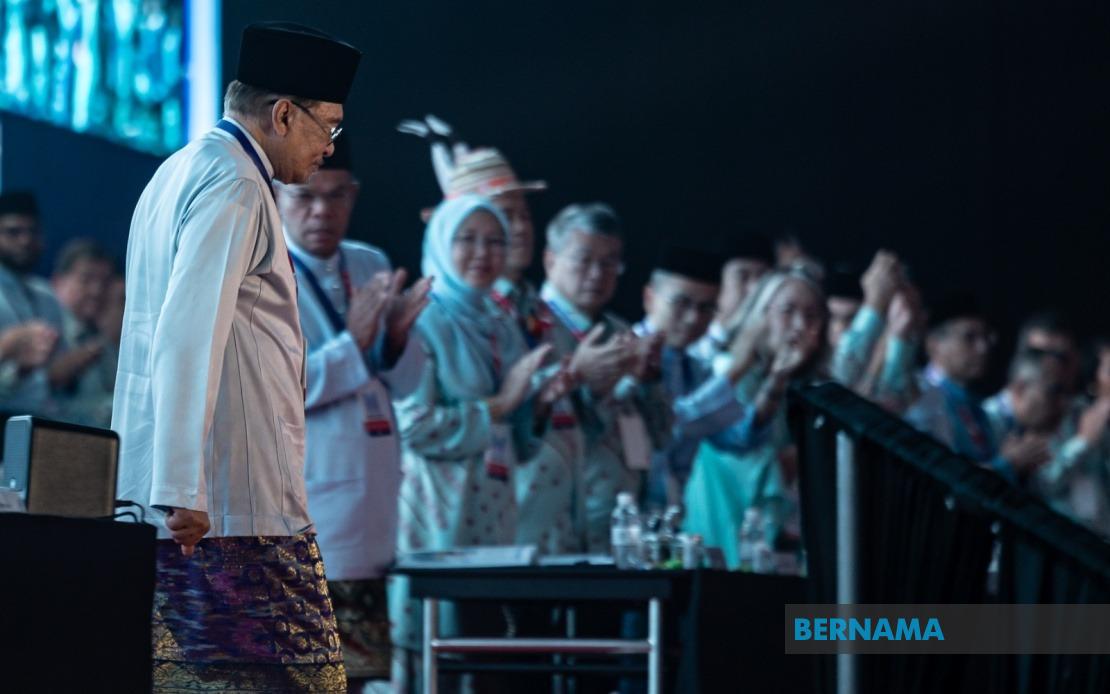
Prime Minister Datuk Seri Anwar Ibrahim has pushed back against criticism of the pace of governmental reform, contending that meaningful progress achieved over the past three years merits recognition even as demands for further change continue. Speaking at the PKR National Congress in Melaka on August 15, Anwar stressed that sweeping institutional change—particularly the kind that had been delayed for six decades—cannot realistically be accomplished overnight, and that citizens pressing for transformation should simultaneously acknowledge the concrete steps already taken.
Anwar, who simultaneously holds the Finance Minister portfolio and chairs Pakatan Harapan, outlined an impressive catalogue of legislative accomplishments to support his position. These include amendments to the foundational Audit Act 1957, overhauls of the Parliamentary Service Act, passage of the Public Finance and Fiscal Responsibility Act 2023, creation of the Special Task Force on Agency Reform, and new protections under the Consumer Credit Act alongside worker protections for gig economy participants. Each of these represents a departure from decades of stalled progress, he suggested, and collectively they signal a government willing to tackle structural weaknesses long ignored by predecessors.
The Prime Minister's comments reflect a broader tension within Malaysia's reform conversation. The MADANI agenda, articulated as the coalition government's defining framework, raised public expectations for rapid and comprehensive institutional transformation when the current administration took office following the 2022 General Election. Yet the realities of governing a diverse coalition—Pakatan Harapan with Barisan Nasional components and other partners—have necessitated pragmatism. Anwar acknowledged this candidly, noting that coalition negotiations constrained the scope and velocity of change that a single-party government might theoretically achieve.
What emerges from Anwar's remarks is a philosophy of incremental institutionalism. Rather than viewing three years of legislative reform as a baseline from which to demand acceleration, he presents it as evidence of a government working methodically to embed change deeply enough to persist across electoral cycles. This approach reflects concern that reforms imposed hastily or without broad governmental buy-in might be reversed when political winds shift. The emphasis on ensuring changes have "strong foundation" and can be "implemented in stages" suggests awareness that sustainability matters more than speed.
However, Anwar's framing also carries implicit acknowledgement that the government has not matched the transformative rhetoric that helped bring the current coalition to power. Citizens who voted expecting swift dismantling of entrenched structures may reasonably feel the pace insufficient. The Prime Minister's appeal to "friends who are demanding change" to "accept the fact that change has already taken place" reads partly as an attempt to reset expectations downward without abandoning the reform banner entirely.
The political context matters considerably for Malaysian audiences. Anwar's government operates within constraints that many countries with more stable executive authority do not face. Malaysia's federal structure, the need to manage state-level concerns, and the requirement to maintain coalition cohesion all impose friction on policy implementation. Additionally, much of the reform agenda touches sensitive areas—fiscal transparency, accountability mechanisms, workers' rights—where different coalition partners hold varying degrees of enthusiasm. What appears glacial to impatient reformers may represent the maximum change achievable within these structural limits.
For Southeast Asia more broadly, Malaysia's experience illuminates broader regional challenges. Across the ASEAN bloc, countries grappling with demands for institutional reform face similar pressures between transformative ambition and political feasibility. Thailand, Indonesia, and the Philippines have all wrestled with how to signal commitment to change while managing competing interests and constitutional constraints. Anwar's three-year stocktake offers a case study in how a reformist government communicates progress when that progress lags public expectation.
Yet the Prime Minister's acknowledgement that "not all steps taken by the government had been perfect" introduces important nuance. Rather than claiming flawless execution, Anwar implicitly concedes that reform implementation has encountered obstacles and learning curves. This candour—unusual in political discourse—suggests awareness that pretending toward perfection erodes credibility. It also opens space for mid-course corrections and course adjustments based on early experience.
The address to PKR delegates also signalled continued commitment to the reform agenda going forward, with Anwar pledging the government would "strengthen the reform agenda based on its capabilities and prevailing circumstances." This formulation preserves flexibility—reform will continue, but calibrated to what the government believes achievable. For critics, this may sound like a preemptive excuse for further delays. For pragmatists, it represents honest acknowledgement of political economy.
What Anwar's remarks ultimately reveal is a government wrestling with the gap between campaign promises and governing reality. The MADANI agenda represented the coalition's vision for a revitalised Malaysia. The accumulated legislative achievements—amendments, new acts, institutional innovations—represent genuine progress on that vision. Yet the slower-than-hoped pace reflects the constraints of coalition governance, federal structure, and the genuine complexity of embedding institutional change across a large bureaucracy. Whether Malaysian voters conclude the government has done enough, or merely made a creditable start on a much longer transformation, will likely shape electoral outcomes and policy trajectories for years ahead.

