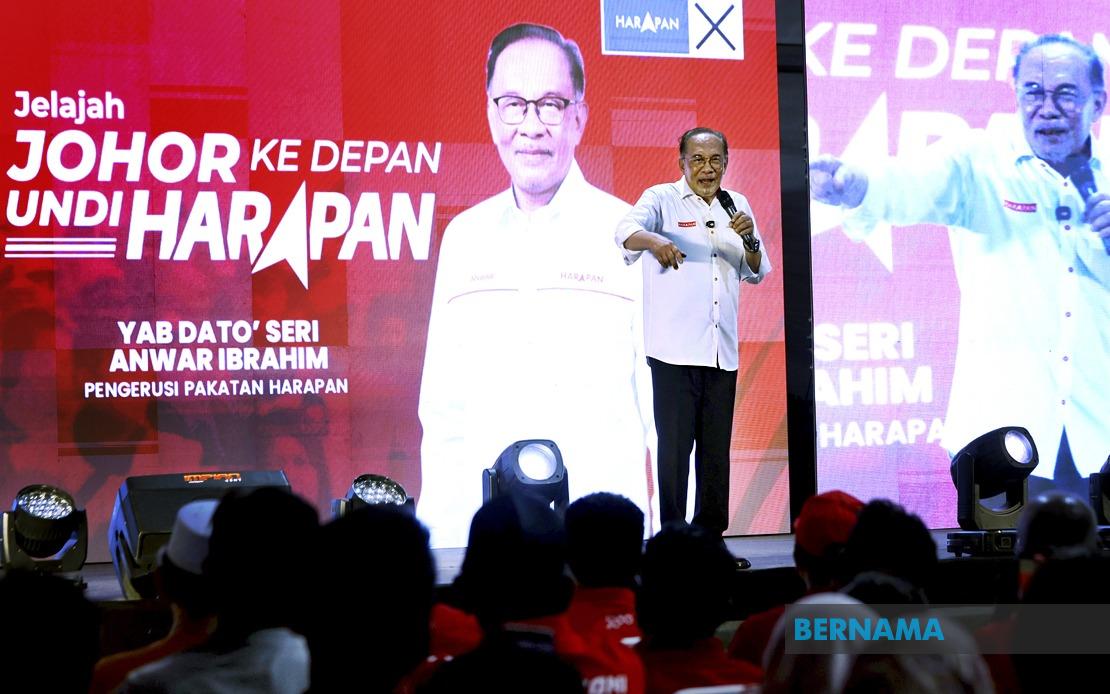
Prime Minister Datuk Seri Anwar Ibrahim has drawn a definitive line under what he characterises as Malaysia's history of systemic corruption, pledging that his administration will offer no sanctuary to officials found to have engaged in unlawful enrichment schemes. Speaking in Muar during a campaign event for the Johor State Election, Anwar signalled a fundamental shift in how the MADANI Government intends to operate, positioning clean governance as non-negotiable rather than aspirational.
The Prime Minister framed his remarks within a broader critique of what he termed the "culture of plunder," a reference to the patronage networks and crony capitalism that characterised previous administrations. He argued that the previous model of governance—where political power served as a vehicle for personal and familial enrichment—represented a fundamental betrayal of public trust. This characterisation carries particular resonance given Malaysia's recent history of high-profile corruption cases and the political transitions of recent years, which have centred substantially on questions of accountability and institutional reform.
Central to Anwar's messaging was the assertion that leadership integrity must transcend racial and communal divisions. He explicitly rejected the notion that integrity should be evaluated through an ethnic lens, instead calling for voters to assess leaders solely on the basis of honesty and competence. This framing appears designed to counter suggestions that anti-corruption measures might disproportionately target particular communities, a common line of political argument in Malaysian discourse. By emphasising that his government seeks "Malays who are good, honest and not corrupt" alongside "Chinese who are good and not corrupt," Anwar attempted to reposition the anti-corruption agenda as fundamentally inclusive rather than factional.
The Prime Minister's remarks extended to concrete practices he identified as requiring immediate cessation. He specifically highlighted the practice of awarding government contracts to family members or close associates as emblematic of the systemic dysfunction requiring remedy. Such patronage arrangements, he argued, not only drain public resources but also undermine Malaysia's international standing and economic competitiveness. The emphasis on contractual impropriety reflects awareness that much of Malaysia's recent corruption involves procurement processes, a vulnerability that requires sustained institutional attention.
Anwar's declaration that no individual would receive governmental protection from corruption proceedings represents a significant commitment, one that carries implications for how the government might handle allegations involving high-ranking figures or politically connected persons. Such assurances become particularly consequential in a Malaysian context where questions of selective accountability have historically plagued anti-corruption efforts. The stated blanket principle offers a counternarrative to perceptions of political manipulation of enforcement mechanisms.
The Prime Minister situated opposition criticism and political pressure as stemming from actors motivated primarily by desire to regain federal control rather than genuine governance concerns. This framing implicitly acknowledges that corruption narratives have become heavily politicised in Malaysian discourse, with different coalitions advancing competing claims about institutional integrity. By attributing opposition objections to faction self-interest, Anwar attempted to inoculate his government's anti-corruption record against criticism emanating from political competitors.
Anwar's emphasis on the economic and reputational consequences of corruption reflected a development-oriented framing of anti-corruption efforts. He linked clean governance not merely to ethical requirements but to Malaysia's capacity to achieve economic progress and maintain international credibility. This appeals to aspirational rather than purely moralistic registers, positioning corruption as an obstacle to the material improvements Malaysians seek. Such messaging targets concerns about competitiveness in regional and global contexts, where governance standards increasingly influence investment flows and institutional cooperation.
The campaign event itself occurred within the context of Johor State Elections scheduled for July 11, with early voting on July 7. The 56 state seats contested by 172 candidates represent a significant electoral test for the coalition government. Anwar's intensive campaigning—completing fifteen engagements over two days—underscores the political stakes involved and reflects efforts to consolidate support ahead of polling. His choice to emphasise anti-corruption themes suggests an assessment that governance integrity messaging resonates with target constituencies in Johor.
The presence of Penang Chief Minister Chow Kon Yeow and Ledang MP Syed Ibrahim Syed Noh at the event reinforced the cross-state dimension of the coalition campaign, signalling alignment across different state leaderships around the MADANI agenda. This coordination demonstrates efforts to present a unified front on governance standards across Malaysia's political landscape, potentially leveraging successful governance models in Penang—a state frequently cited for relatively stringent procurement and institutional practices—to build broader credibility.
For Malaysian citizens and regional observers, Anwar's declarations warrant careful calibration with subsequent institutional developments and enforcement patterns. The credibility of anti-corruption commitments ultimately depends not on rhetoric but on demonstrated willingness to pursue cases impartially, particularly when allegations involve politically significant figures. Southeast Asian experience suggests that anti-corruption campaigns frequently face pressures that test foundational commitments, whether from entrenched bureaucratic interests, political allies seeking protection, or international pressure. Malaysia's trajectory on this front will influence both domestic political dynamics and broader regional perceptions of institutional governance capacity.
The broader significance of Anwar's positioning extends beyond immediate electoral considerations. His articulation of anti-corruption as a defining principle of the MADANI Government establishes a standard against which his administration will be measured. As Malaysia continues navigating complex questions of institutional reform, judicial independence, and accountability mechanism effectiveness, the government's actual performance in pursuing corruption cases will either validate or undermine the ambitious commitments advanced during campaign season. For regional economies and investors evaluating Malaysia's investment climate and institutional stability, governance integrity trajectories remain consequential factors in decision-making calculus.

