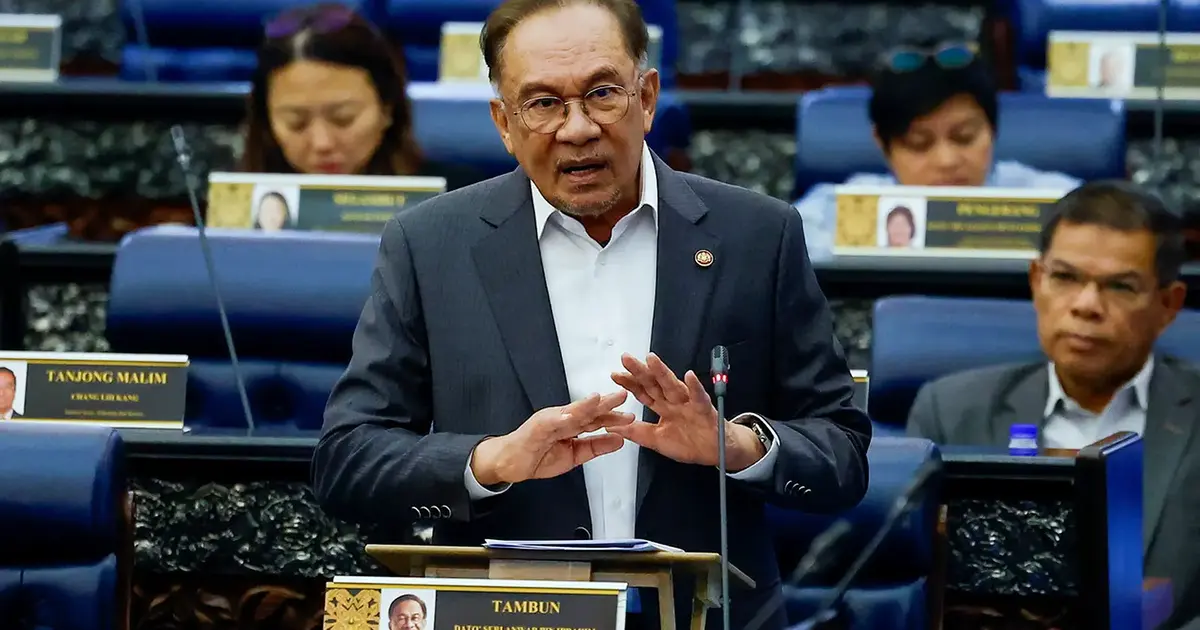
Prime Minister Anwar Ibrahim has moved to clarify the origins of Sabah's special grant arrangement, asserting that the financial commitment was not a new policy initiative but rather a continuation of agreements negotiated under the previous Warisan-led administration. This clarification comes amid ongoing discussions about federal funding mechanisms for the East Malaysian state and underscores the continuity of certain fiscal arrangements despite the political transition that took place in Sabah's governance structure.
According to Anwar, the graduated payment structure for the special grant represents a commitment that was formally approved by the state government before the administration changed hands. The figures demonstrate a substantial escalation in federal financial support for Sabah, beginning from RM53.4 million allocated for both 2020 and 2021, before nearly doubling to reach RM106.8 million by 2024. This upward trajectory reflects either an expansion of the original agreement or the maturation of a phased implementation plan that had been established earlier.
The distinction Anwar is drawing carries political significance within Sabah's complex governance landscape. Warisan, which led the state under Shafie Apdal prior to the 2023 shift towards the Perikatan Nasional-aligned administration, had operated within a delicate balance of state autonomy and federal relationships. The revelation that special grant arrangements were already in place suggests that negotiations over Sabah's fiscal position and development funding had been ongoing topics of discussion between state and federal authorities, regardless of which coalition controlled the state government.
For Malaysian political observers, this clarification addresses an implicit question about whether the current federal administration has been expanding Sabah's financial allocations as part of broader coalition management or whether it has simply been honouring commitments made by its predecessors. The distinction matters because it affects how one interprets federal priorities and the degree to which Sabah's enhanced funding reflects new political alignments versus existing policy trajectories. Anwar's statement positions the current government as a steward of agreed arrangements rather than as an architect of new generosity.
The special grant mechanism itself warrants attention from those monitoring federal-state fiscal relationships. Sabah, as one of Malaysia's easternmost and relatively less densely populated states, has historically occupied a unique position in federal funding calculations. The graduated increase in special grant allocations suggests recognition at federal level that Sabah's development needs and fiscal capacity require ongoing supplementation beyond standard revenue-sharing arrangements. This approach differs from block grants or standard allocation formulas and indicates a degree of customization in how the federal government addresses different state circumstances.
The timing of these grant increases is also instructive. The jump from RM53.4 million to RM106.8 million—essentially a doubling—occurs across a four-year period, with the lower figure holding for two years and the higher figure applying to subsequent years. This suggests either a planned escalation embedded in the original agreement or a structured transition to new funding levels. Understanding which scenario applies would clarify whether state governments can expect such increases to be pre-negotiated or whether future adjustments remain open for renegotiation.
For Malaysian stakeholders monitoring fiscal federalism and state development, Anwar's clarification highlights an important principle: that regardless of electoral outcomes and changes in state administration, certain foundational agreements between federal and state governments endure. This continuity can provide stability for long-term planning but may also limit the ability of new administrations to renegotiate terms they might view as unfavourable. The fact that Sabah's special grant structure predates the current alignment suggests these arrangements enjoy a status that transcends ordinary political contestation.
From a Southeast Asian perspective, Malaysia's approach to managing fiscal relationships between its federal centre and constituent states offers lessons in how multinational federations balance regional autonomy with centralized control. Sabah's special grant status reflects acknowledgment that uniform national policies may not adequately address the particular circumstances of states with distinct geographic, demographic, or economic profiles. The mechanism also demonstrates how federal governments can maintain political flexibility by treating certain states differently without formally dismantling uniform system structures.
Looking forward, Anwar's statement may also signal that the current federal government intends to honour inherited fiscal commitments even where they were negotiated by predecessor administrations or under different coalition arrangements. This approach builds institutional predictability but potentially constrains fiscal flexibility if multiple such arrangements accumulate. For policymakers in other Malaysian states, the Sabah precedent illustrates both the possibility of securing special arrangements and the permanence such arrangements can acquire once established.
The clarification also reflects the evolving relationship between Putrajaya and Kota Kinabalu, where political alignment has shifted notably in recent years. Whether this special grant structure serves as a foundation for deepened cooperation or represents a settled arrangement requiring no further negotiation will become clearer as fiscal planning cycles evolve. For now, Anwar's statement establishes that the funding framework predates current configurations, situating it within a longer arc of federal-state fiscal negotiation that has continued across multiple political cycles.

