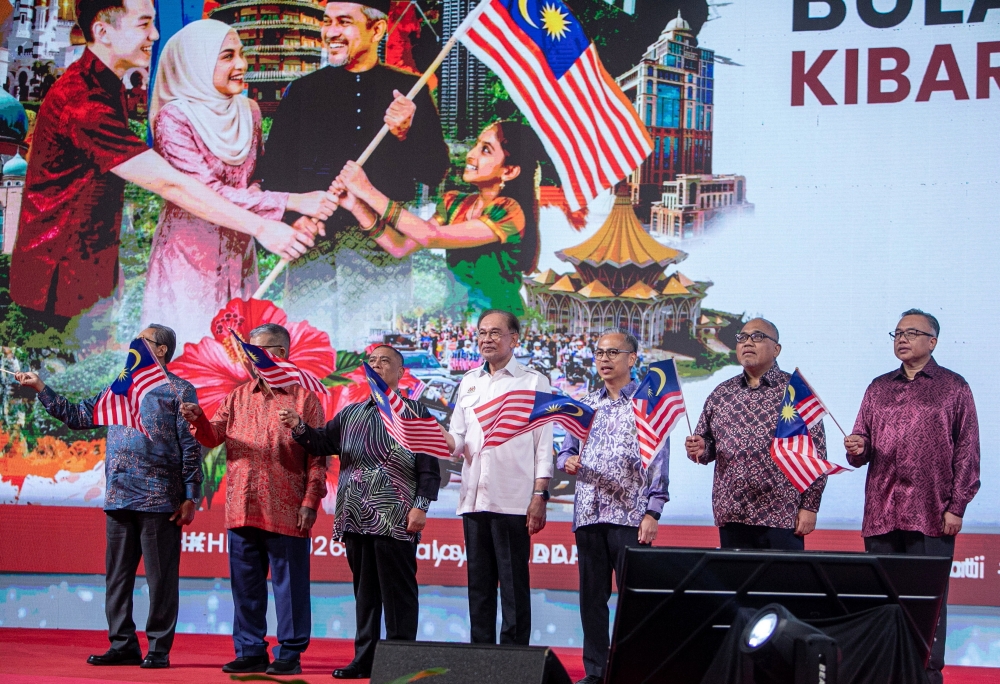
Prime Minister Datuk Seri Anwar Ibrahim has issued a powerful reminder to Malaysia's younger generation about the significant price paid by those who fought for the nation's independence, stressing that contemporary Malaysians must never underestimate the sacrifices embedded in the country's founding history. Speaking in Ipoh, the Prime Minister emphasised the importance of understanding and remembering the courageous efforts of past generations who struggled against colonial rule to secure the nation's freedom.
Anwar's remarks come at a time when Malaysia continues to grapple with questions about national cohesion, institutional strength, and the preservation of founding ideals. The Prime Minister's message carries particular resonance as the country navigates complex political and social challenges that require citizens to return to shared national principles. By invoking the independence struggle, Anwar sought to reconnect contemporary Malaysians with the historical foundations that underpin their nation's identity and constitutional framework.
The call to remember serves as an implicit critique of what Anwar perceives as a generational gap in historical consciousness. Young Malaysians born decades after Merdeka have not lived through the uncertainty and hardship that characterised the pre-independence era, and may lack visceral understanding of why certain national institutions, safeguards, and values were established. This disconnect risks fostering complacency about freedoms that are often taken for granted when inherited rather than earned through direct struggle.
Anwar's emphasis on appreciation extends beyond mere nostalgia or ceremonial patriotism. The Prime Minister appears to be advocating for a deeper civic engagement grounded in historical understanding. When citizens comprehend the genuine sacrifices that secured their rights and freedoms, they become more invested in protecting those institutions and contributing meaningfully to national development. This educational dimension—understanding how independence was achieved and at what cost—becomes foundational to building responsible, engaged citizens.
For Malaysian readers, Anwar's message carries contemporary policy implications. The government under his leadership has prioritised institutional reform and anti-corruption measures, framing these initiatives as essential to preserving the integrity of the nation's founding structures. By reminding citizens of the independence struggle's significance, the Prime Minister seeks to build public support for reforms that he argues are necessary to protect the democratic institutions that the independence generation bequeathed to modern Malaysia.
The statement also addresses a subtle but important challenge in post-colonial societies: maintaining the moral force of national founding narratives across generational transitions. As communities become more diverse, more urbanised, and more globally connected, the symbolic power of independence history can fade unless deliberately reinforced through education, commemoration, and political leadership. Anwar's public reminder functions as both homage and renewal of that historical narrative.
In the Southeast Asian context, Malaysia's experience reflects broader regional challenges. Across the peninsula and archipelago, nations that achieved independence during the mid-twentieth century face similar questions about how to keep historical consciousness alive while adapting to contemporary realities. The tension between honouring the past and building the future exists across Singapore, Indonesia, the Philippines, and Thailand. Anwar's approach—insisting that remembrance and contemporary progress are not mutually exclusive—offers one perspective on managing this balance.
The Prime Minister's focus on youth is strategically significant. Young people will shape Malaysia's trajectory for decades to come, determining whether national institutions strengthen or weaken, whether democratic norms solidify or erode, and whether the social contract that underpins the nation remains viable. By addressing them directly about historical responsibility, Anwar signals that he views the younger generation not as passive recipients of national legacy but as active custodians responsible for its continuation and evolution.
Anwar's remarks also implicitly address concerns about the politicisation of history and national memory. By framing the independence struggle as a shared heritage rather than the exclusive possession of any single political party or ethnic group, the Prime Minister attempts to position historical remembrance as unifying rather than divisive. This approach contrasts with versions of history that weaponise the past to advance narrow political agendas, suggesting instead that genuine appreciation of independence achievements transcends partisan boundaries.
The timing of such appeals matters considerably in Malaysian politics. With general elections potentially approaching and broader questions about the nation's direction under sustained discussion, reminders about founding principles can serve to elevate public discourse above transactional politics. Anwar appears to be making an argument that certain values—freedom, dignity, institutional integrity—supersede short-term electoral calculations and should guide decision-making at all levels of governance and citizenship.
For civil society organisations, educators, and media practitioners in Malaysia, Anwar's intervention suggests both opportunity and responsibility. If young people are to genuinely engage with independence history and understand its contemporary relevance, education systems, museums, documentaries, and public forums must present this material in ways that resonate with modern audiences. Historical consciousness cannot be imposed through exhortation alone; it requires sustained, thoughtful engagement with difficult questions about how independence was achieved and what it actually secured.
Ultimately, Anwar's call represents an investment in what might be termed historical patriotism—a form of national commitment grounded not in blind emotion but in informed understanding of how the nation came to exist and what principles it was founded to protect. In an era when institutions face testing from multiple directions and citizens navigate competing claims on their loyalty and attention, such appeals to foundational memory carry substantial weight, inviting Malaysians to see themselves as links in a chain extending from the independence generation forward to futures yet unmade.

