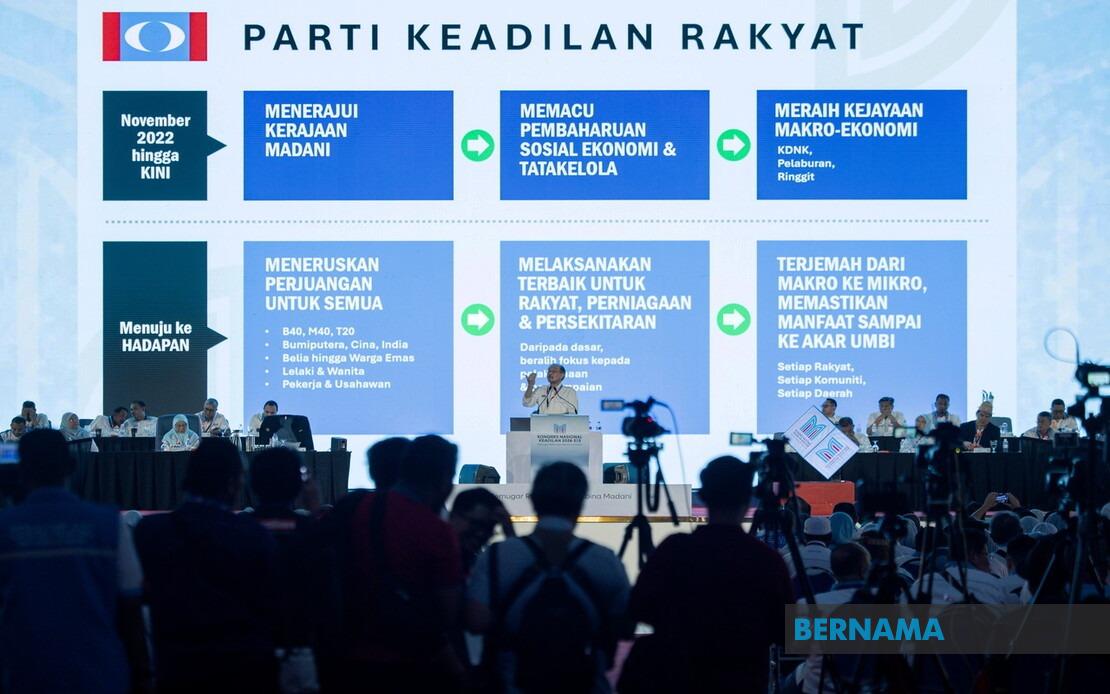
Prime Minister Datuk Seri Anwar Ibrahim has entrusted Home Minister Datuk Seri Saifuddin Nasution Ismail with full authority to discharge the responsibilities of PKR's deputy president position, following a decision to grant Nurul Izzah Anwar a period of temporary leave. The announcement was made during Anwar's closing remarks at the PKR National Congress 2026, held at the Melaka International Trade Centre in Ayer Keroh on August 16.
The transition represents a strategic recalibration within the party hierarchy at a time when PKR faces fresh challenges following recent electoral setbacks. Anwar characterised the assignment as potentially demanding additional work for Saifuddin Nasution, yet emphasised the appointment reflected his deep confidence in the Home Minister's capabilities and their longstanding personal relationship. The PKR president highlighted that Saifuddin Nasution's demonstrated loyalty and understanding of party operations made him the natural choice to maintain continuity in the deputy president's functions during this interim period.
The Central Leadership Council had approved this arrangement on August 6, according to PKR Information Chief Datuk Seri Fahmi Fadzil, confirming that the interim basis for Saifuddin Nasution's appointment would allow the party machinery to function smoothly without disruption. Anwar's statement underscored his expectation that party machinery at all levels would rally behind Saifuddin Nasution with complete support, cooperation, and loyalty. This call for unified backing reflects awareness within the leadership that smooth transitions in top positions require visible endorsement from the broader party structure to maintain morale and operational effectiveness.
Simultaneously, Anwar announced additional leadership assignments aimed at strengthening the party's organisational capacity ahead of future electoral contests. Vice-president Datuk Seri Amirudin Shari has been appointed as the party's election director, a position critical given PKR's need to improve its performance after recent electoral disappointments. In another move, Tengku Datuk Seri Zafrul Tengku Abdul Aziz has taken on the role of coordinator in the Prime Minister's Office, further embedding party representation within the highest levels of government machinery.
The reshuffle takes on particular significance given PKR's defeat in the Negeri Sembilan state election on August 1, an outcome that has created internal pressures and demands for accountability within the party. Six division chiefs from Negeri Sembilan have called for a review of Datuk Seri Aminuddin Harun's position as chairman of the state PKR leadership council, reflecting frustration at the electoral loss. However, Anwar moved to protect Aminuddin while redirecting his focus toward party development work, asking the former Negeri Sembilan Menteri Besar to concentrate exclusively on his duties as vice-president and to lead the party's training initiatives aimed at developing new cadres.
Anwar's defence of Aminuddin illustrates a broader leadership philosophy that rejects individual scapegoating for collective electoral failures. By insisting that the Negeri Sembilan defeat should not be attributed solely to Aminuddin but rather shouldered collectively by the party, Anwar sought to shift the narrative away from personalised blame toward systemic analysis and improvement. This approach reflects recognition that demoralising senior figures through public recrimination could undermine party unity at a moment when PKR needs to consolidate strength and learning from recent setbacks.
The appointment of Aminuddin to focus on cadre training represents an attempt to leverage his extensive political experience in a direction that addresses one of PKR's acknowledged weaknesses: the development and mentorship of younger party members. Anwar specifically tasked Aminuddin with providing the best possible training to young PKR members at various levels, framing this responsibility as essential to the party's medium and long-term sustainability. This emphasis on institutional capability-building signals that PKR leadership views human resource development as critical to reversing recent electoral trends.
For Malaysian political observers, these moves illustrate how coalition governments must carefully navigate leadership transitions while maintaining stability and managing internal factional pressures. The interim arrangement with Saifuddin Nasution preserves the deputy president position within the party structure while accommodating Nurul Izzah's needs, a balancing act that avoids either creating a power vacuum or forcing a permanent restructuring that might provoke wider internal debate. Such transitions in coalition parties like PKR require careful choreography to prevent rival factions from exploiting leadership gaps for political advantage.
The timing of these announcements, occurring at PKR's national congress, provides a platform for Anwar to reframe the party's direction and reaffirm his leadership authority. By making personnel decisions that demonstrate continued confidence in senior figures like Aminuddin while also implementing new assignments and responsibilities, Anwar signalled that PKR's leadership remains focused on problem-solving and organisational strengthening rather than being paralysed by recent electoral disappointments. This messaging matters for party morale and for external perceptions of PKR's stability within the larger Pakatan Harapan coalition.
The interim nature of Saifuddin Nasution's appointment to the deputy president role leaves open questions about the longer-term trajectory of this position. Whether Nurul Izzah returns to the role after her leave, or whether a more permanent arrangement emerges, remains undetermined. Such ambiguity, while potentially useful in the short term for managing competing interests, could become a source of tension if clarity is not established within a reasonable timeframe. PKR's ability to provide this clarity while maintaining party unity will partly determine how successfully it navigates the critical months ahead before major electoral contests.
These leadership changes must be understood within the context of broader challenges facing PKR and the Pakatan Harapan coalition. Recent electoral performance has raised questions about the coalition's longevity and effectiveness, making strong internal party management essential for all component parties. PKR's moves to strengthen its election capabilities, develop its cadre base, and ensure smooth leadership transitions reflect an attempt to position the party for improved electoral performance. How successfully Saifuddin Nasution and other newly appointed leaders execute their responsibilities will significantly influence PKR's trajectory and the stability of the broader political coalition.

