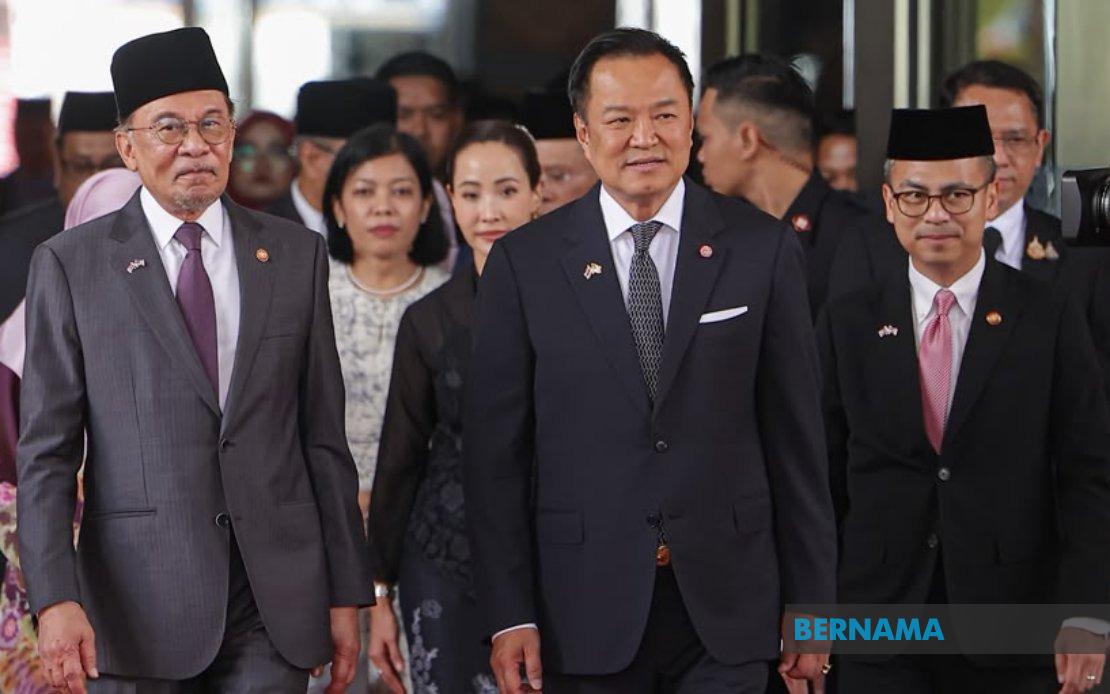
Prime Minister Datuk Seri Anwar Ibrahim and Thailand's Prime Minister Anutin Charnvirakul convened for bilateral discussions at the Perdana Putra Complex in Putrajaya on July 9, signalling renewed momentum in Malaysia-Thailand relations at the highest political level. The meeting, held during Anutin's two-day official visit to Malaysia, provided both nations an opportunity to assess progress on existing cooperation frameworks and chart pathways for deeper integration across priority areas affecting their shared interests and populations.
Thailand's top diplomat arrived at Kuala Lumpur International Airport at 11.11 am, where he received a formal reception from Anwar before the two leaders proceeded to the Perdana Putra Complex for substantive talks. The choreography of the visit underscored the diplomatic significance both governments attach to their relationship, with senior ministers from both sides present to underscore commitment to the agenda. Malaysia fielded a substantial delegation that reflected the breadth of the bilateral agenda, including representation from energy, foreign affairs, transport, agriculture, home affairs, trade and investment portfolios.
Trade and investment emerged as a central pillar of discussion, reflecting the economic interdependence between the two neighbours. With Thailand consistently among Malaysia's major trading partners and both nations competing for regional investment flows, conversations likely focused on tariff arrangements, supply chain connectivity, and sectoral opportunities where comparative advantages could be leveraged. Border connectivity figured prominently as well, given that the two countries share a significant land frontier and that cross-border movement of goods and people remains central to their economic relationship.
Security cooperation also anchored the bilateral agenda, particularly relevant given transnational challenges including human trafficking, narcotics smuggling, and maritime disputes in the Andaman Sea and the Strait of Malacca. Enhanced intelligence-sharing protocols and coordinated border management initiatives would strengthen both nations' ability to address these threats. Agricultural collaboration represented another substantive focus area, with both Thailand and Malaysia being major regional agricultural producers whose interests sometimes diverge but increasingly require coordination on trade standards and market access.
Tourism and people-to-people exchanges constituted the final substantive dimension of planned discussions. Thailand remains Malaysia's largest source of international tourists, while Malaysian visitors contribute significantly to Thailand's tourism revenues. Education partnerships, student exchanges, and cultural initiatives not only generate economic benefits but also build societal bonds that insulate bilateral relations from periodic political friction. These soft power initiatives tend to enjoy stable, cross-party support domestically and provide resilience to the overall relationship.
The composition of delegations on both sides indicated the seriousness with which each government approached the visit. Thailand's Deputy Prime Ministers covered foreign affairs, transport, and finance—departments directly aligned with the substantive agenda. Malaysia's ministerial representation similarly mirrored the breadth of cooperation, from Fadillah Yusof's energy portfolio to Mohamad Sabu's agriculture portfolio, signalling integrated government engagement rather than isolated diplomatic overtures. The inclusion of human resources and economy ministers suggested conversations extended beyond conventional bilateral mechanics into deeper economic restructuring and workforce development issues.
Regional and international strategic considerations formed the backdrop to bilateral talks, particularly regarding ASEAN cohesion and responses to major-power competition in Southeast Asia. Both nations maintain commitments to ASEAN centrality and the regional order, yet face differing pressures from external powers including China, the United States, and India. The bilateral framework provided opportunity to align positions on regional mechanisms including the East Asia Summit, ASEAN Regional Forum, and ASEAN Plus Three arrangements before multilateral forums convened later in the year.
A Memorandum of Understanding on agricultural cooperation scheduled for signing during the visit formalised commitment to deeper sector-specific engagement. Agricultural MOUs between neighbouring nations typically encompass research collaboration, technology transfer, and capacity-building initiatives, with potential to address food security concerns affecting both populations. Given growing global competition for agricultural resources and climate change impacts on production systems, such institutionalised cooperation mechanisms serve mutual interests in stabilising supply chains and prices.
The official luncheon hosted by Anwar following formal talks reflected traditional diplomatic protocol whilst providing informal setting for leaders to discuss matters perhaps too delicate for structured bilateral meetings. Such informal moments often yield understandings on sensitive issues that formal communiqués cannot adequately address, particularly regarding border disputes, minority rights, or regional security flashpoints where both nations share stakes.
For Malaysia specifically, the visit underscored the government's commitment to neighbourhood diplomacy as cornerstone of foreign policy. Thailand remains both competitor and partner—competing for investment and tourism revenues whilst cooperating on security and infrastructure projects. The bilateral engagement demonstrated Malaysia's intent to manage this complex relationship through sustained high-level contact and institutionalised cooperation mechanisms rather than allowing periodic irritants to fester. For Thai leadership, the visit reaffirmed that despite occasional tensions over labour migration, refugee crises, or maritime boundaries, the fundamental relationship remains strategically valuable and worthy of ministerial-level attention.

