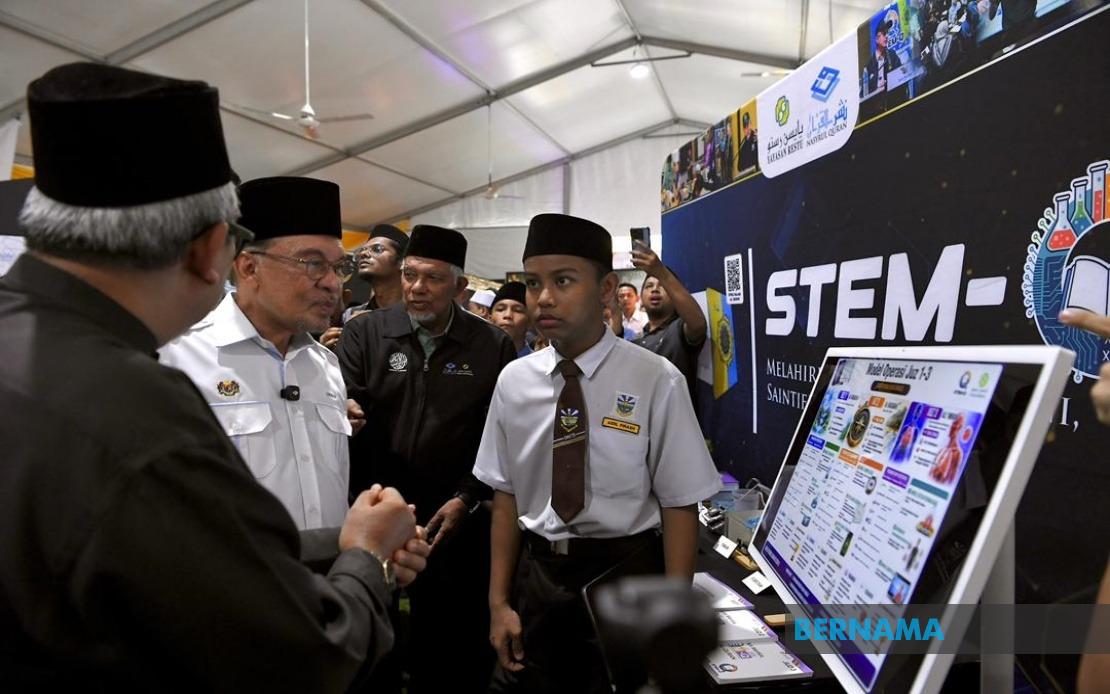
Prime Minister Datuk Seri Anwar Ibrahim has sanctioned RM4.6 million in additional funding to enhance the physical infrastructure of 27 Islamic educational institutions across Penang this year, reflecting the government's intensified commitment to strengthening religious education provision at the state level. The substantial allocation represents a significant scaling-up of support, more than doubling the RM2.11 million distributed in the previous financial year when only 11 Islamic institutions in the state received upgrading assistance. Speaking at the National Tadabbur Perdana and Maidah Wanita MADANI Permatang Pauh programmes at Masjid Muhajirin in Butterworth, Anwar, who concurrently holds the Finance Ministry portfolio, outlined how the funds would address a range of critical infrastructure deficiencies across the sector.
The allocation encompasses diverse upgrading requirements spanning the full spectrum of Islamic educational facilities operating in Penang. Infrastructure improvements earmarked for funding include foundational security and boundary work such as the construction and renovation of perimeter walls and fencing systems, alongside essential facility upgrades at madrasahs and primary Islamic schools. The package also provides for the construction of new kindergarten buildings to expand early childhood Islamic education provision, and the development of dedicated tahfiz academies where students can undertake intensive Quranic memorisation programmes. By addressing these varied infrastructure needs simultaneously, the government aims to create more conducive learning environments that reflect both the physical dignity and practical functionality required for effective Islamic pedagogy.
Anwar's announcement underscores a strategic policy shift toward sustained, enhanced investment in religious education infrastructure at the state level. The doubling of available resources within a single year demonstrates central government recognition that Islamic educational institutions, which serve as important community anchors beyond their formal educational function, have historically faced infrastructure constraints. The expansion from 11 to 27 institutions receiving support signals a broader ambition to ensure more equitable distribution of upgrading funds across Penang's diverse Islamic educational landscape, reducing the likelihood that rural or smaller institutions are overlooked in resource allocation decisions.
Beyond the immediate infrastructure dimension, Anwar articulated a forward-looking vision for Islamic education that extends into the technological realm. He emphasised the imperative for religious instruction to evolve in tandem with rapid technological advancement, particularly through strategic integration of artificial intelligence applications in Quranic exegesis and broader Islamic studies curricula. This represents recognition that traditional pedagogical models must adapt to remain relevant and engaging for digitally native student populations, whilst ensuring that Quranic study and Islamic scholarship benefit from computational tools that can enhance comprehension and analytical depth.
However, Anwar tempered enthusiasm for technological integration with principled caution about the moral and ethical frameworks within which such tools operate. He stressed forcefully that artificial intelligence cannot function as a morally neutral instrument, emphasising that algorithmic systems must be grounded in explicit value systems and ethical principles aligned with Islamic teachings. His warning that technology should not be deployed to cultivate talent and intellectual capability divorced from robust moral and spiritual foundations reflects broader concerns within Muslim societies about unmoored secularism and the instrumentalisation of education purely for economic outcomes. The Prime Minister's position acknowledges that Malaysia's Islamic educational institutions carry responsibility not merely for knowledge transmission but for moral formation of their students.
The philosophical stance Anwar articulated extends beyond educational technology into broader questions about Islam's relationship with modernity in the Malaysian context. By insisting that artificial intelligence must be "rooted in morality" and guided by "good values," he positioned Islamic institutions as custodians of ethical frameworks that can guide technological deployment rather than passive consumers of externally developed digital tools. This framing empowers Islamic educators to interrogate and potentially reshape how technologies are adapted for religious instruction, rather than simply adopting whatever platforms the tech industry produces.
Anwar additionally called upon Malaysian civil society to exercise the constitutional freedoms available to them by organising expanded religious programming throughout their communities. He specifically advocated for intensified scheduling of Quranic study circles, tadabbur sessions focused on reflective Quranic interpretation, and public religious lectures as mechanisms for deepening popular understanding of Islamic teachings. The invocation of governmental "focus" on religious schools and Islamic educational institutions indicates that these entities are positioned within a broader strategic framework of governance, representing the state's substantive engagement with religious life rather than mere administrative tolerance of religious activity.
The significance of this intervention extends beyond Penang's particular circumstances, establishing precedent for enhanced federal support of Islamic institutional infrastructure across Malaysia. The state's position as a major economic hub with substantial urban and rural populations makes it a barometer for national policy approaches to religious education funding. Enhanced resource allocation in Penang may signal the government's intention to replicate similar programmes in other states, potentially reshaping the landscape of Islamic educational facilities nationwide.
For Islamic educational institutions throughout Malaysia, the announcement provides concrete evidence of governmental receptiveness to infrastructure investment requests, potentially emboldening similar institutions in other states to petition for comparable support. The allocation formula—increasing both total funds and the number of beneficiary institutions—suggests flexibility in the government's approach rather than scarcity-driven zero-sum calculations. However, the expansion raises questions about long-term sustainability and whether similar annual increases can be maintained across multiple budget cycles as fiscal pressures potentially intensify.
The timing and venue of Anwar's announcement, at religious programming events rather than in Parliament or formal government briefings, emphasises the integration of this policy development into community religious engagement rather than positioning it as a technocratic administrative matter. This communicative strategy signals to religious communities and institutions that the government views enhanced Islamic educational infrastructure as integral to national development priorities rather than a peripheral cultural accommodation.
Looking forward, the success of this initiative will be measured not merely by fund disbursement but by observable improvements in facility quality, educational outcomes, and the attraction and retention of qualified Islamic educators. The government's willingness to nearly double funding within one year suggests confidence that identified institutions can efficiently absorb and deploy these resources, though implementation monitoring will be crucial to ensure that benefits materialise equitably across diverse institutional contexts and student populations.

