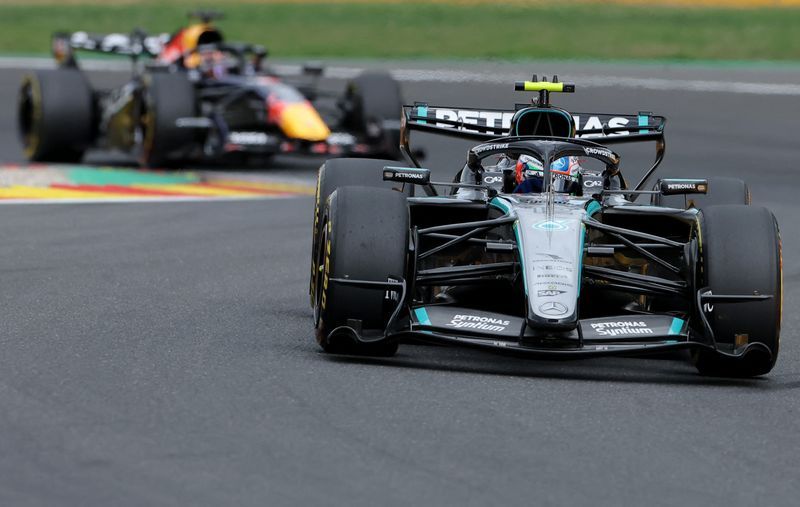
Kimi Antonelli consolidated Mercedes' stranglehold on the 2024 Formula One championship with a commanding performance at Spa-Francorchamps on Sunday, securing his sixth victory in ten races and pushing his advantage to a formidable 45 points over Ferrari's Lewis Hamilton. The 19-year-old Italian's latest triumph on the demanding Belgian circuit proved decisive in what was shaping as a critical juncture in the season's title battle, though the race itself was defined as much by the collision between his teammates as by his own driving prowess.
The opening lap unfolded as a watershed moment in the championship contest. George Russell, who had arrived at the historic circuit as Antonelli's closest challenger in the standings, found himself fighting for position after losing ground at the start. His attempt to reclaim lost ground through an overtaking manoeuvre resulted in contact with Hamilton, the collision sending the British driver spinning into the gravel and ending his race prematurely. This dramatic turn of events immediately shifted the championship dynamics, removing from contention the rival most capable of mounting a sustained challenge to Antonelli's dominance.
Hamilton, despite being the other party involved in the collision, managed to continue and eventually cross the line in fourth position. However, his race was marred by regulatory complications—a five-second penalty was applied for the incident with Russell, and he remained under investigation for potentially unsafe practices during a pitstop procedure that could yet demote him further down the final classification. The circumstances surrounding both drivers and the penalty structure raised questions about consistency in race stewardship, though the focus remained on Antonelli's performance at the front.
Ferrari's Charles Leclerc executed a strategically superior race to finish second, positioned 1.952 seconds behind the Mercedes driver at the chequered flag. Leclerc benefited from positioning during a virtual safety car deployment that allowed him to make a timely pitstop, demonstrating the fine margins that separate winners from runners-up in modern Formula One competition. His second-place finish maintained Ferrari's position as Mercedes' primary challenger, though the gap in points tells a story of a team struggling to mount consistent pressure on the championship leaders.
Red Bull's Max Verstappen rounded out the podium in third place, a result that represented the Austrian team's 300th podium finish in Formula One history—a milestone reflecting the squad's sustained competitiveness across multiple generations of drivers and technical regulations. Despite the significance of this achievement, Verstappen's performance illustrated the growing gulf between Red Bull and the frontrunning teams, a concerning trend for a team accustomed to championship contention.
Mercedes' performance at Spa-Francorchamps extended a remarkable streak of qualifying dominance, with Antonelli securing pole position and continuing the team's 2024 sweep of front-row starts. This consistency in single-lap performance has translated into championship advantage, as the team has demonstrated the ability to convert qualifying pace into race-day results. The combination of speed and strategic execution has created a championship cushion that appears increasingly difficult to bridge.
Antonelli's own assessment of the race reflected both satisfaction and strategic awareness. His comments about capitalising on championship opportunities and acknowledging the swing in his favour—particularly following the opening-lap drama—suggested a driver focused on maximising every advantage. The acknowledgment that Mercedes had endured difficult rounds prior to Belgium also highlighted the volatility inherent in Formula One, where sustained performance depends on technical precision and avoiding mechanical misfortune.
The significance of this victory extends beyond the immediate championship mathematics. For Malaysian and Southeast Asian enthusiasts following the sport, Antonelli's emergence as a dominant force represents a changing of the generational guard in Formula One, with younger drivers displacing established champions. The performance differential between Antonelli and Russell—now separated by 50 points following the Belgian race—suggests a clear hierarchy within the Mercedes team that will likely influence dynamics for the remainder of the season.
Further down the field, McLaren's Oscar Piastri secured fifth position, continuing his team's efforts to establish consistency amid the dominance of Mercedes and Ferrari. Reigning champion Lando Norris, hampered by a ten-place grid penalty, recovered to finish seventh after starting 13th, demonstrating the capability that exists within the McLaren squad even when operating under disadvantageous circumstances. These mid-field performances suggest a three-way contest for constructors' championship honours remains viable.
The international flavour of the points-scoring positions reflected Formula One's global recruitment patterns. Gabriel Bortoleto's eighth-place finish for Audi contributed to the German manufacturer's championship campaign, whilst Franco Colapinto's tenth-place conclusion for Alpine demonstrated the continued representation of South American talent in the sport. These drivers and their performances underline the geographic diversity that characterises modern Formula One competition, with opportunities for talented drivers from across the world.
With the championship's outcome increasingly tilted in Antonelli's favour, attention now turns to whether Russell can mount a credible recovery or whether the Mercedes hierarchy will shift definitively in coming races. The collision in Belgium may prove the turning point in this season's title race, crystallising the competitive advantage that had gradually accumulated in Antonelli's favour.

