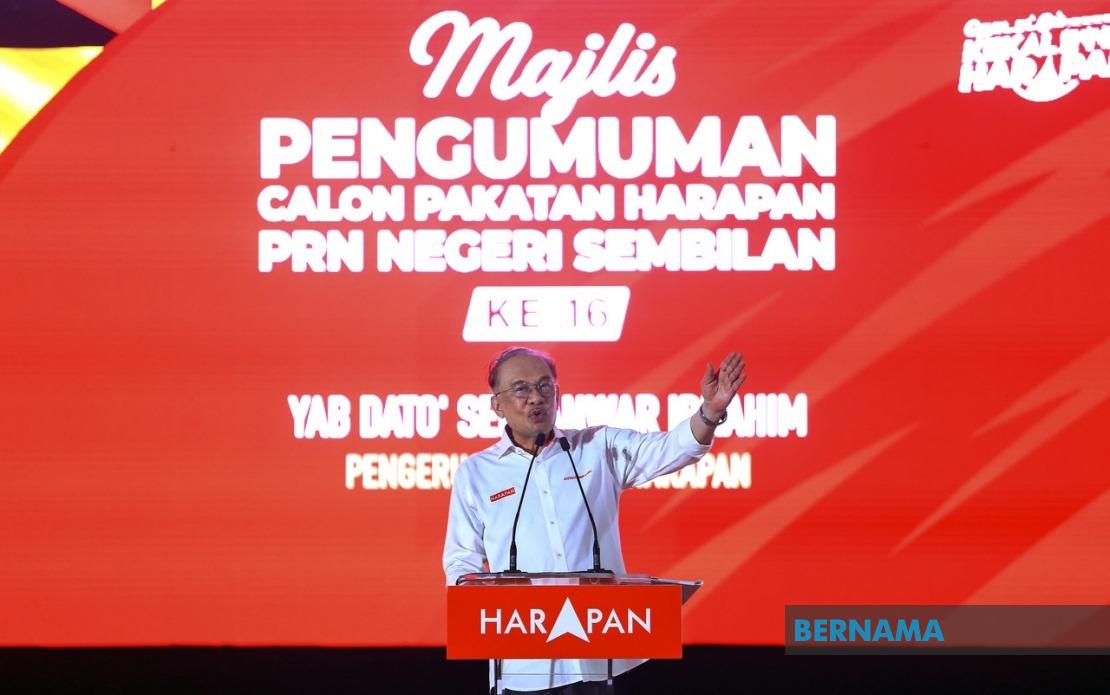
Prime Minister Datuk Seri Anwar Ibrahim has announced that Negeri Sembilan Menteri Besar Datuk Seri Aminuddin Harun will carry the Pakatan Harapan flag in the Linggi constituency for the upcoming 16th Negeri Sembilan State Election, while DAP secretary-general Anthony Loke will seek re-election in Chennah. The announcements were made at a coalition candidate declaration ceremony in Kuala Pilah, where thousands of supporters gathered alongside PH's senior leadership to endorse the coalition's vision for the state.
Aminuddin's candidacy in Linggi represents a strategic repositioning for the Negeri Sembilan Menteri Besar, who previously represented the Sikamat state seat across four consecutive election cycles beginning in 2008. His shift to contest Linggi underscores Pakatan Harapan's confidence in his ability to capture or retain the seat, which carries significant political weight in the state assembly. As chairman of Negeri Sembilan PH, Aminuddin's dual role as both chief minister and campaign figurehead places him at the forefront of the coalition's efforts to solidify its hold on state government.
The announcement of Loke's candidacy in Chennah continues a pattern of continuity within Pakatan Harapan's veteran contingent. Having held the seat since 2013, Loke's presence on the ballot serves as a stabilising force for the DAP, which has maintained parliamentary representation through his performance as a national party leader. Loke's dual responsibilities as DAP secretary-general and state assemblyman have positioned him as a bridge between federal and state-level party operations, making his retention in Chennah crucial to the coalition's organisational coherence.
The ceremony itself reflected the scale of Pakatan Harapan's mobilisation for the Negeri Sembilan contest. Alongside Anwar, the gathering included Amanah president Datuk Seri Mohamad Sabu, PH communications director Datuk Seri Fahmi Fadzil, and the coalition's election director Datuk Seri Amirudin Shari. This assembly of senior figures underscored the high stakes involved in securing Negeri Sembilan, a state that sits within Peninsular Malaysia's competitive political landscape and has traditionally been contested between Pakatan Harapan and its rivals.
Negeri Sembilan's electoral significance extends beyond its nine state seats. The state serves as a microcosm of broader national political trends, particularly in how urban and semi-urban constituencies respond to coalition messaging. Aminuddin's track record in Sikamat, a state seat he won repeatedly over 16 years, demonstrates substantial grassroots support within his political base. Whether that support translates to Linggi will be one of the key indicators of Pakatan Harapan's electoral strength heading into polling day.
Loke's extended tenure in Chennah since 2013 spans multiple electoral cycles, institutional shifts, and internal coalition realignments within DAP and the broader Pakatan Harapan framework. His ability to retain the seat across these transformations suggests a personalised electoral advantage that transcends party affiliation fluctuations. For the DAP, preserving Loke's parliamentary foothold at state level remains symbolically and substantively important, particularly given his responsibilities at the national party apparatus.
The candidacy announcements arrive at a pivotal moment for Negeri Sembilan politics. The state has experienced shifts in political allegiance and governance quality over recent years, with voters increasingly focused on local development, service delivery, and accountability. Both Aminuddin and Loke will need to articulate how Pakatan Harapan's governance has improved constituent welfare and how their continued presence in the state assembly will advance localised priorities.
For Malaysian observers and political analysts, the choice of Aminuddin and Loke as flagbearers signals Pakatan Harapan's reliance on experienced, tested political figures rather than new faces or generational transitions. This conservative approach to candidate selection may appeal to voters seeking stability but could also invite criticism regarding the coalition's openness to emerging political talent and fresh perspectives. The electoral response to these announcements will reveal whether Malaysian voters reward incumbency and experience or harbour appetite for alternative representations.
The broader implications for Southeast Asian politics are noteworthy as well. Malaysia's state-level elections continue to serve as meaningful democratic exercises that test coalition cohesion, measure public sentiment on governance, and provide early signals of shifts in electoral behaviour. Negeri Sembilan's outcome will contribute to understanding how regional coalitions in Southeast Asia maintain voter support and whether traditional power-brokers retain electoral dominance in an era of rising expectations for transparency and performance-based accountability.

