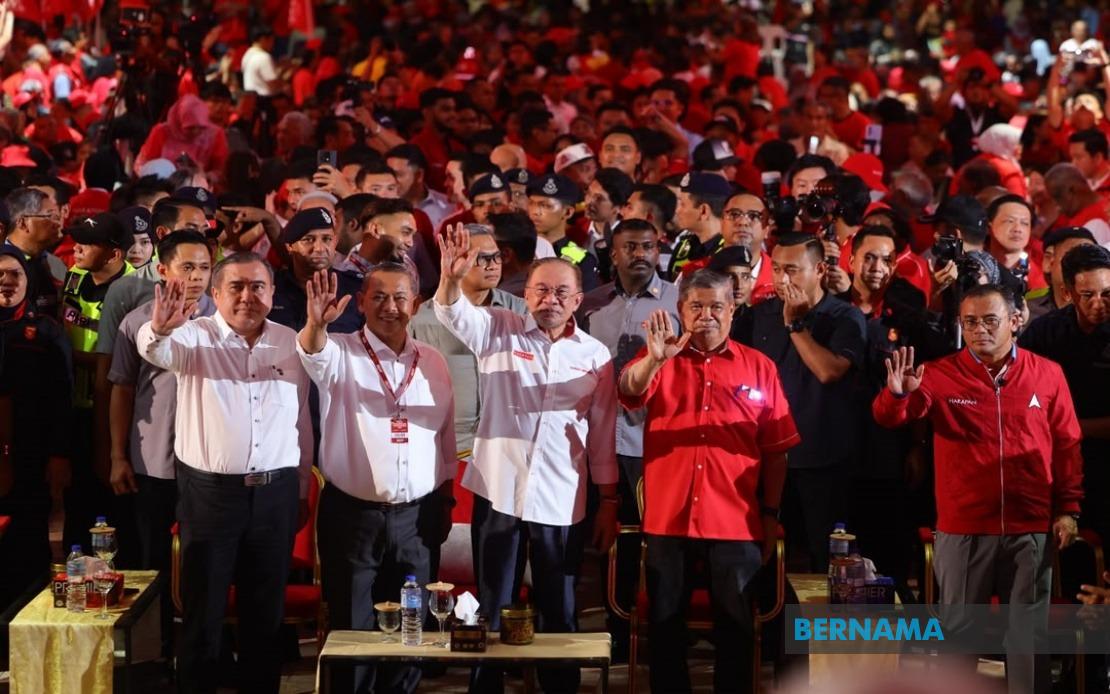
The Pakatan Harapan coalition is banking on a track record of economic expansion and welfare improvements to retain control of Negeri Sembilan in the upcoming 16th state election. Speaking at a candidate announcement ceremony in Kuala Pilah on July 14, Datuk Seri Aminuddin Harun, the state PH chairman, framed the election as a referendum on continuity, arguing that sustained investor confidence and uninterrupted public services depend on maintaining government stability. The appeal comes as PH seeks to rebuild momentum following a disappointing outcome in the recent Johor state contest, making Negeri Sembilan a critical test of the coalition's ability to recover its political footing in peninsular Malaysia.
Aminuddin's central argument rests on concrete achievements since the 2018 general election shifted power dynamics across the country. He highlighted that the state government has delivered on manifesto commitments while executing a range of social safety-net programmes aimed at ordinary Negeri Sembilan residents. The message reflects a wider strategy within PH to pivot campaigns away from abstract political messaging toward tangible deliverables—a recognition that voters increasingly demand evidence of government effectiveness rather than ideological positioning alone. The emphasis on continuity also implicitly acknowledges the risks of transition, positioning stability as a commodity that voters should prize during periods of broader political uncertainty.
One of the coalition's strongest selling points is Negeri Sembilan's investment performance. The state has attracted RM19.1 billion in investments during Aminuddin's tenure, a figure that senior PH figures present as proof of business and investor confidence in the state administration. Economic magnetism of this magnitude translates into employment opportunities, expansion of the commercial tax base, and long-term prospects for infrastructure development. For a state seeking to diversify beyond its traditional economic anchors, such investment inflows represent tangible progress. The scale of capital attraction also serves a political purpose—it demonstrates competence in governance to a electorate that may be sceptical of opposition claims that PH has mismanaged public resources.
Welfare expansion offers another dimension of the coalition's electoral pitch. Aminuddin pointed to significant growth in zakat collection, which has swelled from approximately RM80 million to nearly RM200 million under his administration. This more than doubling of Islamic charitable revenues has enabled the state to channel greater assistance to vulnerable populations, a fact with particular resonance among Muslim-majority constituencies where religious institutions and poverty alleviation carry substantial political weight. The expansion of zakat collections also suggests improved state economic performance and higher compliance, indicating broader-based prosperity rather than concentrated wealth. Educational support initiatives, including tablet provision to students, underscore PH's positioning as a government attuned to modern developmental priorities and youth concerns.
During the same event, DAP secretary-general Anthony Loke reframed the Negeri Sembilan contest in explicitly strategic terms, describing it as PH's "second round" after the Johor defeat. This language is revealing—it acknowledges the Johor setback as a significant blow but signals determination to prevent the coalition from entering a spiral of consecutive electoral losses. Loke's framing suggests that PH views Negeri Sembilan as terrain where it enjoys structural advantages, partly because the state has been under its control since 2018 and partly because the coalition commands broader organizational infrastructure in the state compared to opposition forces. The implicit message is that losing Negeri Sembilan would compound the Johor disappointment and potentially trigger a broader loss of confidence among PH's traditional support bases.
Loke also articulated a disciplinary agenda for the campaign itself, explicitly directing PH members and workers to conduct themselves with respect toward Negeri Sembilan's monarchy and customary institutions. This directive carries particular significance given DAP's historical perception among conservative constituencies as a party skeptical of traditional authorities. By emphasizing loyalty to the Yang Dipertuan Besar and the Undang Yang Empat, Loke seeks to neutralize a perennial vulnerability—the accusation that DAP harbors republican or anti-monarchist sympathies. Such assurances are necessary political theatre in Malaysia's constitutional framework, where the monarchy occupies a constitutionally protected and symbolically potent position. The explicit pledging of allegiance to royal institutions reflects the reality that electoral campaigns in Malaysia must navigate not merely policy disputes but deep constitutional and cultural sensitivities.
The coordination of messaging among PH's component parties is evident from the lineup of speakers at the event. The presence of Amanah president Datuk Seri Mohamad Sabu, DAP's Loke, and PKR-aligned figures underscores an effort to project coalition unity after internal tensions in recent months. Such visible togetherness matters symbolically; voters often interpret squabbling among coalition partners as a sign of governmental dysfunction or approaching collapse. By presenting a unified front at candidate announcements and rallies, PH aims to convince voters that internal differences have been managed and that the coalition can function as a stable governing entity. This becomes particularly important in a state where PH holds power and opposition forces may exploit any perceived divisions.
Aminuddin's emphasis on federal-state cooperation represents a subtle acknowledgment that state-level governments in Malaysia operate within significant constraints imposed by federal control. By highlighting collaboration with the Federal Government for development projects and social programmes, Aminuddin signals that Negeri Sembilan PH is not isolated or opposed to the broader federal apparatus. This positioning is pragmatic, as state governments delivering public services depend heavily on federal funding transfers and federal coordination. It also reflects the reality that Malaysians increasingly evaluate state governments not in isolation but as components of a national governance system. When federal and state governments are controlled by different political coalitions, implementation bottlenecks and funding delays can undermine state-level performance, making federal-state harmony a material factor in electoral outcomes.
The election campaign itself takes place against a backdrop of broader Malaysian political realignment. The recent Johor contest demonstrated that even states long considered secure for Pakatan Harapan cannot be taken for granted, a lesson that has prompted more intensive campaigning and strategic targeting. Negeri Sembilan, with a population smaller than Johor's but still significant, offers PH an opportunity to demonstrate resilience and recapture momentum in peninsular heartland states. The outcome will likely influence how both PH and opposition coalitions calibrate their strategies for future contests, particularly the next federal election cycle. A PH victory would stabilize the coalition's trajectory after recent setbacks; a defeat would suggest deeper structural vulnerabilities requiring more fundamental strategic recalibration.
The specific programmatic commitments outlined—education support, tablet provision, welfare expansion—reflect evolving expectations among Malaysian voters regarding what state governments should deliver. Beyond traditional concerns like security and basic infrastructure, contemporary electorates demand evidence that governments are investing in human capital development and social protection. The fact that PH campaigns prominently feature such initiatives suggests that the coalition has internalized the lesson that welfare and education increasingly drive electoral behaviour, particularly among younger voters and urban constituencies. These programmes may appear modest individually but collectively signal a government attentive to quality-of-life concerns beyond basic service delivery.

