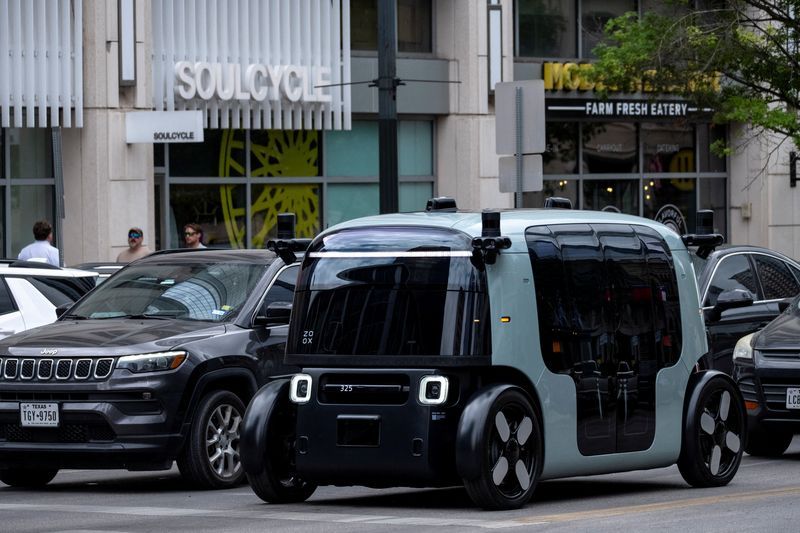
Amazon's autonomous vehicle subsidiary Zoox is stepping into the commercial robotaxi market with a paid service launching in Las Vegas on Monday, marking a significant transition from months of unpaid trials across multiple American cities. The announcement comes just days after the U.S. National Highway Traffic Safety Administration granted Zoox an exemption allowing it to deploy vehicles without human safety drivers, a regulatory milestone that positions the company alongside established competitors in what has become an increasingly crowded autonomous mobility landscape.
Zoox's entry into paid operations represents a critical juncture in the wider robotaxi sector. The company will initially charge passengers in Las Vegas at rates comparable to premium ride-hailing tiers offered by conventional services, which typically command fares between 20 to 40 percent higher than standard options. This pricing strategy reflects the company's positioning of its purpose-built electric vehicles, which feature two rows of inward-facing seats arranged in a distinctive carriage-style layout designed specifically for autonomous operation rather than retrofitted from existing car platforms.
The regulatory pathway Zoox has navigated distinguishes it from competitors. Unlike Tesla and other developers that have adapted existing vehicle designs, Zoox was the first company to receive NHTSA approval for ground-up autonomous vehicle development without requiring human controls. This approval carries important constraints, however, capping Zoox at deploying up to 2,500 vehicles annually across the next two years, effectively limiting the pace of commercial expansion during this critical early phase.
For Malaysian and Southeast Asian observers, Zoox's Vegas launch signals how rapidly autonomous mobility is evolving in developed markets while also highlighting the sophisticated regulatory frameworks required for such deployment. The region's own automotive sector will likely face similar technological disruption within the decade, yet regulatory infrastructure for autonomous vehicles remains underdeveloped across most ASEAN nations. Understanding how American authorities balance innovation with public safety offers valuable lessons for policymakers across Southeast Asia grappling with emerging mobility technologies.
The competitive landscape into which Zoox is launching has already seen significant movement. Alphabet's Waymo operates driverless services across multiple cities, while Tesla has begun commercial deployment of autonomous capabilities. This convergence of major technology companies toward robotaxi markets reflects growing confidence in the viability of fully autonomous ride-hailing, though the sector remains capital-intensive and dependent on continued regulatory cooperation.
Zoox's pricing model emphasizes transparency regarding route efficiency and additional charges. The company calculates fares using a base rate combined with time and distance charges determined by route selection, with airport trips and other destination-specific fees disclosed upfront. Crucially, passengers will not face additional charges if the vehicle takes a longer route than initially planned, a consumer protection measure that distinguishes Zoox's offering from conventional ride-hailing dynamics where driver behaviour directly impacts final costs.
NHTSA's safety determination for Zoox vehicles carries significant implications but also comes with notable conditions. The agency concluded that Zoox's vehicles meet safety standards equivalent to human-operated vehicles, yet imposed additional reporting requirements for incidents including crashes and improper road stops. This middle-ground approach reflects regulatory caution: agencies are permitting innovation while maintaining heightened oversight during commercial deployment phases.
The company's recent software history underscores why such regulatory scrutiny remains justified. Zoox issued multiple software recalls over the past two years, most notably in July after a vehicle failed to detect heavy smoke at an emergency scene. These incidents reveal the complex challenge autonomous systems face in handling edge cases and emergency situations where human drivers rely on intuition, spatial awareness, and contextual understanding developed through years of experience. Until autonomous systems reliably navigate such scenarios, regulatory authorities face legitimate pressure to maintain oversight mechanisms.
Zoox has not disclosed timelines for launching paid services in other cities where it currently operates free trial rides—San Francisco, Austin, and Miami. This measured approach suggests the company will evaluate Las Vegas performance data before expanding commercial operations, a strategy that allows real-world operational feedback to inform next phases. The Las Vegas market, chosen for its relatively contained geographic area and established transportation ecosystem, serves as an ideal testing ground for early commercial viability.
The broader implications for autonomous mobility deployment are significant. Zoox's transition from free trials to paid commercial service demonstrates that regulatory frameworks permitting autonomous operation are now functional in the United States, removing a major uncertainty that has long clouded investor confidence. However, the strict vehicle deployment caps and enhanced reporting requirements indicate that regulators view autonomous ride-hailing as requiring perpetual monitoring rather than a technology ready for unrestricted scaling.
For Southeast Asian markets, Zoox's progression offers both inspiration and caution. The technological capability to deploy autonomous ride-hailing services at scale clearly exists, yet regulatory development, insurance frameworks, and public acceptance remain critical prerequisites. Malaysia, Singapore, and other regional economies will likely face pressure to develop autonomous vehicle policies as these technologies mature, yet rushing deployment without adequate safeguards could undermine public confidence in autonomous systems during their critical early adoption phases.
Zoox's Las Vegas launch also reflects the geographic concentration of robotaxi development in the United States, particularly in areas with favourable regulatory environments and established ride-hailing markets. This clustering accelerates development but also means that companies like Zoox must demonstrate consistent operational excellence in competitive markets where passengers have multiple transportation options. Success in Las Vegas will significantly influence investor confidence in autonomous mobility's commercial viability and may determine whether Zoox can secure additional capital for aggressive expansion or faces investor pressure to pursue acquisition rather than independent growth.

