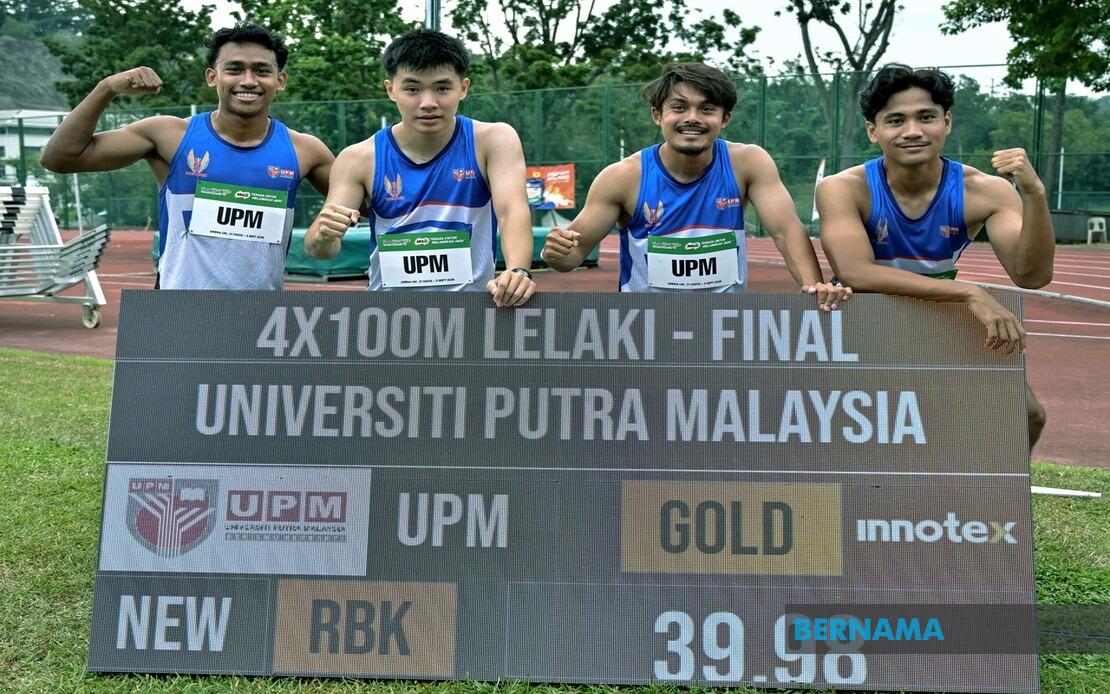
Universiti Putra Malaysia (UPM) has achieved a significant milestone in Malaysian university athletics by shattering the games record in the men's 4x100-meter relay at the 2026 Higher Education Institutions Sports Games (SUKIPT) held in Kuala Lumpur. The winning time of 39.98 seconds, achieved on August 31, eclipsed the previous benchmark of 40.98 seconds that had stood at the championships for several years. The victory represents not merely a single athletic achievement but signals a deliberate and successful transition within UPM's sprinting programme towards a younger generation of competitors.
The composition of the relay team embodied this transition perfectly. Aliff Iman Mohd Fahimi, a senior runner making what he described as his final SUKIPT appearance, anchored a quartet comprised entirely of junior athletes competing in the championships for the first time. This intergenerational partnership proved instrumental in catalysing the record-breaking performance. The union of Aliff Iman's experience, tactical acumen, and competitive resolve with the raw speed and hunger of his younger teammates created a powerful dynamic that propelled UPM past the finishing line in record time.
For Aliff Iman, the gold medal carried profound personal and institutional significance. He characterised the victory as a renewal of UPM's relay and sprint events, symbolising the successful handover of what he termed the "UPM legacy" to runners who will carry the university's athletic reputation forward for years to come. The responsibility of stewarding this transition weighed heavily on the veteran sprinter, particularly given the illustrious names who preceded him in the programme. Aliff Iman acknowledged specifically the contributions of Jonathan Nyepa and Zulfiqar Ismail, former stalwarts whose performances had set a high standard. The burden fell upon his shoulders to ensure that the institutional knowledge, competitive mentality, and pursuit of excellence cultivated by these predecessors would not dissipate but instead find expression through the new generation.
The confidence that underpinned the team's preparation and execution deserves particular scrutiny. Rather than simply hoping to perform well, Aliff Iman and his teammates approached the race with calculated ambition grounded in quantifiable data. By analysing the individual 100-metre times of each relay member—averaging between 10.4 and 10.5 seconds per leg—the quartet established that a sub-40-second collective time was mathematically achievable if each runner executed at or near their established capacity. This evidence-based approach to setting objectives, combined with unwavering belief in teammates' abilities, transformed what might have seemed an optimistic target into an attainable goal.
Reeve Kua's participation in the winning relay added another layer of narrative interest to the achievement. The sprinter had battled a high fever the previous day, spending much of the night recovering through rest and medication rather than engaging in final preparation routines. The fact that he was able to compete without debilitating physical effects, let alone contribute to a record-breaking performance, testifies both to his individual resilience and to the collective determination characterising the UPM team's mindset.
Aliff Iman's personal journey also resonates within the broader context of Malaysian athletics. The wristbands inscribed with "Papa" and "Mama" that he wore during his final SUKIPT appearance served as a poignant reminder of his return to competitive athletics following a six-month injury-enforced absence. This comeback narrative—emerging from adversity to deliver a peak performance on one's final major stage—embodies a compelling human dimension that transcends the mere statistics of timekeeping.
The anchor leg, entrusted to Ahmad Amir Aiman Mohd Kamaruddin, carried additional pressure given the competitive proximity of the opposition. As the final runner, he bore responsibility for either consolidating UPM's advantage or clawing back a deficit in the closing metres. His willingness to trust completely in his teammates' execution of their respective legs demonstrates the psychological cohesion necessary for relay success. The baton handoffs executed across the four legs must synchronise with precision, yet each runner must also possess sufficient speed and strategy to position their team optimally.
The competitive field reflected the quality of Malaysian university athletics. Universiti Pendidikan Sultan Idris (UPSI) secured the silver medal with a time of 40.16 seconds, strengthened by the inclusion of national runner Danish Iftikhar Muhammad Roslee. That UPSI—a dedicated teacher-training institution with a strong sporting tradition—pressed UPM so closely indicates the depth of talent across Malaysia's higher education athletics programme. The bronze medal awarded to Malaysian Polytechnics (41.75 seconds) rounded out a podium comprising three distinct educational sectors, each contributing significantly to national sporting development.
The significance of UPM's record extends beyond the immediate championship context. University athletics serves as a development pathway for Malaysian runners targeting national representation and international competition. When institutions establish records and demonstrate sustained competitive excellence, they attract talented young athletes and provide the training environment necessary for progression. The visible success of UPM's relay team, particularly the evidence that junior runners can perform at the highest university level, creates positive feedback loops that strengthen recruitment and retention within the programme.
From a broader Southeast Asian perspective, Malaysian university sports competitions like SUKIPT contribute meaningfully to regional athletic standards. The sub-40-second 4x100m time achieved by UPM represents a respectable performance by regional standards, reflecting the maturation of Malaysian coaching methodologies, training infrastructure, and talent identification systems. When Malaysian university athletes compete at such levels, they establish benchmarks that influence athletic development across the region.
Aliff Iman's retirement from SUKIPT competition represents the closing of one chapter in UPM athletics and the definitive opening of another. His final appearance, marked by a record-breaking gold medal and the successful transition of the relay programme to younger hands, constitutes an ideal conclusion to a competitive career. For the junior runners he mentored through this record-breaking run, the challenge now involves sustaining and potentially surpassing what their senior colleague achieved, transforming a single golden moment into sustained institutional excellence.

