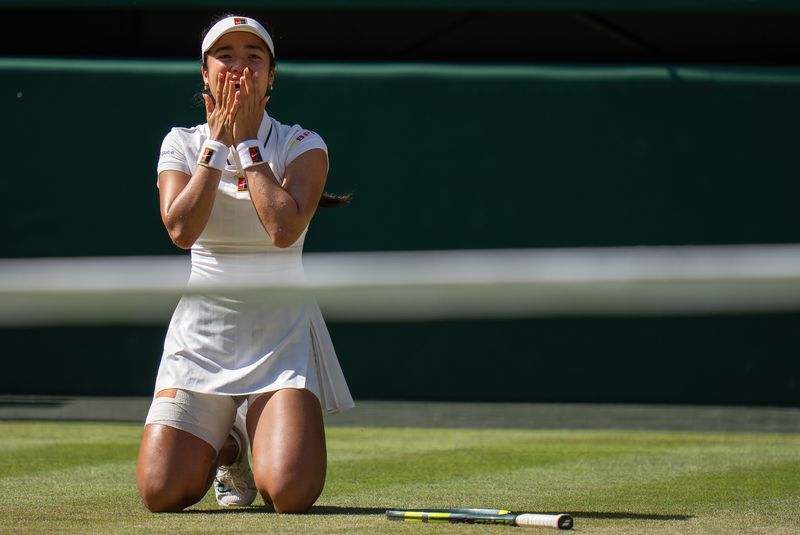
Alexandra Eala's stunning victory over top-seeded Iga Swiatek at Wimbledon has done more than secure the 21-year-old Filipino's place in the tournament's round of 16—it has crystallised a rare sporting moment that extends far beyond the grass courts of southwest London. The comprehensive nature of Eala's breakthrough performance, coming at one of tennis's most prestigious venues, underscores the remarkable trajectory of a player who has captured global imagination through a combination of fearless shot-making and an authenticity that resonates with audiences worldwide.
The significance of Eala's achievement cannot be overstated for a nation where sporting narratives have long been dominated by a single figure. Manny Pacquiao's unparalleled success in professional boxing established a template for Philippine sporting heroism that has endured for decades, creating an almost singular benchmark against which athletic achievement is measured. Eala's emergence on the professional women's tennis circuit represents something fundamentally different—the potential for a new generation of Filipino athletes to establish themselves on global stages beyond boxing's traditional sphere, each bringing their own distinctive voice and competitive identity to international sport.
What distinguishes Eala's approach from the conventional athlete-as-inspiration narrative is her deliberate philosophical stance regarding her influence. Speaking in the immediate aftermath of her victory, the 29th seed articulated a nuanced vision of athletic mentorship that rejects the notion of replication or hero-worship. Rather than positioning herself as a template to be followed, Eala actively encourages younger athletes to view her journey as validation of the possibility to create entirely original paths within professional sport. This messaging carries particular weight in Southeast Asian contexts where sporting participation has historically been funneled toward established disciplines with proven commercial and cultural viability.
The crowds that have materialised around Eala at successive Grand Slam tournaments reflect something beyond casual tennis fandom. Observers have noted the composition and enthusiasm of spectators following her matches, with substantial contingents of Filipino supporters alongside broader international audiences drawn to her compelling on-court demeanour. This engagement pattern suggests that Eala has successfully bridged a gap between elite competitive tennis and accessible, relatable athletic stardom—a combination that extends her influence beyond traditional tennis demographics.
Eala's emotional response immediately following her victory over Swiatek—tears of joy shed courtside, maintained composure during the on-court interview—momentarily created potential ambiguity about her emotional state. However, her subsequent clarification proved revealing about her psychological approach to professional competition. The distinction she drew between celebrating achievement and allowing satisfaction to undermine forward momentum reflects a maturity in competitive thinking that many established professionals take years to develop. Her articulation of the ability to compartmentalise emotion, to celebrate genuinely whilst simultaneously redirecting focus toward upcoming challenges, speaks to deliberate mental conditioning rather than innate talent alone.
The technical challenge awaiting Eala in her round of 16 encounter against Jasmine Paolini, who reached the 2024 Wimbledon final, provides an immediate test of her capacity to maintain this psychological equilibrium under elevated pressure. Paolini represents a substantial escalation in opposition quality, bringing experience from Grand Slam finals and established ranking credentials. This matchup carries the added dimension of testing whether Eala's breakthrough can withstand the rigours of consecutive high-level encounters, a critical benchmark for distinguishing temporary tournament success from sustained elite performance.
For Malaysian and broader Southeast Asian readers, Eala's trajectory carries implications that extend beyond one athlete's career arc. The emergence of top-tier international competitors from the region across multiple sports disciplines traditionally dominated by European and North American athletes speaks to shifting global sporting geographies. Tennis, unlike several other professional sports, has substantially lower infrastructure barriers to entry in developing economies, yet the region has produced remarkably few players reaching elite international rankings. Eala's success therefore potentially catalyses increased investment in tennis development across Southeast Asian nations, from grassroots coaching infrastructure to professional tournament hosting.
Eala's conscious cultivation of authenticity as a professional brand represents a deliberate counter-positioning against the manufactured narratives that characterise much of contemporary sports marketing. Her emphasis on self-reflection, personal values, and genuine interaction with supporters creates a relational dynamic that traditional sponsorship and media frameworks struggle to replicate or commodify. This approach has proven particularly resonant with younger demographics less receptive to conventional athlete endorsement models, suggesting that Eala's influence may extend into territory beyond traditional sports viewership.
The 29th seed's acknowledgment that celebrating victory does not preclude immediate psychological refocusing—that these represent distinct, coexisting mental states rather than contradictory impulses—introduces a model of emotional intelligence that carries implications for broader conversations around athlete wellbeing and mental health. Rather than advocating either emotional suppression or unlimited celebration, Eala articulates a framework of cyclical emotional engagement: genuine acknowledgment of achievement followed by disciplined compartmentalisation necessary for competitive advancement.
Looking forward, the question of whether Eala's Wimbledon performance represents a developmental milestone or a competitive ceiling will occupy significant analytical attention. Her progression to the round of 16 at a major championship constitutes her breakthrough achievement at that level, yet whether such performance proves sustainable or becomes the foundation for deeper tournament runs remains undetermined. For Philippine sports observers and investment in tennis infrastructure, however, the achievement already carries catalytic significance regardless of immediate subsequent outcomes.
Ultimately, Eala's Wimbledon breakthrough matters not principally because it may presage future Grand Slam victories, though that possibility certainly exists. Rather, it matters because it has demonstrated to millions of younger athletes across the Philippines and Southeast Asia that tennis—and by extension, individual athletic excellence in non-traditional sporting domains—represents accessible territory for achievement, recognition, and personal development. That message, delivered through compelling on-court performance and articulated through Eala's deliberate philosophical stance, may prove her most significant contribution to Philippine and regional sport.

