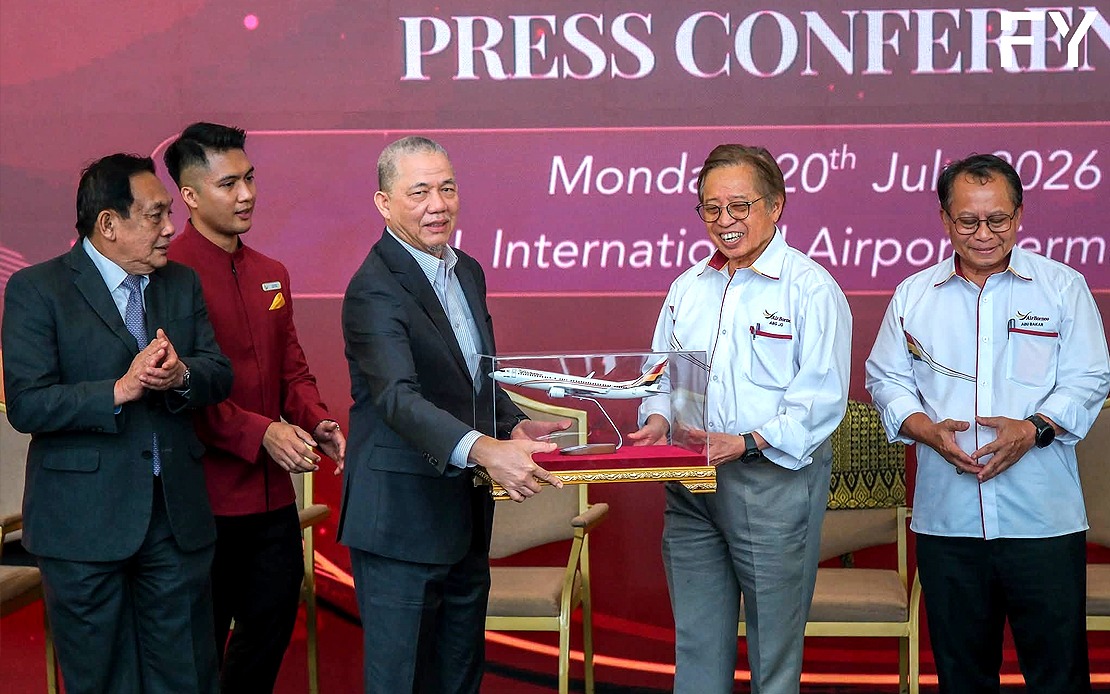
Deputy Prime Minister Datuk Seri Fadillah Yusof has thrown his weight behind AirBorneo, Sarawak's newly established state-owned carrier, framing it as a direct response to the persistent affordability crisis that has plagued air travel in the state. Speaking on the occasion of the airline's inaugural flight from Kuching to Kuala Lumpur International Airport Terminal 1, Fadillah outlined a vision centred on delivering more economical fares while maintaining passenger comfort and service standards. His remarks underscore the strategic importance that federal and state leadership are placing on this venture at a critical juncture for Sarawak's economic development.
The timing of AirBorneo's launch carries symbolic weight, arriving just two days before Sarawak Day on July 22. This proximity to the state's most significant patriotic occasion was not accidental but rather deliberately positioned to reinforce the airline's role as a manifestation of Sarawak's growing autonomy and self-determination in critical infrastructure sectors. For a state that has long navigated a complex relationship with federal structures, the ability to establish and operate its own airline represents a tangible assertion of local capacity and governance. The ceremony welcoming Sarawak Premier Tan Sri Abang Johari Tun Openg and his ministerial delegation on flight MY5005 further ceremonialised the enterprise as a matter of state pride rather than mere commercial operation.
The question of airfare affordability in Sarawak has festered for years, with residents across the state frequently complaining about ticket prices that substantially exceed comparable routes elsewhere in Malaysia and Southeast Asia. This pricing disparity has created practical barriers for ordinary Sarawakians seeking to travel for work, family, medical care, or leisure. By establishing a competitor in the market, AirBorneo theoretically introduces downward pressure on fares through direct competition, though the success of this strategy depends heavily on the airline's operational efficiency and financial viability. The state government's ownership provides a crucial buffer against the purely commercial pressures that might otherwise force the carrier to maintain high margins.
Abang Johari's articulation of AirBorneo as a strategic investment reflects a broader economic philosophy embraced by Sarawak's leadership. Rather than viewing the airline primarily as a public service, the state government has positioned it as a catalyst for sectoral development. Enhanced air connectivity, according to this logic, creates multiplier effects across tourism, trade, foreign investment, and regional development. Better access to Sarawak's interior regions and improved links to major urban centres could unlock economic potential in agriculture, resource sectors, and emerging industries while simultaneously strengthening the state's position as a regional hub. For Malaysian policymakers observing from Kuala Lumpur, this approach mirrors broader trends across the region where state governments deploy strategic industries to consolidate economic sovereignty.
One dimension of AirBorneo's mandate that distinguishes it from purely commercial carriers is its commitment to servicing rural areas where scheduled air services might not be commercially viable. Fadillah specifically highlighted this aspect, emphasising that the airline reflects Sarawak's determination to maintain connectivity to remote communities that depend critically on air transport for access to markets, services, and opportunities. This public service obligation, while potentially constraining profitability, serves a crucial developmental function in a state where geography makes road and rail infrastructure investments prohibitively expensive. The airline thus operates at the intersection of commercial logic and social responsibility, a tension that will likely define its operational decisions over the coming years.
The launch of AirBorneo also signals confidence within Sarawak's political and business leadership that the airline can compete effectively despite the market dominance of established carriers. Malaysia Airlines, AirAsia, and other established operators have substantial advantages in network effects, brand recognition, and operational scale. For AirBorneo to succeed, it must differentiate through superior pricing, service quality, or route coverage that competitors are unwilling or unable to match. The state government's ownership structure potentially provides advantages in this regard, as the carrier is not compelled to generate returns to external shareholders and can absorb initial operating losses during the growth phase.
The inaugural flight's ceremonial significance extends beyond mere symbolism into the realm of regional politics. By showcasing Sarawak's capacity to establish major infrastructure independently, Abang Johari and his government reinforce their credibility and capabilities heading into future negotiations with the federal government over resource allocation, autonomy, and development priorities. For Malaysian citizens outside Sarawak, the airline's emergence illustrates the practical mechanics of devolved economic governance, where state-level actors leverage their constitutional authority to pursue development strategies aligned with local interests and capabilities.
Fadillah's emphasis on transparency and passenger-friendliness indicates an awareness that AirBorneo cannot rely solely on price competition to secure market share. The airline must build a reputation for reliability, clear pricing structures, and customer-centric policies that distinguish it from competitors perceived as opaque or indifferent to passenger welfare. This positioning appeals to a segment of travellers who value not just affordability but also trustworthiness and straightforward dealings. In the Malaysian market, where consumer consciousness around service quality and pricing practices has grown considerably, AirBorneo's early communications strategy appears calibrated to address these broader expectations.
The airline's success carries implications that extend beyond Sarawak's borders. A profitable, well-managed state-owned carrier could serve as a model for other Malaysian states considering similar ventures or seeking to demonstrate government competence in strategic sectors. Conversely, operational difficulties or financial underperformance could reinforce scepticism about state-owned enterprises' efficiency compared to private operators. For investors, regulators, and competitors observing AirBorneo's trajectory, the coming months and years will provide valuable empirical evidence about whether government ownership and strategic investment can effectively address market failures in aviation while maintaining commercial sustainability.
Looking forward, AirBorneo's trajectory will depend on multiple variables beyond leadership's intentions. Fuel prices, global economic conditions affecting travel demand, the competitive responses of incumbent carriers, and the airline's own operational execution will all shape outcomes. The initial enthusiasm visible in the inaugural flight ceremony reflects genuine optimism but also the natural tendency toward optimistic framings during launch events. The true measure of AirBorneo's impact on airfare affordability and Sarawak's economic development will emerge over the medium term as the airline navigates the realities of commercial aviation while serving its broader mandate to strengthen connectivity and economic opportunity across the state.

