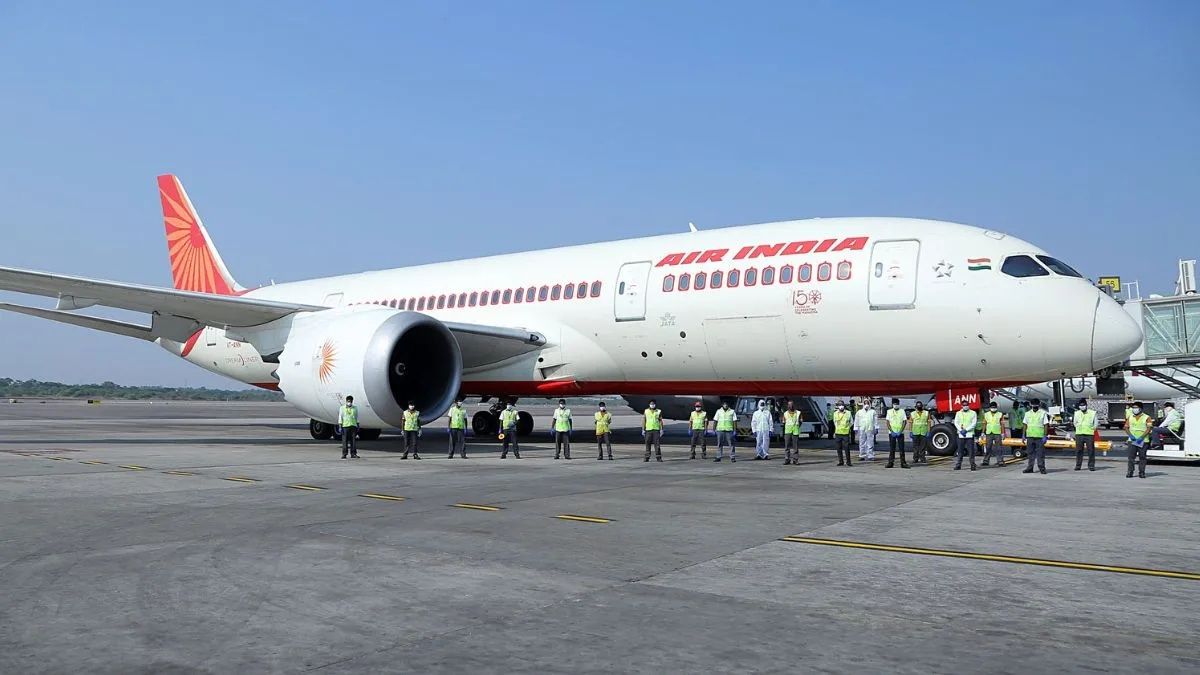
An Air India flight operating between Delhi and Amritsar strayed into Pakistani airspace on Monday evening following a technical malfunction in its navigation systems, prompting swift intervention from Pakistani air traffic authorities to guide the aircraft back into Indian territory. The incident, confirmed by official sources on Wednesday, highlights the operational challenges faced by airlines operating in one of South Asia's most congested and sensitive airspace corridors, where multiple nations operate in close proximity with minimal margin for error.
The Airbus A321 aircraft, operating as Flight AI-463, departed from Delhi's Indira Gandhi International Airport at 9.18pm on Monday carrying passengers destined for Amritsar. The flight had barely begun its short journey northward when the aircraft's onboard navigation system encountered a technical malfunction that caused the flight path to drift substantially westward. This deviation proved significant enough to carry the aircraft across the International Border into Pakistani airspace, an intrusion that carries considerable operational and diplomatic sensitivity given the geopolitical complexities of the India-Pakistan relationship and the heightened security concerns surrounding cross-border aviation.
The wayward deviation was quickly detected by Pakistani air traffic control authorities monitoring their airspace. Rather than allowing the situation to escalate, Pakistani ATC immediately established contact with the flight crew to alert them of the airspace breach. The pilots, upon receiving this alert, swiftly corrected their flight path and guided the aircraft back into Indian territory without further incident. This collaborative response between the two nations' air traffic control systems underscores the established protocols and professional relationships that exist at the operational level, even as broader political tensions persist between the countries. A senior airport official, speaking on condition of anonymity, confirmed that the deviation was handled smoothly through effective coordination between both countries' aviation authorities.
What began as a navigation system failure compounded into a more complex operational situation as the flight prepared to land in Amritsar. By the time the aircraft approached Sri Guru Ram Dass Jee International Airport around 10.30pm, the airspace was experiencing significant traffic congestion, leaving no immediate landing slots available for the incoming flight. Air traffic controllers at Amritsar, facing these capacity constraints, made the decision to instruct Flight AI-463 to return to Delhi rather than hold the aircraft in a holding pattern over congested airspace. This decision reflected the practical realities of managing traffic in increasingly crowded Indian airspace, where several major cities are located within short flying distances of each other.
The flight accordingly reversed course and flew back to Delhi's Indira Gandhi International Airport, where it landed safely for mandatory technical inspection and investigation of the navigation system failure. This layover proved necessary not only to address the technical issue but also to satisfy regulatory requirements before the aircraft could resume service. Engineers conducted the necessary diagnostics and subsequent repairs to restore the aircraft's navigation systems to operational standards. Once the aircraft had received the requisite clearances from air traffic control and maintenance teams, it took off once more for Amritsar.
The flight finally touched down at its intended destination of Amritsar at approximately 2.20am on Tuesday morning, concluding a journey that was nearly four hours behind schedule due to the navigation failure and subsequent diversions. Passengers, who had endured an unexpectedly extended travel experience, were eventually delivered to their destination, though the incident certainly disrupted their plans. The prolonged journey underscores how a single technical malfunction in the modern aviation system can trigger cascading operational consequences across multiple airports and air traffic control zones.
Neither Air India nor India's Directorate General of Civil Aviation (DGCA) has released official statements detailing the specific technical nature of the navigation system failure that triggered the incident. The absence of detailed disclosure in the immediate aftermath is not unusual, as aviation authorities typically conduct comprehensive investigations before providing public summaries of incidents. The DGCA has initiated a formal investigation into the circumstances surrounding the route deviation, examining both the technical aspects of the navigation system failure and the broader operational factors that contributed to the sequence of events.
The incident occurs against a backdrop of similar operational challenges in South Asian airspace. Roughly a month prior to this incident, a Pakistan International Airlines flight briefly entered Indian airspace while operating in adverse weather conditions. On that occasion, Indian air traffic controllers successfully guided the PIA flight back to its designated route. These recurring incidents, though handled professionally at the operational level, highlight the complexity of managing civil aviation across a densely populated and geopolitically sensitive region where airspace boundaries are tightly controlled and any deviation carries immediate safety and diplomatic implications.
For Malaysian and Southeast Asian aviation professionals and operators, this incident serves as a reminder of the critical importance of maintaining robust navigation systems and the value of established international protocols for managing airspace breaches. The incident also underscores how airlines operating across South Asia must invest heavily in navigation technology and pilot training to prevent such deviations. The professional manner in which both Indian and Pakistani air traffic control authorities handled the situation demonstrates that despite political tensions, aviation safety and cooperation remain paramount in the region's airspace management systems.