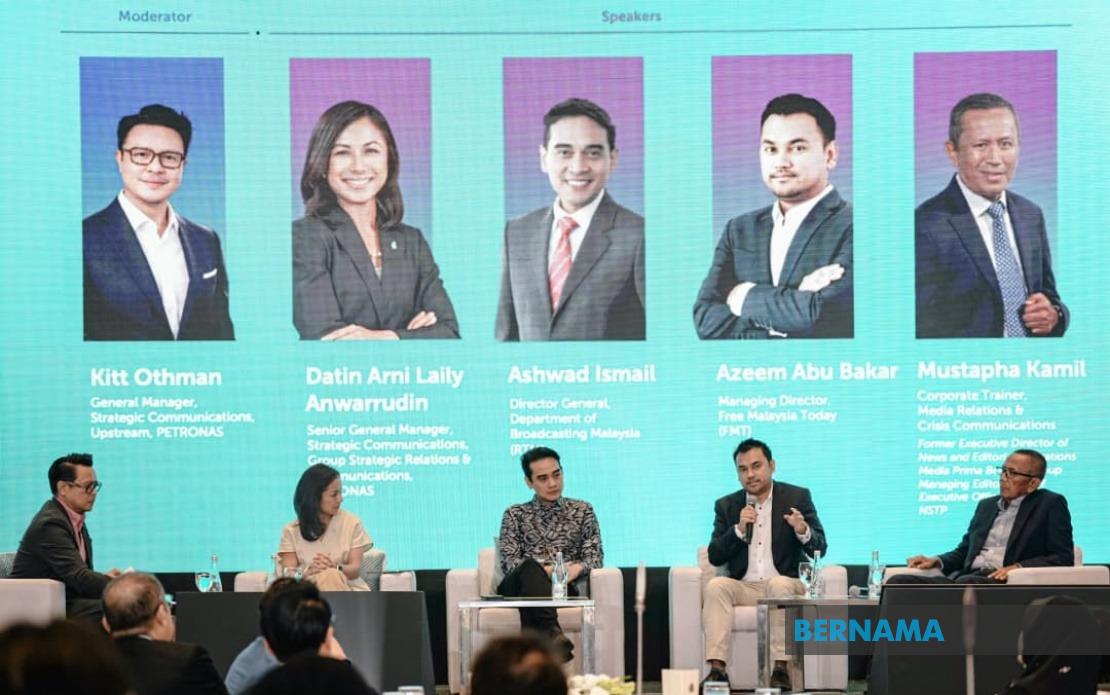
The accelerating capabilities of artificial intelligence are fundamentally disrupting how organisations manage their reputations and respond to crises, according to senior communications strategists and media practitioners gathered in Kuala Lumpur. Speaking at a forum on media credibility and AI, business leaders warned that the traditional playbook for crisis management has become obsolete, forcing companies to adopt radically different approaches to protecting brand integrity in an age where information—verified or otherwise—spreads at unprecedented velocity.
Datin Arni Laily Anwarrudin, Senior General Manager of Strategic Communications at PETRONAS, emphasised that organisations can no longer afford to remain passive observers of public discourse. Instead, companies must seize control of their own narratives before external voices, whether human or algorithmically amplified, shape public perception to their detriment. She argued that transparency has shifted from being merely advisable to absolutely essential, as the vacuum left by corporate silence inevitably gets filled by others whose interpretations may not serve the organisation's interests or, indeed, reflect factual reality.
The challenge posed by AI extends well beyond simple information dissemination. The technology's capacity to rapidly distribute unverified claims at scale creates a new category of risk for corporations already stretched thin managing conventional media relations and regulatory obligations. Unlike traditional crises that typically unfold with some measure of predictability, AI-accelerated information environments can transform minor issues into full-blown reputational threats within hours. This compressed timeline fundamentally alters how companies must structure their response mechanisms and decision-making processes.
Arni Laily highlighted how conventional crisis protocols have been rendered essentially unusable. The notion of a sixteen-hour window before publication—once a standard assumption for media teams—has evaporated entirely in digital environments where breaking news can circulate globally in minutes. Similarly, traditional escalation procedures and approval chains, designed for a slower-moving information landscape, now risk becoming bottlenecks that prevent organisations from responding swiftly enough to shape emerging narratives. The implications are profound: companies must reimagine how they verify information, authorise responses, and deploy communications resources without simply reacting reflexively to every claim that surfaces online.
This assessment was echoed by Mustapha Kamil Mohd Janor, former executive director of news and editorial operations at Media Prima Berhad and NSTP Group managing editor, who stressed that organisational communication structures themselves must be fundamentally restructured. He warned that companies without dedicated, well-trained crisis communication teams are increasingly vulnerable, suggesting this moment represents a critical inflection point for corporate governance and risk management. The implication is clear: investing in crisis communications capability is no longer optional but rather a core business function equivalent to cybersecurity or financial controls.
Despite the disruptive force of AI and digital acceleration, Mustapha Kamil maintained that journalism's foundational purpose remains unchanged. Media practitioners continue to serve as intermediaries between complex events and public understanding, helping citizens navigate information and make informed decisions. Rather than viewing journalists as competitors to be superseded by algorithms, this framing positions quality journalism as increasingly valuable precisely because human insight and contextual understanding become more valuable when automated systems proliferate. The role involves discrimination and judgment—determining what matters and why—capabilities that algorithms currently cannot fully replicate.
The question of how humans and AI can coexist productively in media and communications environments generated particular discussion among panellists. Azeem Abu Bakar, Managing Director of Free Malaysia Today, suggested a pathway forward by advocating for what he termed "SUPER journalists"—media professionals who excel in areas where technology has inherent limitations. This framework encompasses cultivating sources through relationship-building, developing deep contextual understanding of complex issues, identifying patterns across disparate information streams, operating with efficiency despite resource constraints, and maintaining the institutional reputation that audiences trust. These competencies are fundamentally rooted in human experience and judgment, creating a division of labour where AI handles routine operational tasks while journalists concentrate on work requiring insight and ethical reasoning.
The conversation touched implicitly on broader questions about truth and verification in digitally saturated environments. As AI systems become increasingly sophisticated at generating plausible-sounding but potentially false information, and as algorithmic systems amplify content based on engagement rather than accuracy, the ecosystem's ability to converge on factual understanding becomes strained. Media practitioners and communications professionals find themselves in the frontline of this struggle, charged with helping their organisations and audiences distinguish signal from noise. This burden is unlikely to diminish; if anything, it will intensify as AI capabilities expand.
For Malaysian organisations and the broader Southeast Asian business community, the implications are particularly acute. The region's rapid digital adoption, combined with multilingual information environments and diverse regulatory frameworks, creates complex conditions where corporate communications must navigate between local sensitivities and global scrutiny. AI-driven crises may originate or spread through unexpected channels, requiring communications teams to monitor and respond across multiple platforms, languages, and cultural contexts simultaneously. The traditional advantages of geographical distance or limited media reach have largely disappeared, meaning a manufacturing incident in Selangor or a supply chain disruption at a port facility can generate global conversation within hours.
The forum, organised by PETRONAS in collaboration with the Malaysian Press Institute, assembled a notably diverse panel that reflected the ecosystem's recognition that managing media credibility and organisational reputation in the AI era requires cooperation between corporate communicators, journalists, and news organisations themselves. This collaborative framing suggests that adversarial relationships between media and corporations may become increasingly counterproductive—both parties benefit when information environments maintain integrity and audiences can trust that sources are genuinely attempting to communicate truth rather than merely advancing narrow interests.
Looking forward, the consensus emerging from these discussions suggests several imperatives for Malaysian organisations. First, companies must invest in communications capabilities and personnel who can operate effectively in real-time, information-dense environments. Second, organisations should prioritise transparency and proactive narrative management rather than defensive or reactive postures. Third, building sustainable competitive advantage increasingly requires earning and maintaining stakeholder trust—a commodity that becomes more valuable as information abundance makes attention and credibility the genuine scarcities. Finally, both media organisations and corporations must recognise that their long-term interests often align around maintaining functional information environments where truth remains accessible to those seeking it. The AI era, paradoxically, may be making trusted institutional voices more valuable precisely because their scarcity becomes apparent against a backdrop of proliferating unverified claims.

