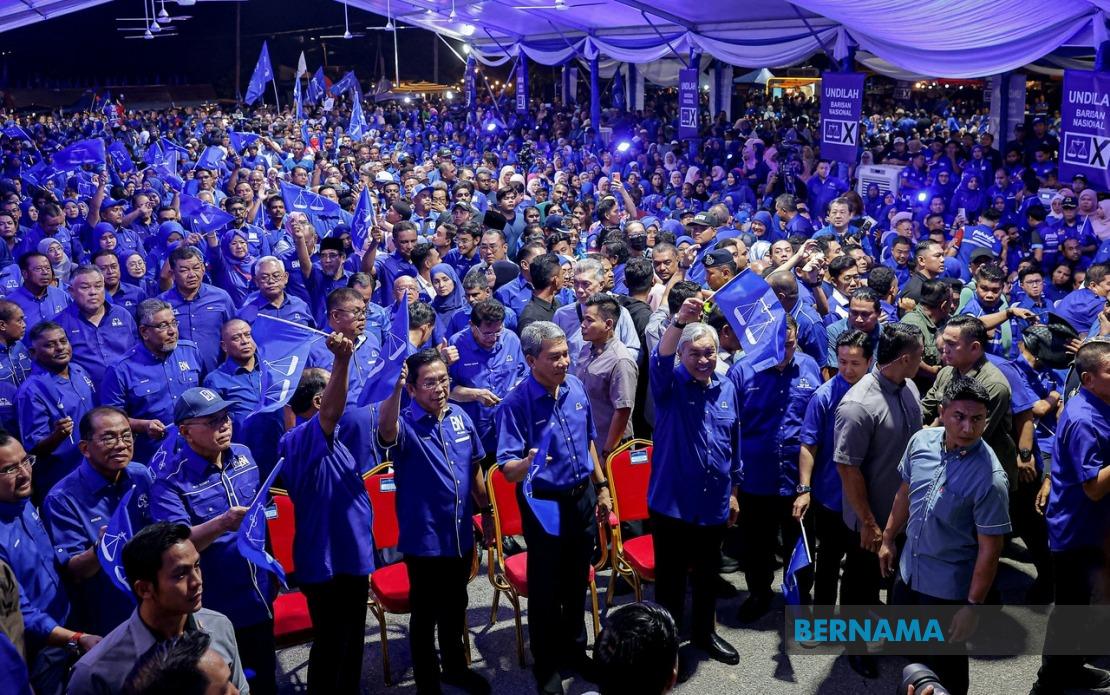
Barisan Nasional's chairman Datuk Seri Dr Ahmad Zahid Hamidi has called on the governing coalition to harness the momentum from its overwhelming triumph in Johor to drive success in the upcoming Negeri Sembilan state election. Speaking at the launch of BN's campaign machinery and candidate announcement in Seremban, Ahmad Zahid framed Johor's landslide as evidence of voter appetite for stability and competent administration, a message he seeks to replicate across Negeri Sembilan's constituencies.
The Johor outcome provides a compelling template for BN's ambitions. The coalition captured 48 of 56 state seats and accumulated nearly 60 per cent of the popular vote, marking its strongest showing in the state's electoral history. Ahmad Zahid underscored how this result reflected public confidence in BN's ability to deliver political stability, foster economic expansion, and exercise responsible governance. For Negeri Sembilan, where BN secured 14 seats in the 2023 state election, the organization hopes to build substantially on that foundation, though the coalition faces pressure to demonstrate it can sustain momentum beyond a single state contest.
Central to Ahmad Zahid's message was the principle of internal cohesion. He stressed that Johor's success stemmed from unity within the BN family, with members functioning as a coordinated force, maintaining trust, and leveraging each other's comparative advantages. This emphasis on solidarity carries particular weight in Negeri Sembilan, where internal BN tensions have occasionally surfaced in previous contests. Ahmad Zahid instructed party members to suppress factional interests and consolidate behind a single campaign narrative, arguing that visible discord among coalition partners would undermine voter confidence.
The Deputy Prime Minister sought to redirect campaign focus away from candidate selection disputes, which have historically consumed party resources and generated negative publicity. He cautioned against members becoming preoccupied with candidacy determinations, warning that such internal preoccupation would distract from the fundamental objective of converting voter preference into electoral success. Ahmad Zahid reminded the machinery that regardless of which individual receives nomination as candidate or faces selection as the prospective Menteri Besar, the operational imperative remains constant: close organisational ranks, expand campaign intensity, structure persuasive messaging, and mobilise community backing.
This directive addresses a recurring vulnerability within BN's campaign structure. In numerous recent elections, disagreements over candidate placement have fractured party discipline, sometimes prompting dissident members to campaign for rivals or simply withdraw enthusiasm from official efforts. By framing candidacy as subordinate to collective victory, Ahmad Zahid attempted to establish a hierarchy of priorities that should theoretically suppress ego-driven conflicts. However, the effectiveness of such appeals depends upon whether lower-tier party officials genuinely accept that their political futures are intertwined with overall coalition performance rather than individual nomination outcomes.
Ahmad Zahid's insistence on aggressive grassroots engagement reflects recognition that state elections increasingly turn on ground-level persuasion rather than top-down messaging. He instructed the campaign machinery to conduct door-to-door operations across constituencies, engaging voters directly to strengthen BN support networks. This labour-intensive approach requires mobilising thousands of party volunteers across Negeri Sembilan's districts, a logistical challenge that tests organisational capacity. The timeframe is compressed: nomination day arrives on Saturday, early voting occurs on July 28, and polling takes place on August 1, leaving scarcely two weeks for sustained community contact.
The electoral mathematics in Negeri Sembilan present distinct challenges compared to Johor. While Johor's 48-seat assembly comprises a large chamber where coalition victories appear more decisive, Negeri Sembilan's smaller legislature means that seat gains or losses carry proportionally greater impact on the government's stability. A BN performance merely replicating 2023's 14-seat outcome would represent stagnation rather than progress, particularly given the framing around momentum. Conversely, significant seat gains would require winning marginal constituencies where voter sentiment remains fluid, demanding precisely the calibre of grassroots engagement Ahmad Zahid emphasises.
The presence of BN deputy chairman Datuk Seri Mohamad Hasan alongside Ahmad Zahid symbolised the coalition's attempt to project unified leadership. Mohamad Hasan's position within both BN and UMNO makes his symbolic participation important for demonstrating solidarity across hierarchical levels. Whether this unity extends through campaign execution remains contingent upon how effectively mid-ranking party officials suppress candidacy grievances and redirect energy toward voter contact.
Ahmad Zahid's framing carries implications extending beyond Negeri Sembilan. Johor's dominance under the BN-led Perikatan Nasional arrangement has strengthened arguments for continued coalition governance at federal level. A successful Negeri Sembilan campaign would reinforce those narratives, while electoral setbacks would raise uncomfortable questions about whether Johor represented an anomaly or genuinely signals revived coalition appeal. Given the proximity of potential federal elections and the incremental nature of electoral momentum, Negeri Sembilan effectively functions as a consequential test case for BN's broader political trajectory.
The coalition confronts an electorate that, while receptive to BN's message in Johor, maintains independent judgement about individual state contests. Negeri Sembilan voters will evaluate BN's state-level track record, local candidate quality, and specific policy commitments rather than simply importing Johor sentiment. Ahmad Zahid's challenge lies in translating the coalition's recent success into concrete campaign operations that convince Negeri Sembilan communities of BN's renewed capacity for effective governance. Whether the machinery can execute this transition—suppressing internal rivalries, coordinating across components, and mobilising voter contact—will determine whether Johor's landslide becomes a foundation for sustained revival or remains an isolated achievement.

