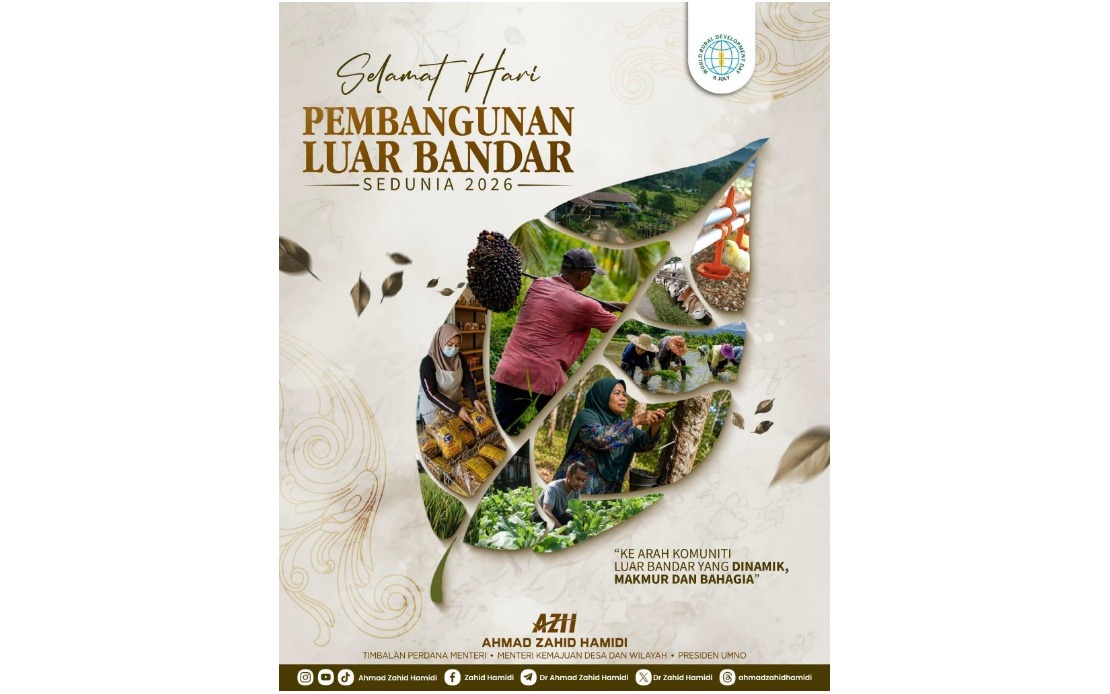
Malaysia has taken a significant step in recognising the importance of rural development by officially observing World Rural Development Day (HPLBS) on July 6 for the first time, marking a commitment to elevating rural communities on the national policy agenda. Deputy Prime Minister Datuk Seri Dr Ahmad Zahid Hamidi, who also holds the portfolio of Rural and Regional Development Minister, stressed that this annual commemoration underscores the ministry's responsibility in pursuing a comprehensive rural development strategy that benefits all communities outside urban centres.
The inaugural celebration, held at the Tun Abdul Razak Stadium in Jengka near Maran, Pahang, reflects the government's determination to place rural prosperity at the forefront of national development priorities. Ahmad Zahid articulated that the establishment of July 6 as Malaysia's designated day for rural development recognition serves a dual purpose: it honours the contributions and potential of rural communities while simultaneously providing an annual platform to reassess and strengthen policies affecting their livelihoods and future prospects.
The choice of July 6 carries historical weight beyond symbolic significance. The date coincides with the founding of the Centre on Integrated Rural Development for Asia and the Pacific (CIRDAP), an international organisation headquartered in Dhaka, Bangladesh, which has been instrumental in shaping rural development frameworks across the Asia-Pacific region for several decades. By aligning Malaysia's observance with CIRDAP's establishment, the government positions itself within a broader regional movement towards addressing rural challenges systematically and drawing on accumulated regional expertise and best practices.
According to Ahmad Zahid, the ministry's vision extends beyond ceremonial recognition to tangible improvements in rural living standards. The government intends to ensure that communities in rural areas gain access to expanded economic opportunities, build more resilient local economies, benefit from improved infrastructure and public services, and progressively achieve prosperity levels comparable to urban regions. This holistic approach acknowledges that rural development cannot be pursued in isolation but must be integrated with broader national development goals.
The 2026 celebration theme, "Toward Vibrant, Prosperous and Happy Rural Communities," encapsulates three interconnected policy objectives that form the foundation of Malaysia's rural development strategy. Community innovation represents the government's recognition that rural residents possess unique knowledge, cultural assets, and entrepreneurial potential that, when mobilised effectively, can drive local economic growth. Rather than imposing top-down development models, the approach encourages rural communities to identify and implement solutions suited to their specific contexts and needs.
Rural digitalisation stands as the second pillar, addressing a persistent gap between urban and rural access to technology and digital services. The proliferation of e-commerce platforms, digital payment systems, and online education has created opportunities for rural entrepreneurs to reach national and international markets. However, without deliberate investment in broadband infrastructure, digital literacy programmes, and technology adoption incentives, rural areas risk being left behind in Malaysia's digital economy transition. The ministry's emphasis on this pillar suggests recognition that technological access is no longer a luxury but a necessity for rural competitiveness.
Rural entrepreneurship development, the third pillar, acknowledges that sustainable rural prosperity depends on generating income-generating opportunities within rural areas rather than perpetuating migration to cities. By supporting small and medium enterprises, agricultural modernisation, agro-tourism, and value-added rural industries, the government seeks to create employment pathways that encourage younger generations to remain in or return to rural communities. This approach has implications for stemming urban overcrowding, reducing pressure on city infrastructure, and preserving rural cultural heritage and agricultural traditions.
For Malaysian readers and policymakers, the establishment of World Rural Development Day represents a strategic acknowledgment that rural development deserves dedicated attention and resources comparable to urban development initiatives. Historically, rural areas in Malaysia have attracted less investment and policy focus despite being home to significant populations, particularly in states like Pahang, Kelantan, and Sarawak. The formalisation of an annual observance signals a shift towards treating rural development as a core national responsibility rather than a peripheral concern.
The timing of Malaysia's inaugural celebration also reflects regional trends. Across Southeast Asia, governments are grappling with the consequences of rural neglect: youth unemployment in agricultural communities, unsustainable farming practices, urban congestion, and widening urban-rural inequality. Countries including Thailand, Philippines, and Indonesia have similarly prioritised rural development in recent years, making Malaysia's formal adoption of World Rural Development Day a move toward alignment with regional development priorities and international development frameworks.
Ahmad Zahid's public commitment, articulated through his Facebook statement, serves multiple strategic purposes. First, it signals to rural constituencies that the government recognises their concerns and is committed to addressing them systematically. Second, it establishes accountability by creating a specific date on which rural development progress can be evaluated annually. Third, it provides a mechanism for communicating rural development achievements and soliciting community feedback on policy effectiveness.
The implications of this initiative extend beyond ceremonial gestures. By institutionalising World Rural Development Day, Malaysia creates a framework for annual policy reviews, budget allocations specifically earmarked for rural priorities, and structured dialogue between government, rural communities, and development partners. The three-pillar approach—community innovation, digital infrastructure, and entrepreneurship—provides concrete metrics against which progress can be measured, moving rural development beyond aspirational rhetoric toward measurable outcomes.
For businesses operating in Malaysia, the government's emphasis on rural digitalisation and entrepreneurship development suggests expanding opportunities in rural markets. Technology providers, fintech companies, logistics operators, and e-commerce platforms may find growing demand in rural areas as digital infrastructure improves and entrepreneurial capacity increases. Similarly, agricultural modernisation initiatives could attract investment from agritech firms and rural supply chain service providers.
The establishment of World Rural Development Day also carries implications for international engagement. CIRDAP's involvement provides Malaysia access to regional expertise and networks for implementing best practices from neighbouring countries. Knowledge exchange programmes, capacity-building initiatives, and collaborative projects with other CIRDAP member states could accelerate rural development outcomes while positioning Malaysia as a regional leader in addressing rural challenges comprehensively and innovatively.

