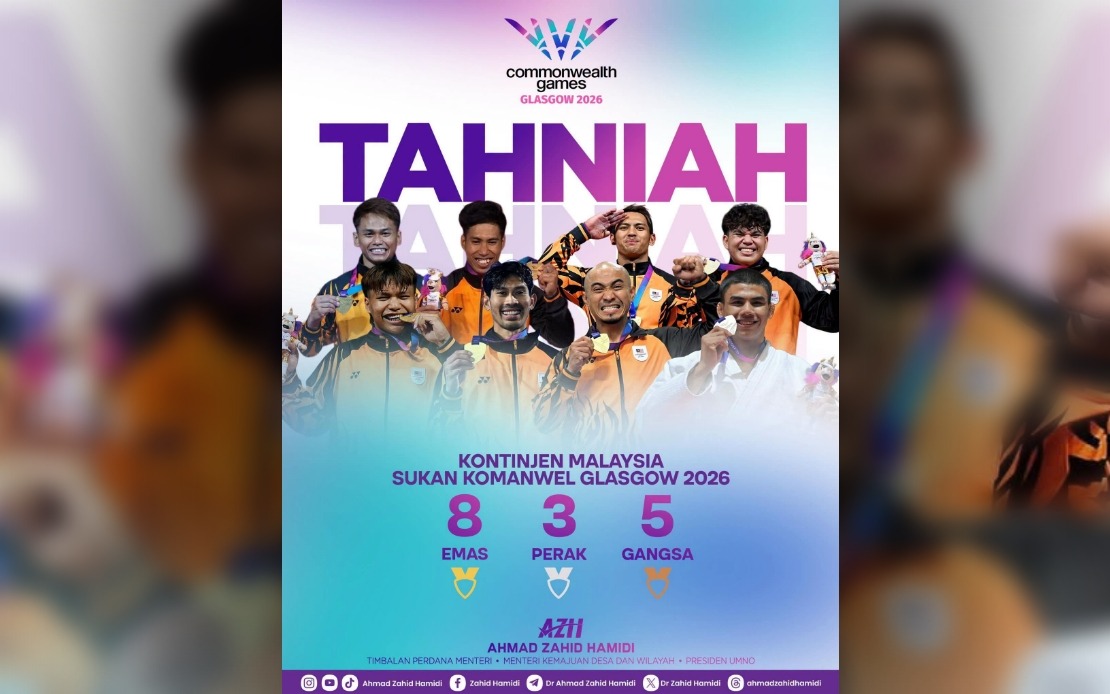
Deputy Prime Minister Datuk Seri Dr Ahmad Zahid Hamidi has extended his congratulations to Malaysia's 2026 Commonwealth Games delegation following their stellar performance at the recently concluded Glasgow Games in Scotland, where the nation's athletes collectively secured 16 medals across various sporting disciplines. The contingent, comprising 59 competitors including 22 para athletes, returned home with eight gold medals, three silver medals, and five bronze medals—a haul that exceeded the performance targets established before the games commenced and represents Malaysia's most impressive Commonwealth Games showing since the 2010 edition.
The deputy premier's public acknowledgement underscores the significance of this achievement within Malaysia's sporting hierarchy, particularly as the nation continues to position itself as a competitive force in regional and international athletic endeavours. Malaysia's tenth-place finish on the overall medal standings reflects the breadth and depth of talent across the delegation, spanning both able-bodied athletes and para-sports competitors who contributed meaningfully to the medal count. This performance gains added weight when considered against the preparation period and resource allocation dedicated by Malaysian sporting bodies and government support structures in the lead-up to the Games.
In his statement shared across social media platforms, Ahmad Zahid emphasised that the athletes' accomplishments were the direct result of meticulous preparation and unwavering team cohesion that permeated throughout the entire contingent. He particularly highlighted the collective effort extended by coaching staff, officials, and behind-the-scenes support personnel whose dedication often remains less visible to the public eye but proves instrumental in enabling athletes to perform at their peak. This multi-faceted acknowledgement reflects a contemporary understanding that medal success at major international competitions depends not solely on individual athletic prowess but on an integrated ecosystem of professional expertise and logistical support.
The deputy premier's remarks carried an inclusive sentiment, extending recognition beyond medal winners to encompass every athlete who represented Malaysia in Glasgow. His emphasis that non-medalists should equally take pride in their participation and sacrifice attempts to broaden the definition of success beyond the traditional binary of medal achievement, a framing that acknowledges the value of international representation and competitive experience in developing Malaysia's sporting pipeline. For younger or emerging athletes making their first Commonwealth Games appearance, such public recognition from senior government figures can provide meaningful motivation and validation of their contribution to national sporting ambitions.
The 16-medal haul represents a tangible improvement over certain previous Commonwealth Games cycles and signals that Malaysia's strategic investment in sports development, talent identification, and athlete support systems is yielding measurable returns. The inclusion of 22 para athletes in the contingent reflects Malaysia's growing commitment to parallel sports development, a priority area that has received increased government backing in recent years alongside efforts to enhance facilities and coaching capacity for athletes with disabilities. This expansion mirrors global trends wherein Commonwealth Games participation increasingly emphasises inclusive sporting opportunities.
Ahmad Zahid's framing of the achievement as validation of Malaysia's capacity to achieve international distinction carries implications beyond sports policy alone. In the current geopolitical context, where nations increasingly leverage sporting success to project soft power and national capability, Malaysia's competitive standing at major games contributes to broader narratives about the country's development trajectory and organisational competence. The 2026 Games performance therefore serves as a benchmark against which Malaysia's sporting infrastructure and investment strategies will likely be assessed in preparation for future major competitions.
The success in Glasgow also arrives at a moment when Malaysia faces various domestic and regional sporting challenges, including infrastructure development, athlete retention, and competition for funding resources. The positive performance may provide momentum for renewed advocacy around sports funding within government and private sector circles, potentially supporting subsequent generations of Malaysian athletes pursuing international competition. Equally, the achievement furnishes evidence that structured support frameworks and commitment to excellence can deliver results, a message particularly relevant as Malaysia prepares its preparations for future Olympic cycles and regional championships.
The para-athletes' contribution to Malaysia's medal tally warrants particular attention, as their success demonstrates expanding capability in a sporting sector that historically received comparatively limited resources and visibility. The presence of 22 para competitors within a 59-member delegation indicates that inclusive sports development has moved beyond peripheral concern to represent a material component of Malaysia's international sporting strategy. This evolution aligns with Commonwealth Games principles that increasingly emphasise accessibility and opportunities for athletes across the full spectrum of physical abilities.
Looking forward, Ahmad Zahid's statement suggests that government leadership views the Glasgow performance as a platform for building greater sporting achievement rather than a conclusion point. His hope that the contingent's success would inspire Malaysia to pursue even greater accomplishments in future competitions indicates that higher targets are likely being contemplated for upcoming major international events. This forward-looking perspective establishes a narrative wherein current achievement becomes a stepping stone toward more ambitious future goals, potentially influencing budget allocations and policy priorities affecting Malaysian sports development in the medium term.

