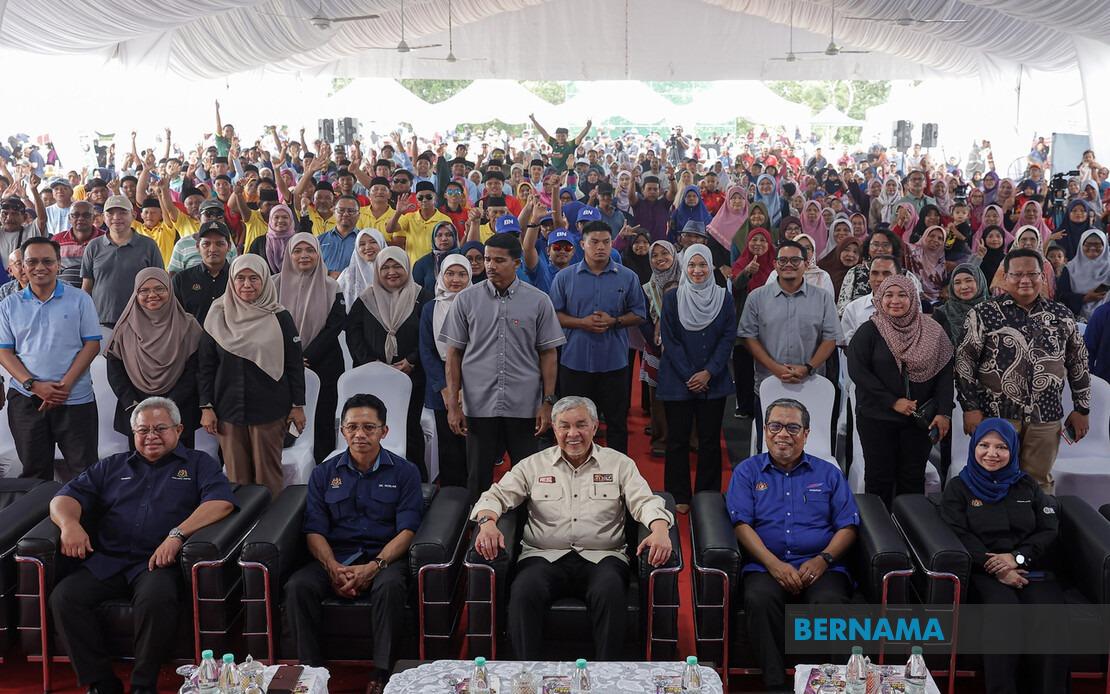
Malaysia's fractured political landscape is forcing the nation's major coalitions to rethink their strategies and forge new partnerships if they wish to maintain political stability, according to Barisan Nasional (BN) chairman Datuk Seri Dr Ahmad Zahid Hamidi. The veteran politician's remarks underscore growing recognition among Malaysia's political establishment that rigid bloc structures no longer guarantee success in an era of volatile voter behaviour and shifting party loyalties across the country.
Speaking during the Gema@KKDW 2026 programme held in Palong 8 near Jempol on July 18, Ahmad Zahid outlined a measured approach to testing new partnership models. The understanding between BN and Perikatan Nasional (PN) for the upcoming 16th Negeri Sembilan state election will serve as an experimental framework, he explained, allowing both coalitions to evaluate whether such arrangements could be extended to other contests, including the Melaka state election and ultimately the 16th General Election (GE16).
This pragmatic strategy reflects the complex realities facing Malaysian politics today. Rather than committing to sweeping coalitional mergers, BN and PN have opted for a more flexible arrangement designed to prevent the vote-splitting dynamics that have plagued Malaysian elections in recent years. Such fragmentation has historically allowed candidates with minority support to secure victories, distorting electoral outcomes and complicating post-election coalition formation. By coordinating their efforts at the state level first, the two coalitions can gather empirical evidence about the viability and benefits of their partnership before scaling it nationally.
Ahmad Zahid was emphatic that this arrangement falls short of a formal political cooperation or binding agreement between BN and PN. Instead, he characterised it as a limited understanding aimed specifically at preventing overlapping contests where candidates from both coalitions might compete for the same seat. This distinction matters considerably in Malaysian politics, where formal coalitional agreements carry significant organisational and ideological implications, whereas tactical understandings allow greater flexibility and less risk of political entanglement.
The Negeri Sembilan test case carries particular significance for Malaysian politics beyond the state itself. The results on August 1, when polling day is scheduled following early voting on July 28, will provide crucial data about whether BN and PN voters can work together effectively without the friction that sometimes characterises competing ideological factions. Success in Negeri Sembilan could validate the model; failure would signal that deeper incompatibilities exist between the coalitions' bases and leadership structures.
For Malaysian observers, the stakes of this experiment extend well beyond state-level politics. GE16 looms as a watershed moment for the country's political trajectory, and the composition of Malaysia's next federal government remains genuinely uncertain. Neither BN nor PN commands sufficient strength individually to guarantee dominance, making coalition arrangements crucial to electoral strategy. The Perikatan Nasional's growth since 2020 has substantially reshaped Malaysia's political map, while BN's recovery has been gradual and geographically uneven. Any national-level understanding between them would fundamentally reshape the election landscape.
The broader context of Malaysian politics makes Ahmad Zahid's emphasis on flexibility especially relevant. The nation has witnessed multiple significant political realignments since 2018, with parties shifting between coalitions, new coalitions forming rapidly, and voter behaviour becoming increasingly unpredictable. The traditional two-coalition model that dominated Malaysian politics for decades has given way to a more multipolar environment where smaller parties and independent candidates wield surprising influence. Under these circumstances, rigid commitment to any single coalition structure becomes strategically risky.
However, the BN-PN understanding also reflects underlying tensions that remain unresolved. Perikatan Nasional emerged partly as a reaction against BN and represents different demographic and ideological constituencies in many states. Muslims with strong religious commitments, rural constituencies with distinct grievances, and voters disappointed with BN's governance record form significant portions of PN's base. Whether these voters would accept coordination with BN, and whether BN members would embrace cooperation with rivals, remains an open question that Negeri Sembilan will partly illuminate.
Ahmad Zahid's statement also reveals BN's recognition that it cannot simply assume its historical dominance or expect automatic voter support. The coalition must earn electoral credibility in each contest and adapt its messaging and partnerships to contemporary political realities. This represents a notable shift from the confidence BN sometimes displayed when it held unchallenged power, acknowledging that Malaysian voters now exercise genuine choice between competing coalitions and alternatives.
Looking forward, the implications of this arrangement for Malaysian federalism and centre-state relations deserve attention. If BN and PN can coordinate effectively in Negeri Sembilan while maintaining distinct identities and party structures, they might demonstrate that Malaysia's complex political ecology can function with cooperation between traditional rivals. Alternatively, tensions could emerge that demonstrate the difficulty of such partnerships at the practical level, suggesting that genuine coalitional integration remains necessary for Malaysian politics to function smoothly.
The timing of Ahmad Zahid's remarks matters as well. With GE16 likely to occur within the next two years and multiple state elections scheduled before then, Malaysian political parties are actively positioning themselves for the contests ahead. The willingness of BN's leadership to openly discuss new alignments signals that the coalition recognises the need to adapt its strategies to contemporary political realities. This contrasts with earlier periods when BN operated with greater certainty about its political position.

