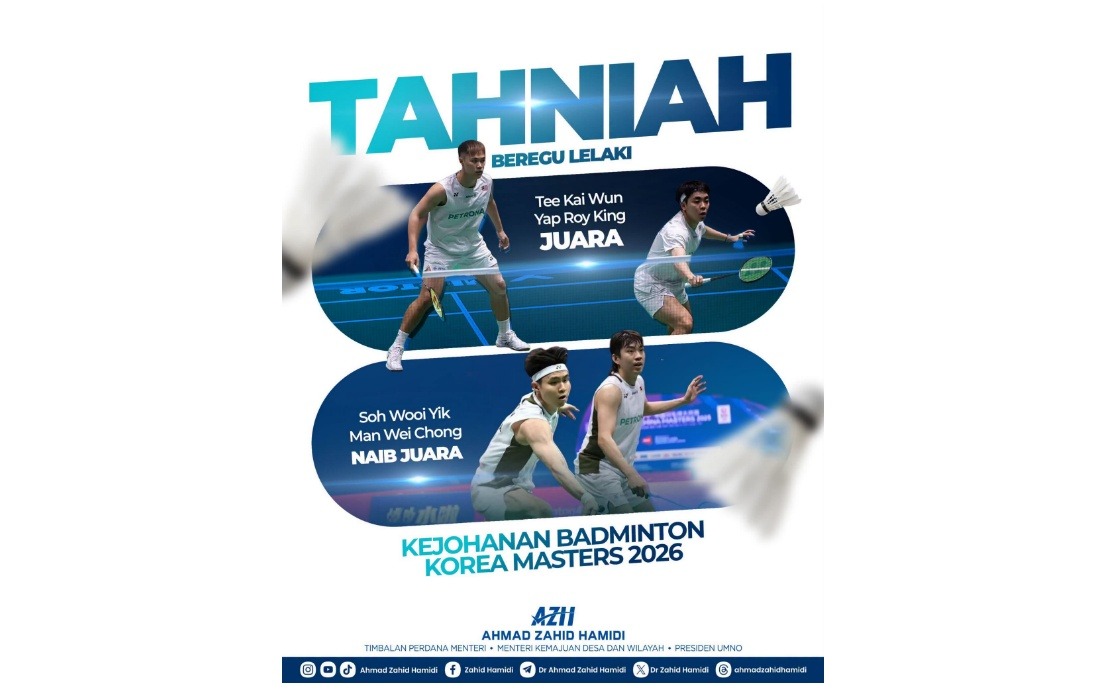
Deputy Prime Minister Datuk Seri Dr Ahmad Zahid Hamidi has extended his congratulations to Malaysia's badminton contingent following an impressive showing at the 2026 Korea Masters Badminton Championships, where local talent swept the top two positions in the men's doubles category at the Yi Sun-sin Gymnasium in Asan. The achievement underscores the depth and quality of Malaysia's badminton programme, particularly in the men's doubles discipline where the nation has established itself as a regional powerhouse.
Tee Kai Wun and Yap Roy King secured the championship title in their debut appearance at the Korea Masters, demonstrating remarkable composure and tactical acumen in their final match. The pair dispatched fellow Malaysians Soh Wooi Yik and Man Wei Chong with a convincing 21-13, 21-18 scoreline, completing their victory in just 31 minutes. The decisive performance highlighted the aggressive, attacking style that has become a hallmark of modern Malaysian men's doubles play, allowing Kai Wun and Roy King to control the tempo and rhythm of the match from the opening rallies.
The runner-up finish for Wooi Yik and Wei Chong, whilst overshadowed by the title victory, nonetheless represents a significant achievement in its own right. For Wooi Yik in particular, the Korea Masters holds special significance: he previously captured the championship crown in 2024 alongside Aaron Chia, making Malaysia's second Korea Masters title win all the more meaningful. The fact that two Malaysian pairs contested the final speaks to the strength and competitive quality within the domestic badminton ecosystem, where these athletes train together and push one another to higher standards.
Ahmad Zahid articulated his perspective through a Facebook post, emphasising that such successes serve as catalysts for sustained excellence. His comments reflect the government's investment in sports development and the broader national objective of maintaining Malaysia's status as a badminton superpower. The Deputy Prime Minister's public acknowledgement carries symbolic weight, signalling political support for athletes competing at the highest international levels and recognising the sacrifices required to achieve such pinnacle moments.
The Korea Masters holds considerable prestige within the international badminton calendar, attracting top-ranked pairs from across Asia and beyond. Malaysia's dominance in the men's doubles category at this tournament has historical roots tracing back decades, though the sport has become increasingly competitive as other nations have invested heavily in badminton development. The fact that Malaysian pairs can still claim both the gold and silver medals demonstrates that the fundamentals of training, talent identification, and coaching excellence remain robust.
The success arrives at a critical juncture for Malaysian badminton, as the sport navigates changing competitive dynamics and the emergence of formidable challengers from neighbouring countries. Indonesia, Thailand, and China have all invested substantially in badminton talent pools, intensifying rivalry in Southeast Asia. Against this backdrop, Malaysia's Korea Masters performance provides affirmation that strategic planning and continued commitment to the sport continue yielding competitive dividends.
For Tee Kai Wun and Yap Roy King, the Korea Masters triumph represents validation of their pairing strategy and development arc. Men's doubles partnerships in badminton require particular synchronisation, as players must coordinate court positioning, shuttle anticipation, and attacking formations with precision. The victory over established rivals from their own country indicates that this pairing has achieved a level of maturity and understanding that positions them as serious contenders in major tournaments ahead.
The implications of this Korea Masters result extend beyond immediate pride and accolade. Success at prestigious tournaments enhances Malaysia's international badminton profile, potentially attracting sponsorship opportunities, media attention, and grassroots inspiration that feeds the development pipeline. Young Malaysian players watching these performances gain tangible examples of excellence achievable through dedication and skill development, motivating them to pursue badminton careers at the highest levels.
Ahmad Zahid's call for continued excellence reflects broader sporting ambitions within Malaysia's institutional framework. The Deputy Prime Minister referenced the efforts of everyone involved in the players' preparation—coaches, support staff, and administrative personnel—acknowledging that individual athletic achievement depends upon comprehensive support systems. This recognition underscores that Malaysian badminton success results from coordinated effort across multiple stakeholders.
Looking forward, the challenge facing Malaysian badminton involves maintaining momentum whilst developing the next generation of champions. The Korea Masters success provides an encouraging snapshot of current capability, but sustaining competitive excellence requires consistent investment, talent nurturing, and strategic planning. For Wooi Yik and Wei Chong, the runner-up finish at Korea Masters positions them well for redemption opportunities at upcoming major tournaments, whilst Kai Wun and Roy King must now manage the increased pressure and expectations that accompany championship status.
Malaysia's badminton heritage remains foundational to the nation's sporting identity, and performances like those at the Korea Masters reinforce this cultural connection. The sport continues generating national pride and international recognition, qualities that Ahmad Zahid's public commendation served to amplify. As Malaysian badminton looks toward future competitions, this Korea Masters result provides both achievement to celebrate and motivation to pursue even greater heights on the global stage.

