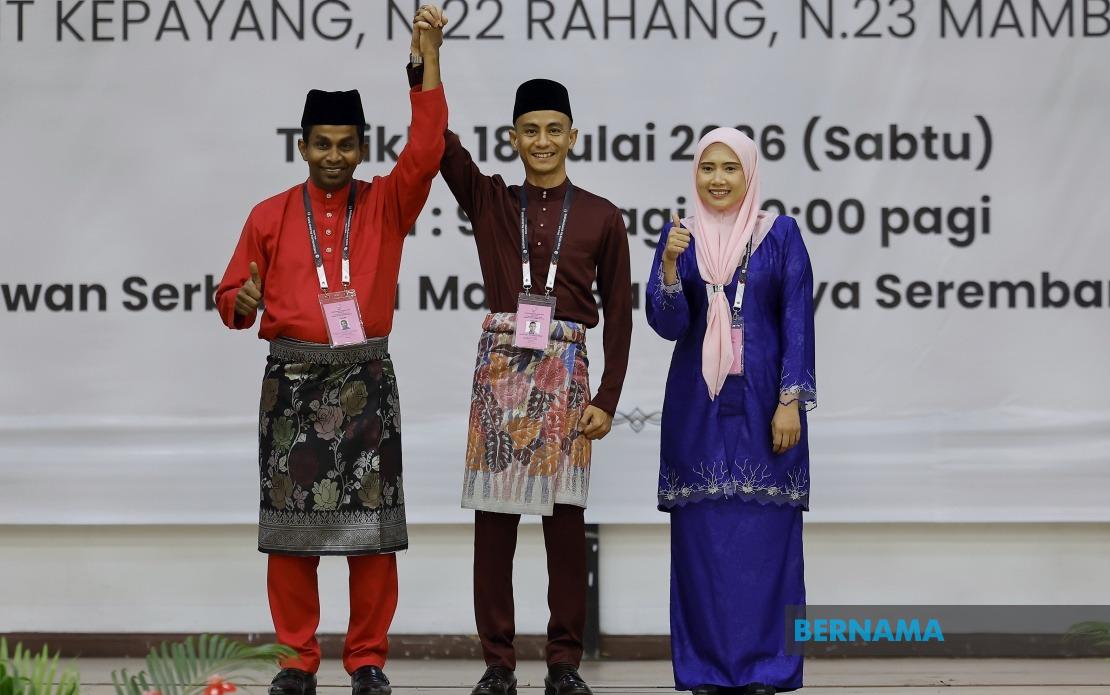
Datuk Ahmad Faez Abdul Razak, Pakatan Harapan's candidate from PKR contesting the Labu state seat for the first time, has positioned himself as the bridge between rapid industrial expansion and community welfare in one of Negeri Sembilan's fastest-changing constituencies. Speaking after nomination day in Seremban, the property developer articulated a vision centred on capturing ground that PH lost in 2023, leveraging nearly three years of grassroots engagement to argue his understanding of local concerns runs deeper than his rivals.
The contrast between ambition and nervousness marked Ahmad Faez's campaign debut. He openly acknowledged the emotional complexity of stepping into electoral politics for the first time, yet projected confidence gained from sustained community interaction across Labu's 32,884 registered voters. This measured tone—mixing optimism with candour about the contest's difficulty—reflects a calculated approach to a seat that shifted hands in the most recent state poll, suggesting neither party can take voter allegiance for granted.
Labu's 2023 result demonstrates how finely balanced this constituency remains. Incumbent Mohamad Hanifah Abu Baker of Bersatu, allied with Barisan Nasional, secured victory with a margin of just 1,640 votes against PH-PKR's Datuk Ismail Ahmad. That narrow victory suggests the seat remains contestable, particularly if opposition-aligned voters consolidate support. Ahmad Faez's task involves convincing voters that his professional expertise and local familiarity can reverse that outcome. The three-way contest involving Siti Nur Umaira Hasim, representing the BN coalition, adds further unpredictability to August 1's polling, potentially fragmenting the vote in unpredictable ways.
The election timeline is compressed. The Election Commission has scheduled early voting for July 28 with polling day on August 1, giving candidates limited time to amplify their messaging. For Ahmad Faez, entering the race after sustained groundwork, this acceleration into the formal campaign phase represents a culmination of months of preparation rather than an abrupt entry. His emphasis on prior community presence appears calculated to overcome any sense that he is an outsider or a parachuted candidate, a criticism sometimes levelled at new political aspirants.
Ahmad Faez's manifesto emphasises infrastructure that directly affects younger voters—specifically a community centre and youth recreational hub. This focus responds to a perceived gap in existing facilities, suggesting his campaign has identified demographic segments, particularly the under-40 population, as critical to victory. In Negeri Sembilan, where younger voters increasingly influence state-level contests, such targeted promises address material concerns rather than abstract political rhetoric. The proposal reflects pragmatic campaign strategy: identify a specific deficiency, pledge to remedy it, and position oneself as responsive to ground-level feedback.
His background as a property developer informs both his pitch and presents potential vulnerabilities. Ahmad Faez argues his professional experience uniquely qualifies him to navigate Labu's explosive growth trajectory while protecting community interests. However, this same background might invite scrutiny from voters concerned that developers prioritise profit over residential stability. He appears aware of this tension, repeatedly emphasising the need for balanced development and community safeguarding—rhetorical positioning designed to preempt accusations of developer bias. This defensive framing suggests his campaign team recognises that his professional identity requires careful handling.
The Malaysia Vision Valley development corridor represents both opportunity and challenge for Labu's next elected representative. Encompassing 11,000 to 12,000 hectares zoned for industrial and residential projects, this regional initiative promises employment and economic stimulus. However, large-scale development corridors frequently generate community anxiety around displacement, infrastructure strain, and loss of local character. Ahmad Faez's pledge to ensure careful management of this expansion appears calibrated to appeal to voters who welcome growth but fear its potential social costs. Whether such promises, if tested by actual development pressures, prove implementable remains a question for the elected representative after August 1.
The broader political context shapes Labu's significance. Negeri Sembilan's 16th state election occurs within Malaysia's complex multi-level political landscape, where state contests influence federal dynamics and vice versa. A PH victory in Labu would contribute to opposition momentum in a state where coalition politics remain fluid. The presence of Bersatu—historically a complex player navigating between Mahathir-era politics and Perikatan Nasional alignment—adds ideological ambiguity to the incumbent's position. For voters seeking clarity on post-election coalitions, the three-way contest muddies rather than clarifies future governance arrangements.
Ahmad Faez's emphasis on alignment between state and federal government policies signals PH's strategy of presenting itself as administratively coherent. By highlighting how state-level initiatives reinforce federal direction, he implicitly argues for political continuity and unified governance. This messaging appeals particularly to voters prioritising stability and infrastructure delivery over ideological positioning. Whether voters in Labu prioritise such administrative seamlessness or respond more strongly to local grievances and development concerns will substantially influence the election outcome.
The numerical foundation of Labu's electorate—32,869 ordinary voters plus 15 police personnel and spouses—provides a defined target for all campaigns. In a constituency where the 2023 margin was under 2,000 votes, seemingly small shifts in voter behaviour carry disproportionate consequences. Ahmad Faez's three-year community engagement, his willingness to articulate nuanced positions on development, and his explicit acknowledgment of nervousness about his debut all constitute elements of a campaign approach emphasising substance and humility over bombast. Whether these elements prove sufficient to overcome the incumbent's advantage remains the central question heading into August 1.
The Labu contest exemplifies how Malaysian state elections increasingly turn on localised development concerns and constituency-specific grievances rather than purely national political narratives. Ahmad Faez's campaign reflects this reality, prioritising tangible infrastructure promises and professional expertise over grand ideological appeals. His positioning as a development professional determined to balance growth with community welfare responds directly to Labu's status as a rapidly urbanising constituency grappling with expansion's consequences. The coming weeks will test whether this constituency-focused strategy proves more persuasive than either the incumbent's track record or the BN coalition's organisational machinery.

