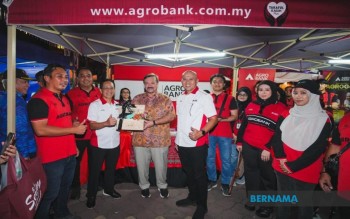
Agrobank has mobilised over RM8 million in financing applications through a series of direct engagement initiatives with hawkers and small-scale traders, marking a significant push to democratise access to capital in Malaysia's informal business sector. The bank's strategy of taking its services directly to the ground has resonated with entrepreneurs who often struggle to navigate traditional banking channels, demonstrating that meeting customers where they work can unlock substantial untapped demand for business finance.
The Sabah expansion represents a crucial moment for the bank's outreach programme, which previously focused on the Klang Valley farmers' markets before extending into Borneo. Two sessions conducted at the Api-Api Night Market on Jalan Gaya and the Papar Tamu Farmers' Market proved particularly productive, with the Api-Api venue alone drawing 153 hawkers and entrepreneurs seeking financing guidance, while Papar Tamu attracted 95 traders. These numbers underscore the hunger for accessible financing options among Malaysia's bustling informal economy, where many operators struggle with cash flow despite robust business potential.
The deliberate selection of night markets and farmers' markets as engagement venues reflects an understanding that these spaces function as vital economic engines within their respective communities. Rather than expecting traders to travel to distant bank branches during operating hours, Agrobank positioned itself within the rhythms and locations of actual trading activity. This ground-level approach acknowledges that petty traders and hawkers operate under time constraints and may be unfamiliar with formal banking procedures, creating barriers to credit access despite their creditworthiness.
Datuk Tengku Ahmad Badli Shah Raja Hussin, Agrobank's group president and chief executive officer, framed the Sabah initiative as evidence of the bank's commitment to serving communities beyond major metropolitan centres. His remarks emphasise a key insight that business financing needs vary significantly across regions, with Borneo traders facing distinct challenges from their counterparts in Selangor. By conducting on-site assessments, Agrobank can tailor its financing structures and advisory services to address localised circumstances, whether involving supply chain logistics, seasonal income fluctuations, or regulatory environments specific to East Malaysia.
The financing discussions centred on addressing immediate operational needs, particularly working capital requirements and funds for business expansion. These categories reflect the most pressing constraints facing micro-entrepreneurs, who frequently operate with minimal cash buffers and lack ready access to overdraft facilities or revolving credit lines. By identifying these pain points directly, Agrobank can structure products that match actual business cycles rather than imposing standardised loan terms designed for corporate clients.
The initiative aligns with directives from Prime Minister Datuk Seri Anwar Ibrahim, who has tasked financial agencies with accelerating disbursement of RM5 billion allocated specifically for small trader financing. This broader policy context provides strategic backing for Agrobank's ground-level efforts, positioning the bank as a key implementation vehicle for government objectives to strengthen Malaysia's informal sector and create employment stability. The convergence of bank initiative and policy priority suggests momentum toward systemic change in how informal businesses access finance.
Finance Minister II Datuk Seri Amir Hamzah Azizan's attendance at the Api-Api session signals ministerial support for Agrobank's approach and underscores the government's commitment to informal sector development. High-level participation in such grassroots events sends a message that petty trading is taken seriously within policymaking circles, potentially encouraging other financial institutions to adopt similar community engagement models rather than relying solely on digital or branch-based distribution.
The methodology employed through these engagement sessions offers advantages beyond immediate loan generation. By conducting face-to-face discussions, Agrobank simultaneously builds financial literacy among traders who may have limited experience with formal credit products, reducing future default risk and fostering long-term banking relationships. The advisory component helps entrepreneurs develop business planning discipline, inventory management practices, and record-keeping systems that improve their viability independent of any single financing transaction.
For Malaysian policymakers watching from Putrajaya, Agrobank's success demonstrates that informal sector financing responds to targeted outreach rather than waiting passively for business to arrive at bank doors. The Sabah expansion proves that successful models can be transplanted across regions, suggesting potential for replication in other East Malaysian states and peripheral areas where formal banking infrastructure remains thin. This geographic expansion carries implications for financial inclusion metrics and small business development objectives outlined in Malaysia's economic transformation plans.
The RM8 million in applications generated to date represents only the beginning of what Agrobank projects could be a much larger pipeline once these sessions generate approvals and successful loan disbursements. Traders who receive positive responses will likely become advocates within their communities, creating organic demand for services through reputation rather than marketing expenditure. This word-of-mouth multiplication effect could accelerate application inflow significantly as the programme matures across additional markets and regions.
Looking forward, the challenge lies in matching application volume with efficient processing and disbursement capabilities while maintaining the quality of credit assessment that protects the bank's portfolio. Agrobank's expansion into Sabah suggests confidence in its ability to scale these operations, yet success will ultimately depend on approval rates, repayment performance, and whether financed traders genuinely achieve the business growth outcomes they project during engagement sessions. These early Sabah results will therefore serve as benchmarks for programme evaluation and future expansion decisions across Malaysia's remaining underserved trading communities.

