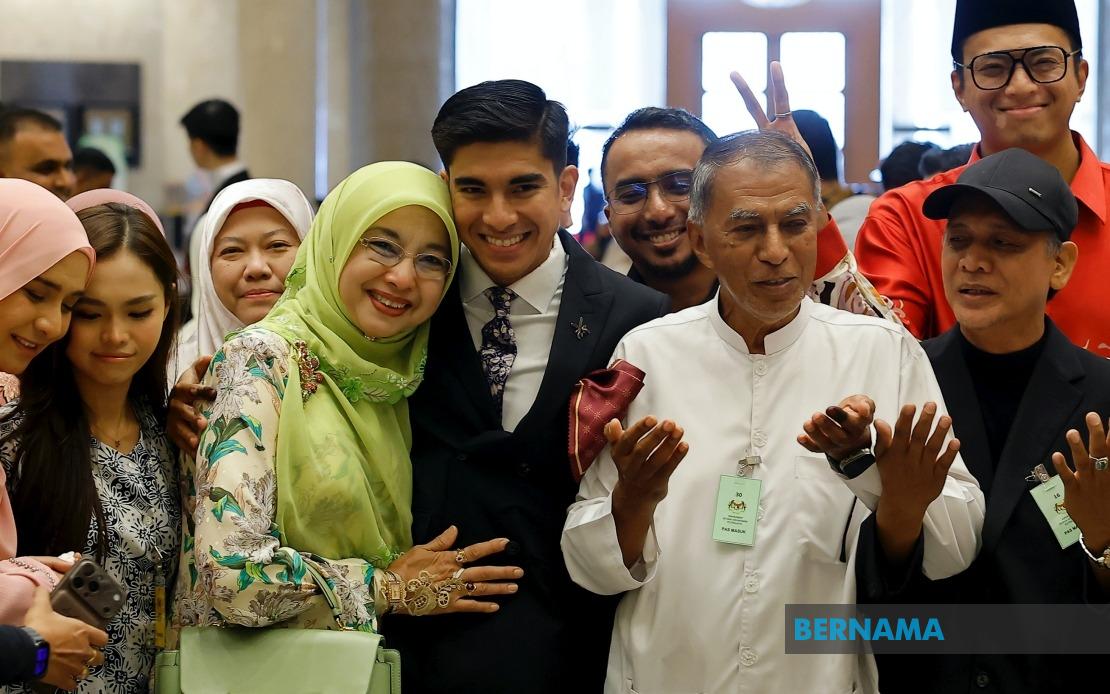
The Muar Member of Parliament Syed Saddiq Syed Abdul Rahman has emerged victorious from a gruelling six-year legal battle after the Federal Court today acquitted him of all charges. The 33-year-old, visibly relieved at the Palace of Justice in Putrajaya on July 13, performed a sujud syukur with his family to mark the momentous court decision, which dismissed four counts of abetting criminal breach of trust, misappropriation of property and money laundering relating to funds from Angkatan Bersatu Anak Muda (Armada).
The overturned charges represented a significant chapter in Malaysian legal proceedings, spanning from 2018 when the allegations first surfaced through multiple court hearings across the tribunal hierarchy. For Syed Saddiq, the journey through the judicial system became a test not only of legal argument but of personal resilience and political standing. Speaking candidly to reporters, he reflected on how the extended ordeal had reverberated beyond his immediate circumstances, touching his family members, close associates, and the wider political community. The former youth and sports minister characterised the experience as formative, one that deepened his conviction in the principles underlying democratic governance and rule of law.
In his statement at the Palace of Justice lobby, Syed Saddiq articulated a philosophy grounded in moral conviction, suggesting that courage derives from knowing one's cause is just. He framed today's judgment as validation of that principle, a moment when persistence and unwavering integrity had navigated him through what appeared at moments to be an insurmountable legal labyrinth. His comments carry particular weight in Malaysia's contemporary political climate, where judicial independence has occasionally drawn scrutiny. By positioning his acquittal as a vindication of institutional strength, Syed Saddiq implicitly endorsed the court system while suggesting that integrity in legal institutions forms the bedrock upon which national stability rests.
The six-year span of this legal contest carries deeper implications for Malaysian politics and governance. Cases of this duration, involving public figures and questions of financial mismanagement, typically generate substantial political discourse and public interest. For Syed Saddiq specifically, the charges had shadowed his career during a period when he was establishing himself within Malaysian political circles. Now, with the acquittal secured through the highest court, he regains substantial political latitude that the legal cloud had constrained. This resolution comes at a juncture when younger political voices are increasingly prominent in Malaysian public life, and Syed Saddiq's emergence from legal proceedings strengthens his position within that cohort.
In remarks that suggest a momentary stepping back from the intensity of political engagement, Syed Saddiq indicated his intention to redirect focus toward family and personal affairs. He acknowledged that while he remains committed to his MUDA party membership, he would defer decisions about immediate political advancement. This measured response contrasts with the triumphalism that sometimes accompanies legal vindications in political contexts. Rather than immediately leveraging the acquittal for political gain, he chose to emphasize restoration of personal equilibrium and family time—a notably measured approach that may enhance his standing among constituents seeking stability and principle-driven leadership.
The Muar MP's reference to pending parliamentary responsibilities indicates that his immediate obligations remain anchored in legislative duties despite his personal circumstances. He signalled plans to return to Parliament following his statement, underscoring that while celebrating the court's decision, he recognises the continuing demands of elected office. Simultaneously, he referenced intention to convene with Muar constituents, suggesting that maintaining connection with his electoral base remains a priority even during this period of personal recalibration.
Family dimensions feature prominently in Syed Saddiq's public remarks following the verdict. The endorsement from his parents to proceed with wedding arrangements signals that the legal conclusion permits him to transition toward major personal milestones that had presumably been deferred throughout the prolonged proceedings. In Malaysian society, where family relationships and generational approval carry significant weight, his parents' blessing—publicly referenced—underscores the personal toll that legal battles of this magnitude exact beyond courtroom arguments and technical legal questions.
The legal team representing Syed Saddiq, led by counsel Datuk Hisyam Teh Poh Teik, expressed gratitude toward the judicial panel and acknowledged the client's confidence throughout the extended litigation. This expression of professional satisfaction reflects the significance attorneys attach to complex cases spanning multiple court levels and years of preparation. The acknowledgment of Syed Saddiq's family's trust emphasises the partnership between legal representatives and clients in navigating protracted judicial processes where emotional resilience proves as essential as technical expertise.
Authorities through the prosecution office indicated measured acceptance of the Federal Court's judgment. Deputy Public Prosecutor Datuk Wan Shaharuddin Wan Ladin confirmed that the prosecution had not yet determined whether to pursue judicial review, indicating deference to the Attorney General's forthcoming decision. This procedural stance suggests that while the prosecution maintains theoretical options for further appeal, the immediate inclination favours acceptance of the appellate court's ruling. For Malaysian jurisprudence and broader governance processes, such prosecutorial restraint in the face of adverse verdicts demonstrates institutional acceptance of hierarchical court authority and final judgments.
The implications of this acquittal extend beyond individual vindication to encompass broader questions about charging standards, prosecutorial decision-making, and the evidentiary foundation underlying complex financial crime allegations. When cases spanning six years ultimately result in complete acquittal at the highest court level, questions inevitably arise regarding the original investigation and charging process. For Malaysian governance structures, such outcomes occasion reflection on investigative protocols and prosecution guidelines, particularly in cases involving public figures where political dimensions may intersect with criminal allegations.
Syed Saddiq's articulation of lessons drawn from his legal ordeal emphasises the importance of maintaining principled positions even when circumstances appear hopeless. This message resonates within Malaysian political and civic contexts where institutional challenges sometimes tempt compromise. His framing of institutional trust—particularly toward judicial structures—serves as implicit endorsement of Malaysia's constitutional order despite occasional controversies surrounding judicial matters. The emphasis on placing confidence in established institutions, coupled with personal integrity, offers a philosophical perspective aligned with democratic governance principles.
Moving forward, Syed Saddiq's position within Malaysian politics has been substantially reconstituted through this Federal Court decision. The removal of legal encumbrance permits him to engage more fully in legislative and political activities without the constraint of pending charges or uncertain legal outcomes. Whether this acquittal catalyses greater political prominence or facilitates a period of consolidation remains contingent on his own strategic choices and broader political developments within his party and across Malaysian electoral politics. What remains clear is that after six years of litigation, Malaysia's judicial system has delivered a complete acquittal, affirming once again that the independence of courts and respect for legal processes constitute essential pillars of national strength.

