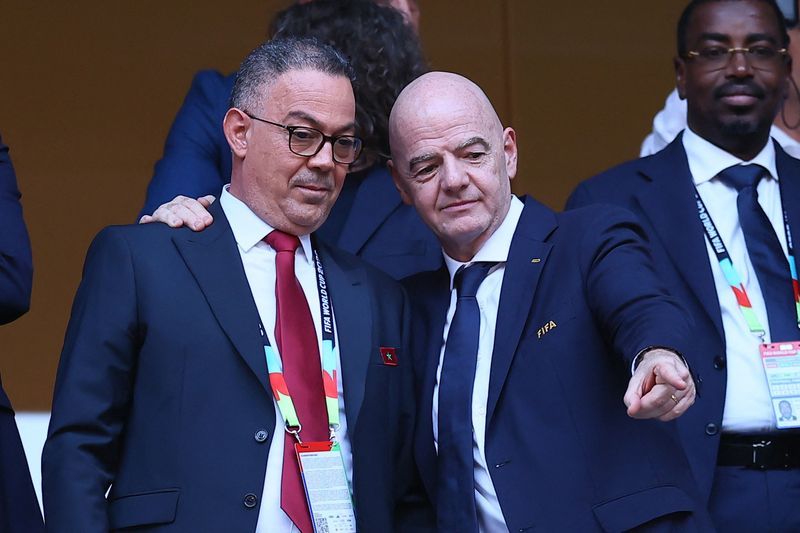
Gianni Infantino is banking on African support to survive a mounting leadership crisis at FIFA, with prominent administrators from the continent's 54 member nations signalling backing for the embattled president as he prepares for a crucial re-election battle next March. The show of solidarity from Africa's football hierarchy comes after Infantino abandoned a controversial scheme to monetise future World Cup broadcasting rights, a move that sparked sharp rebukes from rival confederations but has not dented enthusiasm among CAF's most influential figures.
The backing emerged ahead of an executive committee meeting for the Confederation of African Football, where members reviewed the shelved plan to raise $4.2 billion through a new commercial entity that would have given investors a stake in World Cup revenues. Five of Africa's most prominent football leaders—including CAF Vice President Fouzi Lekjaa of Morocco and fellow FIFA Council members Hany Abo Rida of Egypt, Hamidou Djibrilla of Niger, and Ahmed Yhaya of Mauritania—released carefully coordinated statements endorsing Infantino and welcoming his decision to scrap the initiative. The unified messaging underscores a carefully orchestrated effort to demonstrate continental support at a moment when Infantino faces unprecedented isolation from other global football regions.
The contrast between African and non-African responses to the controversy is striking. Asia, Europe, and CONCACAF, which governs football across North and Central America and the Caribbean, all publicly declared a loss of confidence in Infantino's leadership over the weekend. Yet the Confederation of African Football has maintained strategic silence, refusing to issue formal condemnation and instead allowing individual leaders to shape the narrative on their own terms. This restraint suggests that CAF sees political advantage in appearing flexible and open to dialogue, rather than joining a coordinated international rebuke that might diminish Africa's negotiating position within FIFA's governance structure.
Infantino's relationship with African football has long been characterised by financial incentives that have proven transformative for the continent's relatively under-resourced national associations. Since assuming FIFA's presidency in 2016, he dramatically expanded development funding through the FIFA Forward programme, doubling payments to member federations and establishing baseline guarantees of $8 million per four-year cycle for each of FIFA's 211 member associations. This largesse represents a fundamental shift from FIFA's historical posture toward African nations, which received virtually no development support from world football's governing body prior to Infantino's era, even though the Confederation of African Football formally endorsed FIFA's previous president as a candidate decades earlier.
The financial dependency that Infantino cultivated has created a structural advantage for his candidacy in African countries where government budgets are stretched thin and football development requires external resources. Officials from smaller and poorer nations emphasise the existential importance of FIFA money to their competitive viability. Saïd Ali Athouman, president of the Comoros Football Federation, articulated this plainly when discussing the obstacle of obtaining domestic sponsorship and how wealthy nations enjoy inherent advantages through superior government spending on sporting infrastructure and medical facilities. Similarly, Fleetwood Haiya, president of Malawi's football association, highlighted how his government cannot simultaneously fund healthcare and competitive football programmes, making FIFA's grants essential to maintaining even basic competitive standards.
The strategy of using financial patronage to secure political loyalty in FIFA elections has roots extending back decades. Sepp Blatter, Infantino's predecessor, first successfully employed this tactic when he distributed development funding through what became known as the Goal Project while campaigning against incumbent Lennart Johansson in 1998. Blatter's largesse toward previously neglected African nations proved decisive in securing their electoral support, establishing a precedent that Infantino has refined and expanded substantially. By increasing the scale and consistency of development payments under the rebrand of FIFA Forward, Infantino has intensified African members' reliance on FIFA revenue while simultaneously creating a perception that his departure would diminish the financial flows to which they have become accustomed.
The personal relationships that Infantino has cultivated with influential African leaders add another dimension to his continental support. Veron Mosengo-Omba, recently elected president of the Democratic Republic of Congo's football federation and a former CAF general secretary, studied alongside Infantino at university in Switzerland and has emerged as a vocal supporter. Mossengo-Omba's backing carries symbolic weight beyond his institutional position, suggesting that Infantino has invested in building genuine personal networks alongside transactional financial relationships. The Confederation of African Football itself remains formally neutral despite the individual endorsements, maintaining the option of either supporting or distancing itself from Infantino depending on how political calculations evolve over the coming months.
The timing of these endorsements reflects careful political choreography. Leading African officials released their statements of support immediately before CAF's executive committee meeting and well ahead of any formal confederation-wide pronouncement, effectively shaping the conversation around Infantino's viability without committing the broader organisation. By having prominent figures act independently while the formal governance structure remains noncommittal, African football's leadership has preserved flexibility to adjust positions if the political landscape shifts dramatically. The abandoned World Cup revenue scheme remains formally on the meeting agenda, though no guarantee exists that CAF will issue any official statement regarding either the failed initiative or Infantino's candidacy.
For Malaysia and other Southeast Asian nations, the unfolding dynamics within FIFA carry particular significance. The continent's football federations face similar resource constraints to their African counterparts and benefit substantially from FIFA's development funding and capacity-building programmes. Should Infantino's electoral prospects brighten through consolidated African support, he would enter the March election with a significant bloc of votes from a confederation representing 54 nations. This scenario would fundamentally alter the calculus for other regional confederations, potentially influencing how Asian nations—which have not yet formally coordinated a response—position themselves ahead of the presidential election.
The broader implications extend to questions about FIFA governance and whether financial redistribution mechanisms should drive electoral outcomes for the world's most powerful sports administrator. Infantino's ability to sustain presidential power through targeted development spending raises concerns about whether less wealthy member nations can exercise genuine electoral autonomy or whether their votes are effectively mortgaged through dependency relationships. The contrast between African nations' apparent willingness to accept his leadership and the swift rejection from better-resourced confederations suggests that FIFA's power structures increasingly reflect global economic inequalities, with poorer nations' electoral influence explicitly purchased through development grants.
As Infantino navigates toward March's election, the solidifying African support provides a crucial counter-narrative to the public criticism from other regions. The strategy of cultivating African backing through sustained financial generosity demonstrates how institutional power within FIFA can be maintained even during moments of international controversy, provided that key blocs of member nations perceive tangible benefits from the incumbent's continued leadership. Whether this continental coalition will prove sufficient to secure re-election against potential challengers remains uncertain, but the coordinated African messaging indicates that Infantino has successfully converted development funding into durable political capital on the world's most competitive sports stage.

