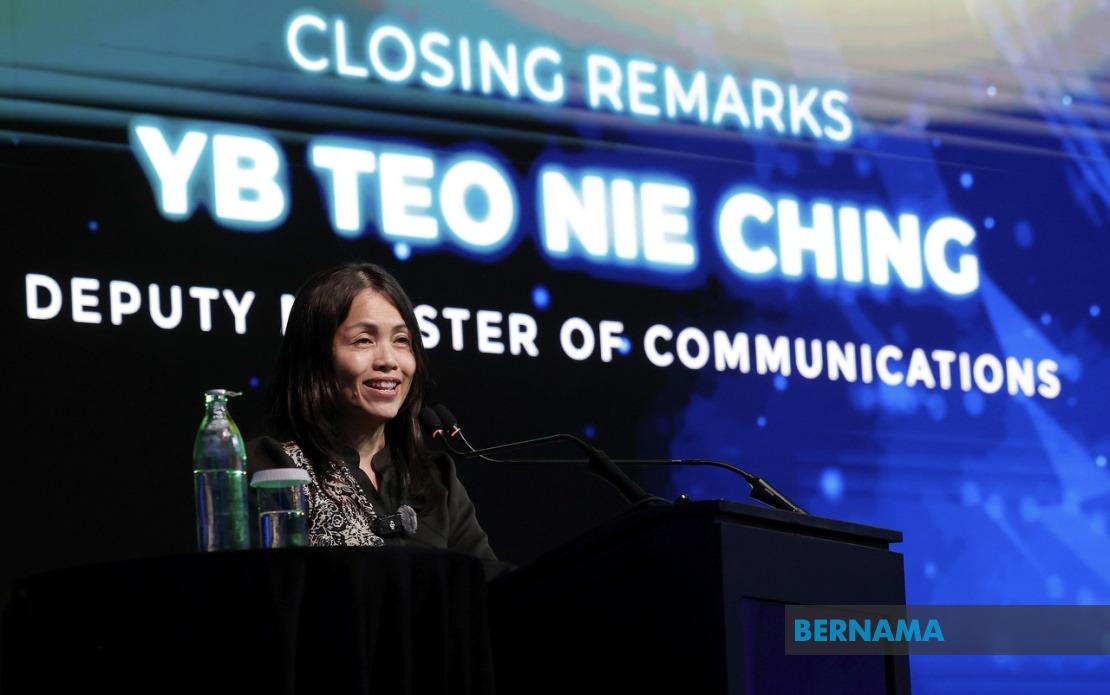
Malaysia's approach to digital governance must pivot toward greater accountability and a framework that places public welfare at its core, Deputy Communications Minister Teo Nie Ching said today at the conclusion of the International Regulatory Conference 2026. Her remarks underscore a growing recognition within government circles that the rapid expansion of digital services and online platforms requires fundamentally different oversight mechanisms than those traditionally applied to telecommunications and media sectors.
Teo's intervention, delivered at the conference's closing session, challenged the prevailing assumption that technological sophistication alone drives progress in the digital economy. Instead, she framed digital development as a social contract in which innovation must ultimately serve the public interest and earn citizen confidence. This philosophical repositioning reflects mounting global concerns about the societal consequences of unchecked digital expansion, from data privacy breaches to algorithmic bias and online misinformation campaigns that have destabilised democratic processes across multiple countries.
The scale of Malaysia's content moderation challenge became starkly apparent through data presented by Teo during her address. Between January 2022 and mid-July 2026, the Malaysian Communications and Multimedia Commission had issued 1.2 million removal requests to social media platforms, resulting in the successful takedown of approximately 1.138 million pieces of harmful content. These figures underscore the sheer volume of problematic material circulating on digital platforms operating within Malaysia's jurisdiction, from hate speech and disinformation to content exploiting minors and inciting violence.
The acceleration in recent months reveals the intensifying nature of the problem. In just the first half of 2026 alone, the MCMC issued 377,502 removal requests, representing nearly 78 percent of all requests made throughout the entire year 2025. This escalation translates to approximately 1,900 daily removal requests, a pace that illustrates both the effectiveness of Malaysia's detection systems and the relentless rate at which harmful content proliferates. Platform compliance has remained reasonably strong, with removals reaching 350,332 items during the same January-to-July 2026 period, though the gap between requests issued and content actually removed suggests ongoing challenges in enforcement and verification.
What distinguishes Teo's intervention is her explicit rejection of a purely regulatory approach to digital governance. She argued forcefully that no set of rules or government mandates can unilaterally solve the complex problems created by digital platforms' globalised operations and the semi-anonymous nature of online interactions. This acknowledgment represents a significant departure from the command-and-control regulatory models that have dominated telecommunications policy in Malaysia and across Southeast Asia for decades, suggesting a recognition that digital governance requires fundamentally different tools and stakeholders.
Instead, Teo advocated for a multi-stakeholder ecosystem encompassing social media platforms, government regulators, educational institutions, local communities, and broader industry participants. The emphasis on collective responsibility places particular weight on platforms themselves to embed safety mechanisms into their system architecture from the design phase rather than implementing reactive measures after harm has already occurred. This preventative orientation aligns with emerging international best practices, such as the Digital Services Act in the European Union, though it represents a novel emphasis in Malaysia's regulatory discourse.
The conference itself, now in its third iteration, has evolved into a significant regional convening space for discussing digital governance challenges. Titled "Shaping the Next Digital Era: Regulation, Resilience and Trust," the gathering brings together national regulators, industry executives, academic experts, and civil society representatives to examine how different jurisdictions are navigating the tension between innovation and protection. For Malaysia, hosting this event positions the country as a thoughtful voice in regional digital policy discussions, particularly as Southeast Asian nations grapple with managing platforms headquartered in the United States, China, and other global technology hubs.
The emphasis on building "resilience" into digital systems reflects lessons learned from successive waves of online harms over the past decade. Financial fraud schemes, manipulation campaigns during elections, harassment targeting specific communities, and coordinated disinformation networks have demonstrated that reactive removal of content, while necessary, addresses only symptoms rather than underlying vulnerabilities. Resilience suggests instead developing digital literacy, platform transparency, user authentication mechanisms, and community-based reporting systems that distribute the responsibility for maintaining safe online spaces more broadly.
Teo's framing of the relationship between technology and accountability as co-evolving rather than existing in tension offers important guidance for policymakers across the region. She argued that the future shape of digital innovation will be determined not merely by what engineers and entrepreneurs invent, but by the governance choices societies make about how those innovations are deployed and whether they serve concentrated private interests or dispersed public benefit. This formulation invites deeper questions about who controls digital infrastructure, how algorithmic decisions are made and reviewed, and what recourse exists when platform operations cause demonstrable harm.
The practical implications of these principles for Malaysia remain to be seen in proposed regulatory frameworks and enforcement strategies. The MCMC's high volume of content removal requests demonstrates active monitoring capacity, yet questions persist about whether current approaches adequately address root causes of online harms or merely manage their most visible manifestations. Furthermore, the balance between protecting vulnerable users and preserving the open communication channels that make digital platforms valuable for legitimate speech, activism, and commerce continues to require careful calibration.
Regional observers will be watching how Malaysia's stated commitment to people-centred digital governance translates into concrete policy measures. Other Southeast Asian nations, many facing similar challenges with misinformation, online harassment, and platform accountability, may look to Malaysia's approach as a potential model. The principle that technology must earn public trust through demonstrable safety and fairness, rather than expecting acceptance based on innovation alone, resonates across a region where digital platforms' penetration has far outpaced regulatory capacity and where public confidence in online institutions remains fragile.

