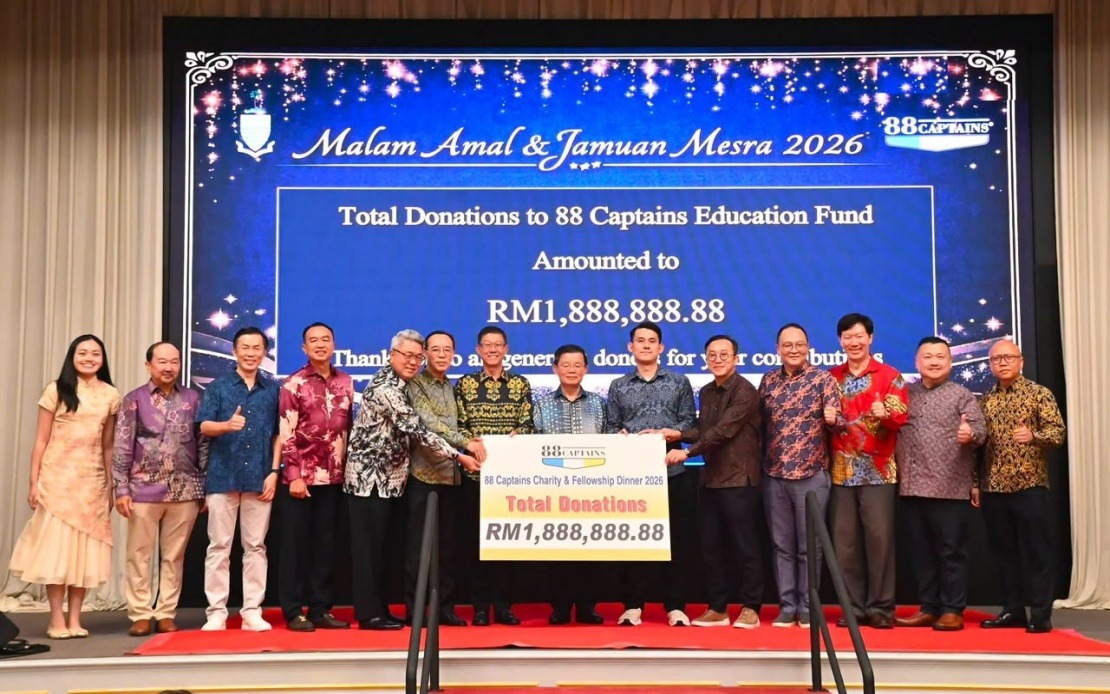
The 88 Captains charitable organisation has distributed more than RM1 million in scholarships across 44 students attending five educational institutions in Penang and the Northern Region, marking a significant push in the state's talent development infrastructure. The initiative reflects broader efforts to address Malaysia's persistent challenge of bridging the skills gap between graduates and industry requirements while simultaneously lifting financial barriers for deserving young people.
Datuk Seri Dr Ooi Eng Hock, the organisation's chairman, framed the scholarship programme as extending well beyond simple financial assistance. His vision emphasises character formation and social responsibility, positioning education funding as a catalyst for cultivating leaders who will eventually contribute meaningfully to their communities. This philosophical approach aligns with Malaysia's broader push towards developing not just skilled workers but morally grounded citizens capable of navigating complex contemporary challenges.
A cornerstone of 88 Captains' strategy lies in its Apprenticeship, Internship, Reskilling and Upskilling (AIRU) programme, which debuted last year at Universiti Sains Malaysia. This initiative directly addresses one of Southeast Asia's most pressing labour market issues: the disconnect between what universities teach and what employers actually need. By creating structured pathways for students to engage with industry leaders, the programme aims to demystify workplace expectations and equip graduates with realistic career trajectories.
The 88 Captain Young Fellowship has become the operational nerve centre of this bridge-building effort. Drawing exceptional scholars from USM, ViTrox College, Tunku Abdul Rahman University of Management and Technology, and INTI International University, the fellowship creates a two-way dialogue between academia and industry. These young representatives meet directly with corporate decision-makers and entrepreneurial founders to understand market realities while simultaneously advocating for graduate interests, including the emerging consensus around RM4,000 as a minimum starting salary benchmark.
Chow Kon Yeow's endorsement of 88 Captains' work carries particular weight in Penang's development narrative. The Chief Minister explicitly connected the organisation's initiatives to Penang's economic diversification strategy, identifying education-industry partnerships as critical infrastructure for the state's ambitions in advanced manufacturing, semiconductors, artificial intelligence and digital economy sectors. This positioning transforms scholarship and talent development from philanthropic activity into economic strategy.
The organisation's fundraising capacity demonstrates sustained community support for these initiatives. The 88 Captains Annual Charity Dinner 2026 raised RM1.89 million, indicating strong engagement from both public sector leaders—evidenced by Penang Governor Tun Ramli Ngah Talib's attendance—and private donors. This financial momentum reflects confidence that targeted investment in human capital yields measurable returns for regional competitiveness.
Beyond scholarships, 88 Captains has implemented tangible infrastructure improvements across Penang's education system. Over four years, the organisation has distributed smart televisions to primary and secondary schools and established 5G Education Digital Libraries in 88 schools. These initiatives acknowledge that digital inequality remains a significant barrier in Malaysia's education landscape, particularly in peripheral areas. The support for the Special Education Integration Programme (PPKI) further demonstrates commitment to inclusive talent development that doesn't exclude students with disabilities.
A newly launched initiative addressing mental health in schools through AI-assisted early education represents 88 Captains' responsiveness to emerging social challenges. The timing of this Joint Mental Health Development programme immediately following the Anti-Bullying Act 2026's introduction demonstrates sophisticated understanding that legislation alone cannot solve behavioural problems. Chow's articulation of this reality—that prevention requires coordinated effort from schools, families and communities—reflects mature policy thinking about education's holistic demands.
The responsible use of artificial intelligence in educational settings presents both opportunity and challenge for Malaysian institutions. As AI tools increasingly mediate learning experiences, ensuring ethical deployment and protecting young people from algorithmic harms has become a critical governance issue. 88 Captains' proactive stance on this front positions it ahead of many regional peers still grappling with basic digital infrastructure.
For Malaysian readers, the 88 Captains model offers instructive lessons about collaborative social investment. The organisation functions as a bridge between philanthropic impulse and systemic change, channelling private resources toward public goods while maintaining focus on measurable outcomes. Its emphasis on scholarship recipients eventually giving back to society creates a multiplier effect where today's supported students become tomorrow's mentors and community leaders.
The initiative also highlights Penang's particular advantages in talent development. As an established manufacturing and technology hub with competitive educational institutions and engaged private sector leadership, the state possesses ecosystem conditions that amplify the impact of targeted investments. This suggests that similar models, properly adapted, could succeed elsewhere in Malaysia where equivalent institutional density and stakeholder commitment exist.
Looking forward, the sustainability of 88 Captains' impact depends on maintaining momentum beyond headline-generating events. The transition of supported graduates into productive employment, their retention in the Northern Region's economy, and their eventual transition to mentorship roles will determine whether these scholarships represent genuine talent pipeline development or temporary financial relief. Success metrics should increasingly focus on long-term employment outcomes, earning trajectories and community contribution rather than scholarship distribution alone.
The 88 Captains phenomenon ultimately reflects Malaysian society's growing recognition that talent development cannot be delegated solely to government. Private initiative, when strategically aligned with public sector priorities and informed by genuine industry partnership, can accelerate the human capital formation that sustained regional competitiveness demands in an increasingly knowledge-intensive global economy.

