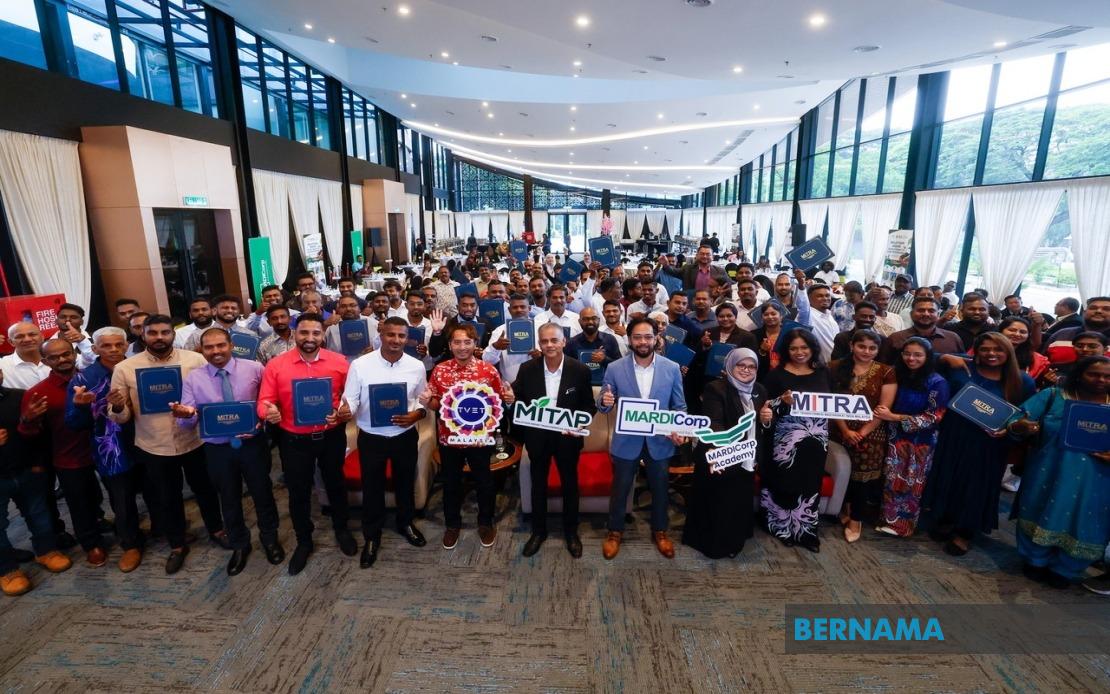
Putrajaya has formally distributed RM30,000 Agricultural Transformation Grants to 68 young entrepreneurs from the Indian community as part of an ambitious push to diversify rural livelihoods and strengthen agricultural participation among underrepresented groups. The Malaysian Indian Transformative Agri Programme (MITAP), administered by the Malaysian Indian Community Transformation Unit (MITRA) in partnership with MARDICorp, represents a strategic effort to channel capital and expertise toward first-generation farmers seeking to establish viable agricultural enterprises.
The initiative addresses a longstanding gap in agricultural participation among Malaysia's Indian community, historically concentrated in urban professions and plantation labour rather than independent farming ventures. By deploying the Agricultural Transformation Grants (GTP) through MITAP, the government aims to reverse this trend and build a new cohort of competitive, knowledge-enabled agropreneurs capable of contributing meaningfully to domestic food security and rural economic development. The scheme reflects broader recognition that sustainable agricultural growth depends on inclusive participation and active engagement from all major demographic groups.
MITA director-general K. Raveendran Nair outlined the programme's dual architecture during the grant presentation ceremony. QuickWin MITRA distributes direct capital grants of up to RM30,000 to qualifying young agropreneurs—a mechanism designed to lower entry barriers and enable rapid business establishment. The Young Agropreneur Programme (PUM), running parallel to the grant component, operates as an intensive 10-month capacity-building initiative focusing on agricultural knowledge, business management, and technical skills. Eight participants have thus far completed the PUM curriculum and are now transitioning into operational farming phases.
The breadth of supported agricultural activities demonstrates MITAP's sector-agnostic approach to entrepreneurship development. Recipients are pursuing ventures across food crop production, dairy cattle management, beekeeping operations, oyster mushroom cultivation, freshwater fish farming, and food processing technology. This diversity reflects both market opportunities and the heterogeneous skill sets and interests among participating young farmers. By supporting multiple production pathways rather than mandating a single agricultural model, MITAP encourages specialisation and comparative advantage while building systemic resilience through sectoral diversification.
The significance of the RM30,000 grant quantum should not be underestimated in the context of Malaysian smallholder agriculture. For young entrepreneurs without substantial inherited agricultural assets or family capital, this injection provides sufficient working capital to acquire essential inputs—breeding stock, equipment, seeds, or initial infrastructure—and sustain operations through the critical pre-revenue phase. The grant structure thus functions as a direct subsidy to overcome capital access barriers that have historically excluded marginalised communities from farming.
MARDICorp managing director Mohamad Zamir Ghazali emphasised that grant distribution represents merely the beginning of a sustained support ecosystem. The corporation commits to ongoing technical mentorship covering production optimisation, market linkage facilitation, and downstream product development. Critically, Ghazali highlighted the networking function of MITAP—the programme deliberately aggregates young agropreneurs into association structures, creating collective visibility to government procurement, subsidy, and development programmes. This collective positioning amplifies individual farmer influence and reduces vulnerability to market volatility that often afflicts isolated smallholders.
The technology transfer component warrants particular attention, as it addresses one of Malaysian agriculture's persistent productivity challenges. Smallholders frequently operate with outdated techniques, limited access to improved varieties or breeds, and minimal exposure to efficiency-enhancing innovations. By embedding technology transfer into MITAP's support architecture, the programme aims to leapfrog traditional adoption timelines and enable participating farmers to operate at contemporary productivity standards from inception. This approach contrasts sharply with ad hoc extension services and positions MITAP participants for faster profitability and competitiveness.
Some MITAP recipients have already formalised association membership, signalling early institutional integration and potential for collective marketing and advocacy. These emerging farmer cooperatives could eventually function as nodes in broader value chains, reducing transaction costs and improving bargaining power relative to input suppliers and output buyers. The transformation from isolated small producers to networked enterprise clusters represents the implicit theory of change underpinning MITAP's design.
For Malaysian policymakers, MITAP reflects a deliberate strategy to decouple agricultural opportunity from ethnic or social hierarchies and explicitly engineer diversity in farming demographics. This approach carries implications beyond Indian community participation—it signals official commitment to making agriculture viable as a profession for ambitious young Malaysians regardless of background. The success of MITAP will likely influence whether similar models are extended to other communities and regions underrepresented in agricultural entrepreneurship.
The eight young farmers who have completed PUM training now face the critical transition from classroom to commercial production. Their performance over the next 18-24 months will substantially determine MITAP's ultimate developmental impact. Successful farms will generate proof-of-concept evidence, attract peer interest, and justify continued government investment. Conversely, high failure rates would suggest that capital grants, while necessary, remain insufficient without complementary market support, price stabilisation, or sophisticated value chain integration. The coming months will reveal whether MITAP has adequately equipped its cohort to thrive in competitive, increasingly globalised agricultural markets.

