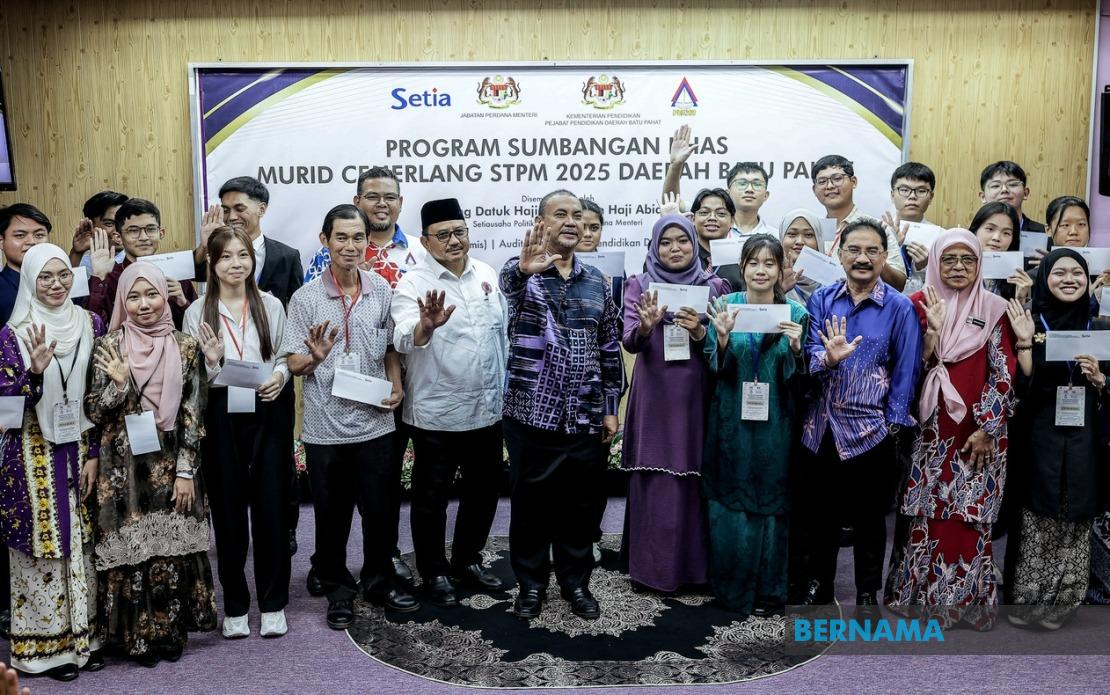
The Prime Minister's Office has distributed special financial recognition to 214 outstanding STPM students across Batu Pahat, honouring their academic achievements and signalling government investment in Malaysia's brightest young minds. The initiative, unveiled at a ceremony held at the Batu Pahat District Education Office, extends across 16 secondary institutions within the district and represents a targeted effort to support meritorious students as they prepare for tertiary education.
Datuk Azman Abidin, Political Secretary to the Prime Minister, oversaw the awards presentation and emphasised that the programme serves a dual purpose: recognising exceptional student performance while simultaneously providing tangible encouragement for recipients to pursue university studies. The contributions underscore government commitment to nurturing talent at a critical juncture in Malaysian students' educational trajectories, when financial considerations often influence decisions about higher education accessibility.
The recognition extends beyond monetary assistance; officials framed the awards as a broader statement of government care toward the education sector and student welfare. Datuk Azman articulated that such initiatives demonstrate the administration's intention to empower young Malaysians through education while celebrating their accomplishments. The programme's design reflects an understanding that financial barriers frequently impede capable students from accessing quality tertiary opportunities, a persistent challenge within Malaysia's education landscape.
Authorities indicated that programme continuity depends on budgetary availability, with expansion to additional districts and regions under consideration. This conditional commitment suggests the government views the initiative as promising but recognises fiscal constraints that may limit scaling. Malaysian education stakeholders have long advocated for sustained funding mechanisms supporting high-achieving students from less affluent backgrounds, making the potential expansion of this scheme significant for equitable access to higher education.
Among the recipients was Afida Auni Airulnizam, a 20-year-old former student of Sekolah Menengah Kebangsaan Tun Sardon in Rengit, who expressed deep appreciation for the recognition. She characterised the contribution as validating her academic efforts while simultaneously strengthening her resolve to excel in university study. For Afida, the award carried particular weight given her family circumstances as the younger of two siblings, with her older brother's university experience serving as familial inspiration for her own tertiary aspirations.
Afida's intended path toward sports science reflects Malaysia's growing emphasis on developing talent in emerging professional fields beyond traditional academic disciplines. Her ambition to follow her brother into higher education, supported by this award, illustrates how targeted financial recognition can reinforce family educational trajectories and broaden socioeconomic participation in advanced learning. Such examples demonstrate the multiplicative effect of recognition programmes that encourage entire households to prioritise tertiary education as an achievable goal.
A fellow recipient, Muhd Ammar Firdaus Mohd Fadzil, aged 20 and formerly of Sekolah Menengah Kebangsaan Tun Ismail, highlighted the practical financial dimensions of the award. He noted that financial assistance during the pre-university period meaningfully eases preparation burdens for tertiary study, a sentiment that resonates across Malaysia's middle and lower-income student populations. His perspective underscores the genuine economic challenges students confront when preparing applications, undertaking entrance examinations, and arranging accommodation for university study.
The Batu Pahat initiative addresses persistent inequities within Malaysia's education system, where family financial capacity disproportionately influences tertiary access despite widespread academic capability among students nationwide. By concentrating recognition across multiple schools within a single district, the programme distributes benefits beyond elite institutions, potentially reaching capable students from under-resourced areas who might otherwise remain unsupported. This geographic approach reflects contemporary understanding that talent exists across all communities and schools, though opportunity access remains unevenly distributed.
Such programmes carry particular significance for Southeast Asia's broader education agenda, as regional economies increasingly compete for skilled workforces in technology, healthcare, engineering, and professional services. Malaysia's investment in recognising and supporting high-achieving STPM students aligns with national workforce development objectives, signalling that government prioritises converting academic excellence into productive human capital contribution. The award ceremony itself functions as public acknowledgment that educational achievement merits tangible state support, potentially normalising similar initiatives across other Malaysian states and territories.
The expansion potential flagged by officials suggests government receptiveness to scaling successful education support models, particularly those addressing the critical transition period between secondary and tertiary study. If sustained and expanded, such recognition programmes could establish important precedent for systematic state investment in talented students, particularly those from families lacking established tertiary education networks. However, realisation of this potential depends substantially on budgetary priorities and political commitment across electoral cycles, creating uncertainty about programme longevity and ultimate reach throughout Malaysia's diverse student population.

