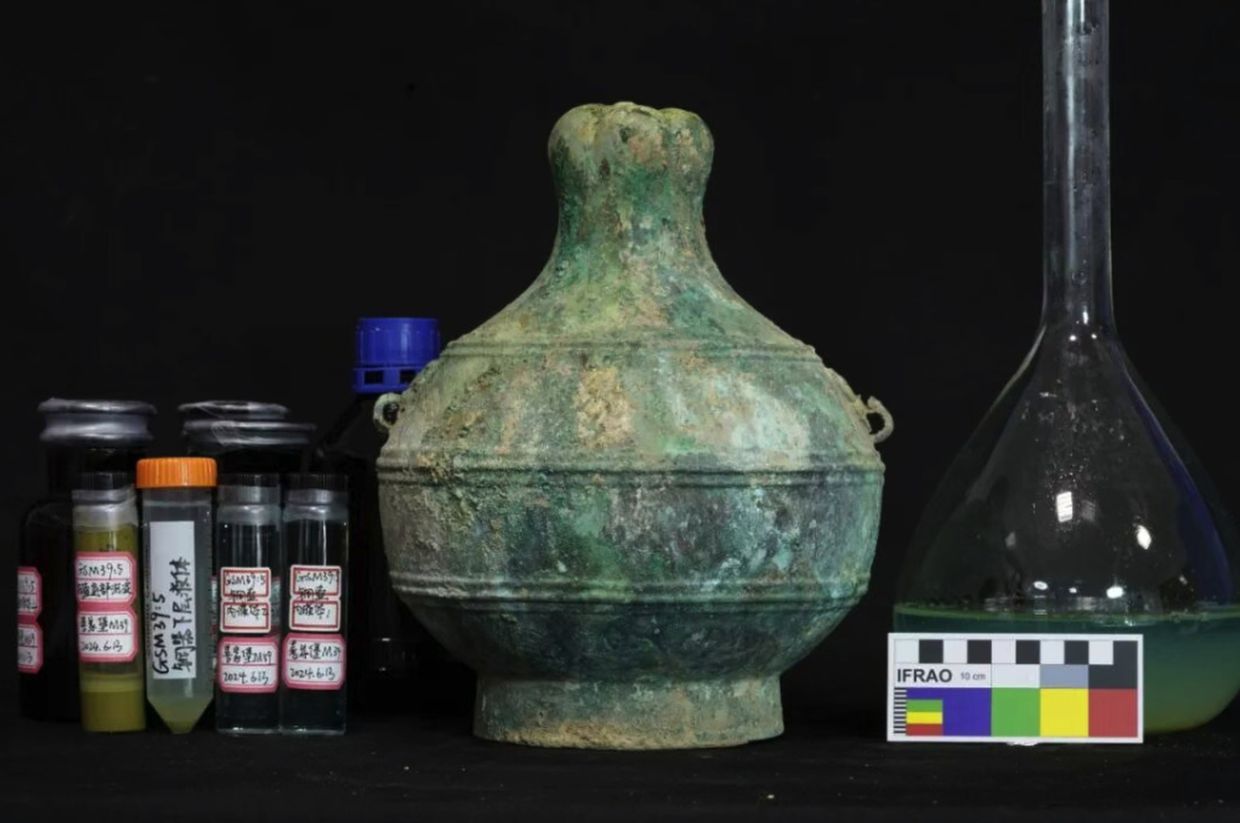
Archaeologists excavating a cemetery near the Warring States-era Qin Great Wall in Gansu province have uncovered a bronze wine vessel so meticulously sealed that its contents remained substantially intact after more than two millennia—a discovery that provides rare documentary evidence of ancient grain-based brewing technology in northern China. The find, unearthed at the Shanjiabao cemetery approximately two kilometres from the defensive fortification, represents the most comprehensively preserved alcoholic beverage relic from the Qin period yet publicly reported in China, according to research published in the Journal of Archaeological Science.
The 183 excavated tombs at the site, with 179 demonstrating Qin cultural characteristics, appear to constitute a communal burial ground for military personnel and civilian dependents stationed at the garrison posts dotting the 170-kilometre stretch of defensive wall. These fortified outposts served critical functions during an era when border security required permanent populations of soldiers and their families, making the cemetery a valuable archaeological window into the daily lives and material culture of frontier communities. The discovery patterns suggest this was not an elite burial ground but rather a representative cross-section of the diverse populations maintaining the frontier infrastructure.
Inside Tomb No. 39, researchers recovered approximately 3,740 millilitres of ancient liquid residue from a distinctive bronze vessel with a garlic-head-shaped design characteristic of Qin craftsmanship. Wang Xiaoyang, director of the Shanjiabao archaeological project at the Ningxia Institute of Cultural Relics and Archaeology, explained that the container employed a sophisticated double-layer sealing mechanism comprising an inner textile lining combined with an outer protective coating of organic clay. This engineering approach proved remarkably effective, preserving the wine's chemical composition sufficiently for modern analytical investigation—a technical achievement that suggests ancient winemakers possessed considerable understanding of preservation principles and material properties.
The analysis identified 24 distinct chemical compounds within the liquid, including organic acids and derivatives, amino acids and their derivatives, and carbohydrates. The particular distribution pattern of organic acids closely matched that of naturally aged yellow wine, a finding that conclusively distinguished this beverage from fruit-based wines such as grape varieties and confirmed instead a grain-fermented origin. This chemical fingerprinting technique represents a methodological advance in archaeological beverage studies, permitting researchers to reconstruct brewing practices from compositional data alone.
Particularly significant was the starch residue analysis, which established that over 92 percent of the fermentable grain originated from broomcorn millet—a drought-resistant crop well-suited to the semi-arid climate of northern China and fundamentally different from the rice predominating in southern brewing traditions. This geographical distinction has deep implications for understanding the agricultural foundations supporting military logistics and provisioning strategies during the period. The reliance on millet rather than rice reflects not merely culinary preference but rather the environmental constraints and crop availability patterns of the northern frontier, suggesting that garrisons adapted their food and beverage production to local agricultural capabilities.
China occupies a foundational position in global fermentation history, with evidence suggesting alcoholic beverage consumption dates to the earliest periods of agricultural settlement. However, the trajectory and technical evolution of brewing across different regions of China remains incompletely documented. Recent archaeological discoveries have intensified scholarly interest in identifying regional variations, technological innovation sequences, and the mechanisms through which brewing knowledge propagated through ancient societies. This Qin discovery contributes substantially to filling the Ningxia region's archaeological record during the Warring States period, a transformative era marked by political consolidation and technological advancement.
The excavation team dispatched samples to Northwest University for comprehensive chemical analysis, recognising that deciphering the precise recipe and manufacturing techniques required sophisticated modern laboratory investigation. The collaboration between field archaeologists and analytical chemists exemplifies contemporary approaches to archaeological interpretation, combining traditional excavation documentation with molecular-level investigation. This multi-disciplinary methodology permits far more detailed reconstruction of past technologies than excavation alone could accomplish.
The discovery carries broader implications for understanding supply chains, dietary practices, and cultural traditions within ancient frontier communities. The presence of such carefully sealed, high-quality wine in a soldier's burial suggests not merely that alcoholic beverages featured in garrison life but rather that wine possessed sufficient cultural and personal significance to warrant inclusion in funerary provisions intended to accompany the deceased into the afterlife. This practice reflects sophisticated belief systems and underscores the integration of fermented beverages into the spiritual and material dimensions of Qin frontier society.
For Southeast Asian readers, this discovery illuminates parallel developments in fermented grain beverages across East Asia, a tradition with continuing relevance to contemporary regional food cultures. The technological sophistication evident in Qin-era sealing techniques demonstrates that ancient Asian civilisations possessed advanced materials engineering capabilities comparable to contemporary Mediterranean practices. Understanding these technological lineages provides context for examining continuities and transformations in fermentation traditions across the broader Asian region, potentially clarifying how knowledge systems related to grain processing and beverage production interacted across trade networks and cultural frontiers that characterised the ancient world.

