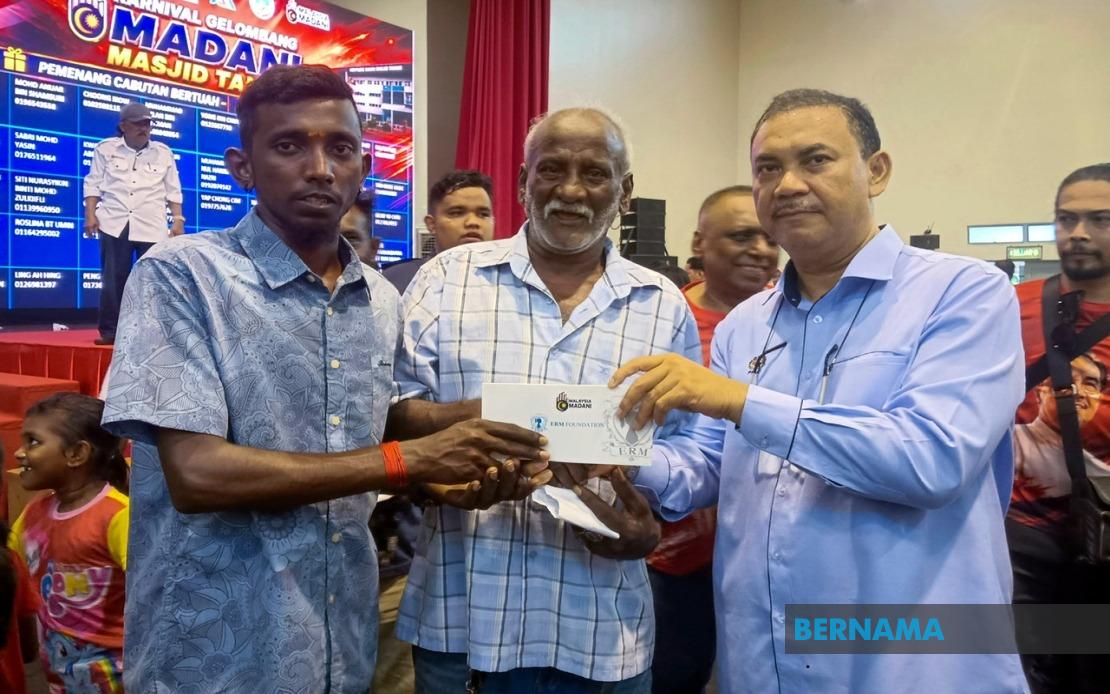
The Gelombang MADANI Carnival in Alor Gajah has extended financial relief to approximately 2,000 economically vulnerable residents across the Masjid Tanah parliamentary constituency through the Sentuhan MADANI Donation initiative. The programme, held at the Masjid Tanah Sports Complex, represented a targeted intervention aimed at supporting Malaysia's lower-income population during challenging economic conditions. Each qualifying recipient walked away with RM200 in direct cash assistance, a sum designed to provide immediate relief for essential household expenses.
Datuk Azman Abidin, the Prime Minister's political secretary, oversaw the donation ceremony and provided details on the distribution framework. The initiative cast a deliberately wide net across five constituent state assemblies operating within the Masjid Tanah electoral division: Kuala Linggi, Lendu, Tanjung Bidara, Ayer Limau, and Taboh Naning. This multi-constituency approach ensured that vulnerable populations across the broader parliamentary area could access support, rather than concentrating resources in a single locality. The targeting strategy specifically prioritised individuals classified within the bottom 40 percent income bracket, commonly referred to as the B40 group, alongside other marginalised segments including persons living with disabilities, elderly citizens, and workers earning below the established income threshold.
The Sentuhan MADANI programme reflects the government's stated commitment to addressing poverty and income inequality through direct cash transfers. Rather than relying solely on larger structural economic reforms or long-term social programmes, the initiative employs an immediate assistance model that acknowledges the pressing daily financial pressures facing Malaysia's most economically constrained households. For many recipients, the RM200 payment represents a significant injection of purchasing power into household budgets stretched thin by rising costs of living, healthcare expenses, and education-related expenditures. This approach has become increasingly common across Southeast Asia as governments seek to demonstrate responsiveness to citizen welfare concerns.
Ramlah Othman, a 63-year-old resident of Tanjung Bidara, articulated the practical value of the assistance to her household circumstances. She noted that the contribution would meaningfully reduce the financial strain of managing daily domestic expenses, a burden that typically intensifies for seniors living on limited or fixed incomes. Her gratitude reflected not merely appreciation for the monetary transfer itself, but recognition that government bodies had acknowledged her economic vulnerability. For elderly residents like Ramlah operating outside the formal employment sector and lacking comprehensive retirement provisions, such targeted interventions can determine whether households maintain adequate nutrition, medication access, and utility payments.
N. Mariappan, a 69-year-old stroke survivor residing in Ladang Sungai Baru, represented another significant beneficiary category within the programme's scope. His experience as a person living with a serious health condition compounds the economic challenges faced by seniors, as ongoing medical expenses, rehabilitation costs, and care requirements consume disproportionate shares of limited household income. Mariappan's participation underscored how the Sentuhan MADANI initiative addresses intersecting vulnerabilities, recognising that disability status and advanced age frequently coincide to create heightened financial need. His observation that the contribution lightened the burden of meeting daily requirements highlighted how even modest cash transfers can have outsized impacts on quality of life for individuals managing chronic health conditions.
The carnival setting for this donation distribution carries symbolic weight beyond the logistical convenience of assembling numerous beneficiaries in a single location. By framing the assistance delivery as part of a broader community celebration rather than a clinical welfare bureaucracy operation, the government attempted to preserve recipient dignity while delivering material support. This approach acknowledges growing sensitivity around how assistance programmes are administered, recognising that the manner of delivery can either reinforce or ameliorate the stigma sometimes associated with means-tested welfare. The carnival context permitted beneficiaries to receive support within a festive environment that celebrated community rather than emphasising individual poverty or dependence.
The Masjid Tanah constituency presents particular relevance for such targeted assistance programmes. Located within Melaka, a state with significant concentrations of lower-income households, the parliamentary area encompasses both urban and rural components with distinct poverty profiles and economic characteristics. Rural constituencies like those represented within the five state assemblies often experience higher rates of unemployment and underemployment compared to urban centres, with agricultural dependence exposing residents to seasonal income volatility. By conducting the initiative across multiple state assemblies rather than concentrating efforts in a single location, authorities acknowledged these varying local economic conditions and ensured that constituencies with particular need received proportionate attention.
The timing of the Gelombang MADANI Carnival reflected broader political communications strategy. The programme name itself invokes MADANI, a concept central to the current government's development narrative, suggesting that assistance to vulnerable populations constitutes a core component of the administration's governance philosophy. By associating direct cash transfers with the MADANI framework, the government positioned welfare support as integral to its modernisation and inclusive development agenda rather than presenting such programmes as temporary crisis responses or politically motivated handouts. This framing carries implications for how Malaysian voters perceive government responsibility for social protection and economic security.
The delivery of assistance through parliamentary constituencies highlights how Malaysia's federal and state political structures shape welfare distribution channels. Rather than centralised national administration, programmes often flow through elected representatives and their constituent service operations. This model permits politicians to maintain direct engagement with beneficiary communities and allows for some customisation of assistance based on local conditions and priorities. However, it also raises questions about consistency of provision across different constituencies and potential variations in implementation depending on political dynamics within particular electoral areas.
For Malaysian policymakers and observers tracking approaches to poverty alleviation, the Sentuhan MADANI initiative represents one component of the government's broader social protection architecture. Direct cash transfers have gained prominence in recent years as evidence from various countries demonstrates their effectiveness at reducing poverty and improving immediate household welfare outcomes. However, they also provoke debate about whether such programmes should serve as permanent features of the social safety net or temporary interventions during periods of heightened economic stress. The scale of the Masjid Tanah programme—reaching 2,000 residents across a single parliamentary constituency—suggests the government views such interventions as substantive commitments rather than token gestures.
The visible expressions of gratitude from beneficiaries like Ramlah Othman and N. Mariappan provided immediate feedback on programme reception. Their appreciation extended beyond simple acknowledgment of financial benefit to recognition that government institutions had registered their economic vulnerability and responded with practical support. For populations often feeling marginalised or overlooked by development processes, such acknowledgment carries psychological and social value alongside material benefits. These individual testimonials became part of the public narrative surrounding the MADANI initiative, shaping how programme effectiveness would be understood and communicated to broader constituencies.
The Gelombang MADANI Carnival in Alor Gajah represents the government's investment in visible, direct welfare delivery that reaches beneficiaries through their parliamentary representatives. As Malaysia continues navigating post-pandemic economic recovery while managing inflationary pressures affecting household budgets, such targeted assistance programmes are likely to remain politically prominent. The programme's success in reaching 2,000 individuals across five state constituencies and generating positive responses from beneficiaries suggests it achieved its immediate objectives of providing financial relief and demonstrating government responsiveness to vulnerable populations' needs. Whether such initiatives will expand to reach additional constituencies or intensify in existing areas depends on budgetary considerations and evolving assessments of economic conditions facing Malaysia's lower-income households.

