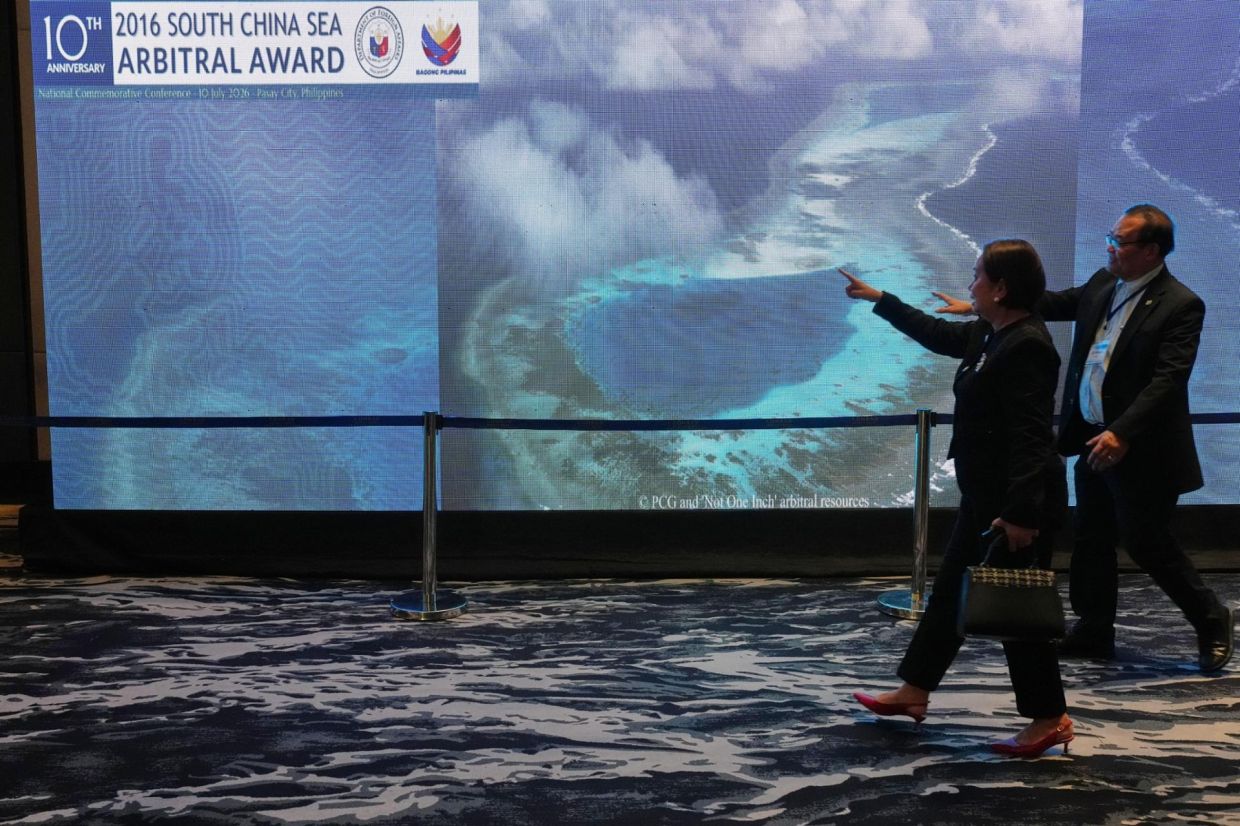
A coalition spanning the Philippines and thirteen other nations gathered Sunday to commemorate a decade since the Permanent Court of Arbitration delivered a historic decision that fundamentally reshaped the legal landscape of South China Sea governance. The commemorative joint statement reaffirmed the tribunal's 2016 ruling as remaining permanently binding and definitive, signalling unified international support for rules-based maritime order in one of the world's most strategically significant waterways. The thirteen co-signatories—Australia, Canada, Estonia, Germany, Italy, Japan, Latvia, Lithuania, New Zealand, Romania, Slovenia, the United Kingdom, and the United States—represent a diverse geographic coalition stretching across the Atlantic, Europe, the Pacific, and Oceania, underscoring how far-reaching concern about South China Sea stability extends beyond the region itself.
The arbitral tribunal's decision on July 12, 2016, addressed a case initiated by the Philippines in 2013 before the Permanent Court of Arbitration under Annex VII of the United Nations Convention on the Law of the Sea. The ruling systematically dismantled China's longstanding territorial assertions across most of the South China Sea by declaring that Beijing's invocation of "historic rights" lacked legal foundation under international maritime law. Equally consequential, the tribunal determined that contested features including Panganiban Reef—internationally known as Mischief Reef—and Ayungin Shola, also termed Second Thomas Shoal, fall within the Philippines' exclusive economic zone rather than being subject to Chinese sovereignty. This technical-sounding determination carried profound practical implications, potentially affecting maritime boundaries, resource access, and military positioning across a region traversed by trillions of dollars in annual shipping traffic.
China's "nine-dash line," a demarcation extending across approximately ninety percent of the South China Sea, represents perhaps history's most ambitious territorial maritime claim. The line had served for decades as the visual embodiment of Chinese assertions over the waterway, yet the 2016 arbitral process subjected these claims to rigorous international legal examination and found them wanting. The tribunal's invalidation of this approach did not merely represent a legal technicality; it fundamentally challenged the spatial architecture upon which Beijing had constructed its South China Sea strategy, forcing a recalibration of how maritime entitlements could be legitimately claimed under contemporary international law.
The joint statement issued by the fourteen nations framed their position around commitment to "a free and open Indo-Pacific that is peaceful, stable, and rules-based." This formulation reflects a conscious diplomatic choice to situate South China Sea stability within the broader Indo-Pacific framework—a regional concept that has gained increasing prominence in international relations as policymakers recognize the interconnected security and economic dynamics spanning from East Africa through South Asia, Southeast Asia, and extending to the Pacific. For Malaysian readers and Southeast Asian observers, this positioning matters significantly because it demonstrates how maritime governance in the South China Sea cannot be treated as an isolated bilateral issue but rather as integral to regional architecture affecting shipping lanes, fisheries, resource access, and military movements that touch every Southeast Asian economy.
Specific language in the statement carried pointed diplomatic significance. The fourteen countries registered "strong opposition" to "any destabilising or unilateral actions including by force or coercion that threaten peace and stability in the region." This carefully constructed phrasing functioned as implicit criticism of incidents that have periodically inflamed tensions—ranging from confrontations between vessels over resource access to military buildups on artificial features. The statement proceeded to explicitly oppose the use of coast guard, military, and maritime militia vessels to "harass, obstruct, or intimidate lawful operations by other States at sea or in the air," a formulation that referenced the varied actors involved in South China Sea incidents beyond traditional navy vessels, including paramilitaries and civilian maritime agencies that blur lines between military and civilian operations.
The reference to endangering "personnel and fishermen" underscored humanitarian dimensions often overlooked in strategic analysis. Fishing communities across Southeast Asia depend on waters adjacent to contested features, and escalating tensions create direct physical dangers for ordinary workers simply pursuing their livelihoods. When coast guard vessels operate in contested waters, collision risks increase exponentially, and the potential for minor incidents to cascade into serious confrontations becomes substantial. By invoking protection of fishermen specifically, the coalition acknowledged that South China Sea disputes affect not abstract strategic interests but concrete human communities whose welfare depends on peaceful maritime conditions.
The fourteen nations collectively urged adherence to the 2016 arbitral award and resolution of disputes through "dialogue and other lawful mechanisms consistent with international law." This language represented a deliberate contrast to approaches relying on unilateral assertions or coercive measures, signalling that the coalition views international law and negotiation as preferable pathways forward. Malaysia, as an ASEAN member with its own maritime claims and interests in South China Sea stability, finds strategic advantage in such positions because they legitimize rules-based approaches to resolving competing interests without requiring any party to surrender sovereignty claims.
The coalition explicitly reiterated support for ASEAN's vision of the South China Sea as "a sea of peace, stability, cooperation, and prosperity driven by vibrant lawful commerce." This alignment with ASEAN's stated objective serves multiple functions diplomatically. It positions the fourteen nations as supporting ASEAN's own framework rather than imposing external preferences, while simultaneously reaffirming that ASEAN's own institutional aspirations align with rules-based maritime order. For Southeast Asian governments navigating relationships with major powers, this formulation provides diplomatic cover—they can support the joint statement not as capitulating to external pressure but as advancing their own regional vision.
The tenth anniversary commemoration occurs against a backdrop of continued maritime complexities in the South China Sea. Despite the arbitral ruling, contestations persist, ranging from disputes over resource exploration to military activities in areas adjacent to contested features. The ruling itself has not produced comprehensive regional settlement; rather, it has established a legal foundation upon which peaceful resolution might proceed. The fourteen-nation coalition essentially argues that this legal foundation remains valid and binding, and that all parties should structure future conduct within its parameters rather than seeking workarounds or alternative legitimizing frameworks.
For Malaysia, Indonesia, Vietnam, and other Southeast Asian nations with South China Sea interests, the continued international affirmation of the 2016 ruling's binding character provides important political and legal support. It validates that maritime order in the region rests upon UNCLOS principles and established arbitral decisions rather than upon power assertions or coercive capacity. This matters particularly for smaller or mid-sized regional states that lack overwhelming military superiority but possess stronger legal positions when international law governs disputes. The coalition's emphasis on peaceful resolution mechanisms, dialogue, and adherence to established legal frameworks essentially argues that regional disputes should be decided through processes where legal arguments matter as much as military capabilities.
The breadth of the coalition—encompassing European nations alongside traditional Indo-Pacific powers—also signals that South China Sea governance has become a matter of broader international concern. European nations' inclusion reflects recognition that maritime order in Asia affects global stability, trade, and security architecture. This internationalization of what might otherwise be framed as regional concerns works strategically for nations seeking to prevent any single power from dominating South China Sea affairs through superior military presence or economic leverage.
Moving forward, the persistent challenge involves translating legal affirmations into practical behavioral changes on the ground. The arbitral ruling remains definitive in law, but translating that legal status into consistent compliance with its spatial delineations, freedom of navigation principles, and restrictions on coercive acts requires continued diplomatic pressure, institutional coordination, and commitment to peaceful dispute resolution mechanisms. The fourteen-nation coalition's reaffirmation on the ruling's tenth anniversary represents such diplomatic pressure, making clear that the international community views the 2016 decision not as a historical artifact but as a continuing foundation for South China Sea order.

