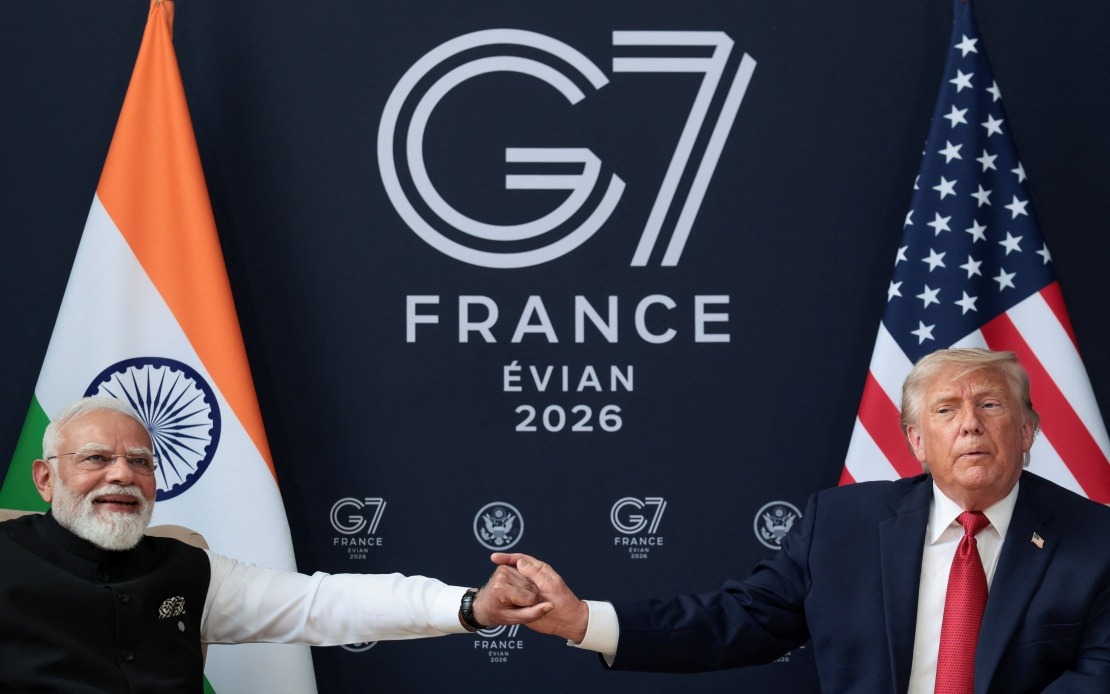
The lengthy and contentious trade negotiations between the United States and India have reached a decisive turning point, with both governments announcing meaningful progress toward finalising a bilateral trade accord. The breakthrough emerged from discussions between Indian Prime Minister Narendra Modi and US President Donald Trump during their meeting on the sidelines of the Group of Seven summit in Evian, France, signalling renewed momentum in talks that have dragged on for months amid mounting trade tensions between the world's largest and fifth-largest economies.
India's External Affairs Ministry confirmed the advancement in an official statement, noting that the two leaders expressed particular satisfaction with developments in the negotiations toward an interim bilateral trade agreement. The statement underscored their joint commitment to achieving an arrangement that balances the interests of both parties while delivering genuine commercial value—language that reflects the intricate nature of these negotiations and the need to satisfy diverse stakeholder groups in each nation. Critically, both governments have tasked their respective officials with accelerating the process, indicating a shared desire to move beyond preliminary discussions and reach concrete terms in the near term.
The urgency behind the push for a finalised agreement becomes apparent when examining the recent history of US-India trade relations, which have been marked by escalating tariff disputes and mutual recriminations. In 2025, the Trump administration imposed steep 25 per cent tariffs on Indian goods, compounded by an additional 25 per cent penalty specifically targeting New Delhi's purchases of Russian crude oil—measures that triggered considerable anxiety within India's export-oriented manufacturing and energy sectors. These punitive measures represented a dramatic escalation from previous tensions and threatened to undermine the bilateral relationship across multiple economic dimensions.
The two nations had already managed to reach a preliminary interim accord in February this year, through which the United States agreed to reduce its tariff rate on Indian products to 18 per cent. That agreement, while modest in scope, provided a foundation for broader negotiations and demonstrated both sides' capacity to negotiate workable compromises despite underlying strategic differences. The fresh talks emerging from the G7 summit represent an attempt to build upon that foundation and achieve a more comprehensive arrangement that might address the underlying drivers of trade friction, including intellectual property concerns, agricultural market access, and manufacturing reciprocity.
US Trade Representative Jamieson Greer is scheduled to visit India in the coming week specifically to advance these discussions, a mission that underscores the seriousness with which the Trump administration views reaching closure on the agreement. Greer's appointment as the chief negotiator signals that Washington intends to move these talks beyond routine diplomatic channels and engage directly through a senior official with authority to make binding commitments. The timing of this visit, so soon after the G7 summit, suggests both capitals are attempting to capitalise on the momentum generated by the Modi-Trump discussion and prevent the negotiations from stalling once more.
Trump's characterisation of Modi as an exceptionally tough negotiator—one of the most formidable he has encountered—offers insight into the difficulties both sides have faced in reaching agreement. The US president's comments, delivered with evident respect despite their competitive context, acknowledge that India has been unwilling to make unilateral concessions and has instead held firm on its core interests. Trump's colourful description of Modi as appearing angelical while negotiating with killer instinct reflects the complexity of Modi's approach: maintaining a diplomatic demeanor while fiercely advancing New Delhi's economic agenda and refusing to accept unfavourable terms merely for the sake of concluding an agreement.
For Southeast Asia and regional economic observers, the trajectory of US-India trade relations carries substantial implications beyond bilateral commerce. A successful trade agreement would signal that even amid significant geopolitical tensions and tariff disputes, major economies retain the capacity to negotiate mutually acceptable arrangements. Conversely, should negotiations collapse once more, it would reinforce perceptions of an increasingly fragmented global trading system and strengthen the hand of those arguing that protective measures rather than open commerce characterise the contemporary international economy.
India's negotiating position reflects the country's diverse economic interests and the political sensitivity of trade concessions at home. New Delhi must balance demands from its manufacturing sector, agricultural producers, and services industries while simultaneously responding to domestic concerns about foreign competition and the need to protect emerging industries. The Indian government has consistently refused to accept tariffs it views as discriminatory or punitive, particularly given that New Delhi has historically maintained relatively open trade policies compared to many developing nations.
The stated objective of achieving a "balanced, mutually beneficial, and commercially meaningful agreement" encapsulates the challenge before both negotiating teams. Such language signals that neither side intends to emerge as a clear victor with the other accepting an unfavourable arrangement; rather, both seek an outcome where genuine value flows to key constituencies in each country. For India, this likely means securing improved market access for technology services, pharmaceutical products, and agricultural exports. For the United States, it probably entails commitments regarding intellectual property protection, defence procurement openness, and reduced barriers to American agricultural and manufactured goods.
The coming weeks will prove critical in determining whether the current momentum translates into a finalised agreement or dissipates into renewed acrimony. Greer's visit, combined with instructions to officials to prioritise these talks, suggests both governments recognise the costs of prolonged trade friction and the benefits of normalising commercial relations. Whether that recognition proves sufficient to overcome the significant structural differences and competing priorities that have complicated these negotiations remains an open question that will reverberate through global supply chains and investment decisions across Asia and beyond.