Two people have been rescued from a high-rise residential unit in Singapore's Jurong West after a major fire erupted in the early hours of June 17, highlighting the persistent risks posed by electrical faults in densely populated public housing estates. The Singapore Civil Defence Force received the emergency call at approximately 3.35am, dispatching crews to Block 842 Jurong West Street 81, where flames had engulfed the living room of a unit on the 13th storey. Firefighters navigated through thick smoke to reach the interior and successfully contained and extinguished the blaze using water jets, but not before the fire had caused substantial damage to the affected flat and nearby properties.
The incident drew the attention of the entire residential block as emergency responders worked to secure the scene. Four family members from the compromised unit were transported to Singapore General Hospital, while approximately 40 neighbouring residents were evacuated as a precautionary measure to ensure no further lives were endangered. The quick mobilisation of emergency services and the evacuation protocol prevented what could have been a far more catastrophic outcome, particularly given the height of the affected unit and the rapid spread of the fire within the confined living space.
Investigations conducted immediately after the fire determined that the blaze almost certainly originated from an electrical source within the living room, a finding consistent with broader patterns of residential fire causation across the region. The exact nature of the electrical fault—whether stemming from faulty wiring, overloaded circuits, or malfunctioning appliances—remains under examination by authorities. Such electrical fires are notably common in older housing estates where aging infrastructure and high household electrical consumption create overlapping risk factors, a challenge familiar to Malaysia's own public housing communities where similar electrical-origin fires have occurred with alarming frequency.
The heroic response that morning came not from emergency personnel alone, but from an alert 18-year-old neighbour living directly above the affected unit. The student, who had been awake and engaged in gaming, detected smoke seeping through his windows and made the critical decision to investigate rather than ignore the warning signs. Upon discovering the door to the unit below was dangerously hot to the touch, he immediately began knocking on neighbouring doors to raise the alarm, then rushed back to alert his own family before contacting emergency services through his mother's call to the police. This sequence of events underscores how community vigilance and rapid public response can be the difference between a contained incident and a tragedy.
Witnesses to the aftermath described scenes of considerable trauma and injury. The young woman from the affected unit who had moments earlier knocked on the neighbour's door seeking towels to treat her father's wounds showed visible signs of severe burns—her hair had been singed and soot had blackened her face. Another occupant of the flat displayed extensive burns across his back and arms, the skin showing the characteristic bright-red colouration indicating serious thermal injury. These injuries, combined with the family's initial unconsciousness during the fire, suggest that smoke inhalation posed as significant a threat as the flames themselves, a hazard that often catches residents unprepared in the crucial minutes before rescue personnel arrive.
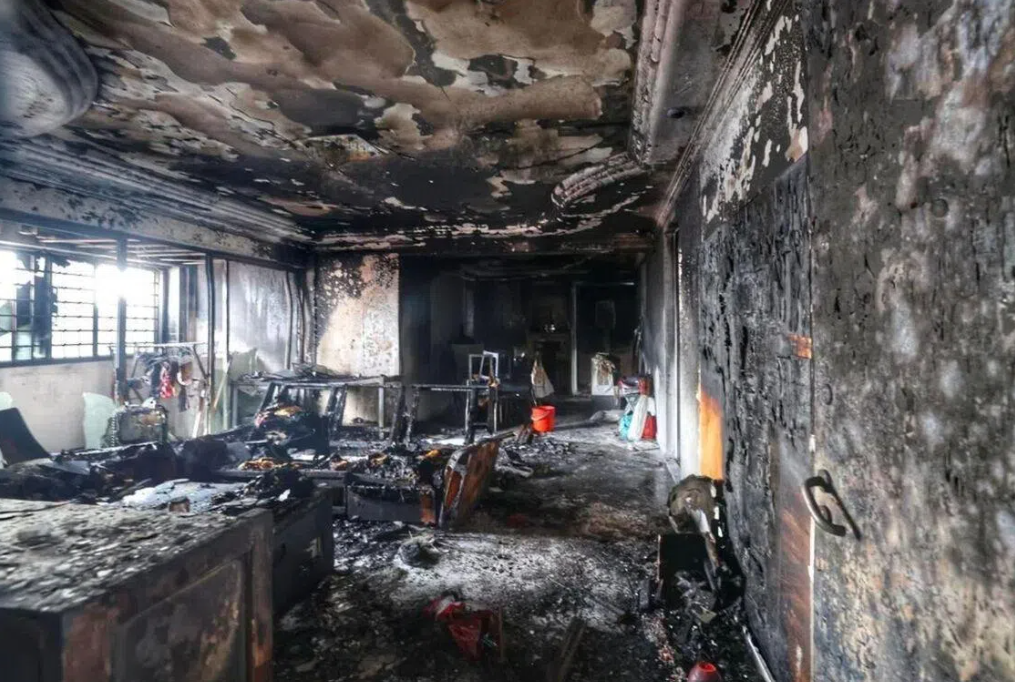
Photographic documentation by visiting journalists revealed the true extent of the destruction wrought by the blaze. The walls and ceiling of the 13th-floor unit had been completely blackened by intense heat and smoke, while the windows had shattered from thermal stress, leaving the interior exposed and unlivable. Such visual evidence serves as a stark reminder of how quickly fire can devastate a residential space, transforming a family home into a charred shell within minutes. The damage also raised questions about the structural integrity of neighbouring units and whether residents elsewhere in the block had sustained secondary damage or smoke inhalation injuries that might not have prompted immediate hospitalisation.
The response from emergency management authorities has focused on prevention as the key strategy for reducing residential fire incidents. The Singapore Civil Defence Force has issued comprehensive guidance to the public, emphasising the dangers of overloading electrical outlets—a practice that remains disturbingly common across Southeast Asia where multiple appliances compete for limited socket access. SCDF has urged all residents to switch off devices and appliances when not actively in use, a simple measure that can substantially reduce the risk of overheating and subsequent ignition. Additionally, authorities stress the importance of using only electrical equipment and plugs that bear the Safety Mark certification issued by Singapore's Consumer Product Safety Office, ensuring that devices meet minimum safety standards before reaching households.
Battery-powered devices and charging systems present another specific hazard that authorities have highlighted, particularly in the context of modern household technology. SCDF has advised against leaving batteries, mobile phones, laptops, and other rechargeable devices charging unattended overnight or for extended periods, practices that have been linked to numerous residential fires across Asia. The heat generated during extended charging cycles can degrade battery components and create conditions for thermal runaway, a situation where internal chemical reactions cause rapid temperature escalation. Such warnings carry particular relevance for Malaysian households, where the use of budget-brand electronics and counterfeit chargers—often lacking proper safety mechanisms—remains widespread despite regulatory efforts.
The broader statistical context reveals a troubling upward trajectory in residential fire incidents across Singapore and the region. According to the most recent data released by SCDF in February, the total number of fires in Singapore rose by three percent, climbing from 1,990 incidents in 2024 to 2,050 in 2025. More concerning still is the residential component of this total: of the 2,050 fires recorded, 1,051 occurred in residential buildings, representing a substantial proportion and indicating that homes remain the primary arena for fire risk despite decades of safety campaigns and regulatory measures. This statistic serves as a cautionary indicator for Malaysia and other Southeast Asian nations, suggesting that aggressive public education and enforcement of electrical safety standards remain inadequate in curbing the residential fire epidemic.
For Malaysian readers, the Jurong West incident offers valuable lessons applicable across the region's public housing landscape. HDB flats in Singapore and similar residential blocks in Malaysia share comparable construction methods, wiring systems, and household electrical consumption patterns. The concentration of residents in high-rise buildings means that a fire in one unit poses dangers not only to its occupants but to hundreds of neighbours who may find evacuation complicated. Communities should consider establishing neighbourhood fire watch programs, similar to the informal system that functioned in this incident, where residents remain alert to warning signs. Individual households benefit from conducting regular electrical audits, identifying overloaded outlets and aged wiring that may pose hidden risks. Investment in smoke detectors, fire extinguishers, and evacuation planning transforms residential safety from an abstract concept into concrete, actionable preparation that could prove lifesaving during a genuine emergency.