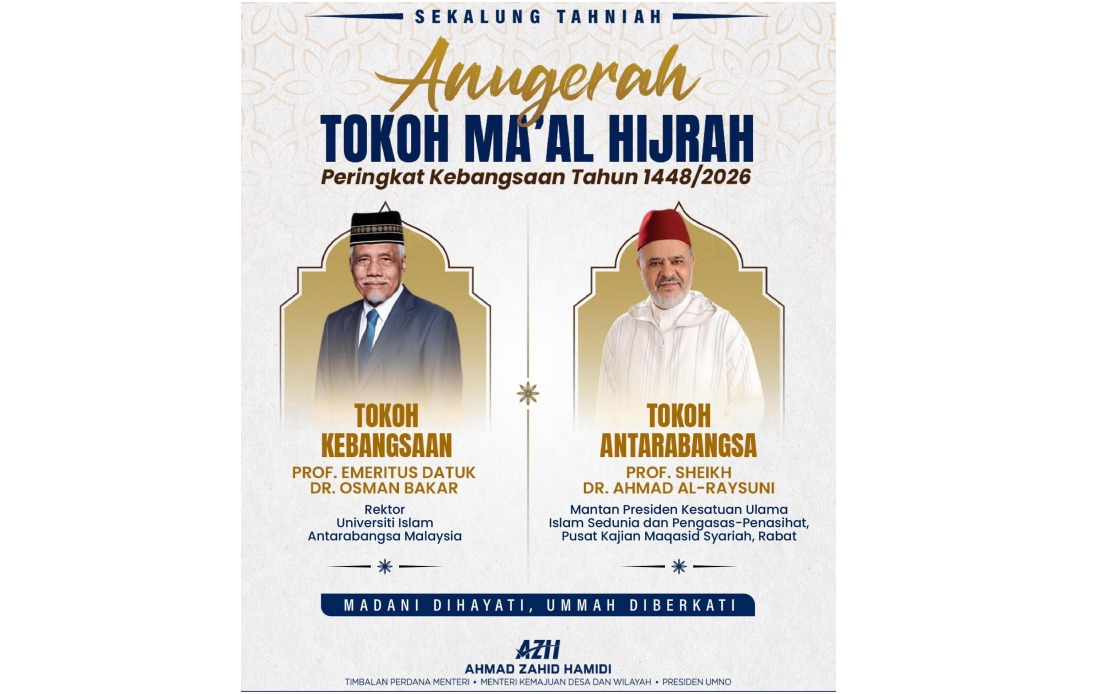
The recognition accorded to this year's Tokoh Maal Hijrah award recipients should energise Malaysia's Muslim population to deepen their commitment to learning, community engagement and nation-building, according to Deputy Prime Minister Datuk Seri Dr Ahmad Zahid Hamidi. Speaking after the presentation ceremony held at Masjid Putra in Putrajaya, Ahmad Zahid highlighted how the honours bestowed upon the awardees exemplify the kind of dedication that strengthens both the Muslim ummah and the broader Malaysian society. The awards, he suggested, function as a powerful reminder of what Muslims across the country can aspire to achieve through sustained effort and service.
Ahmad Zahid extended formal congratulations to the two recipients: Prof Emeritus Datuk Dr Osman Bakar, who secured the National Tokoh Maal Hijrah Award, and Prof Sheikh Dr Ahmad Al-Raysuni, the recipient of the International Tokoh Maal Hijrah Award. The Deputy Prime Minister underscored that their accolades represent far more than individual achievement; rather, they reflect meaningful contributions toward empowering the Muslim community, elevating intellectual and spiritual standards, and disseminating Islamic values that fundamentally prioritise compassion, insight and societal wellbeing. By honouring such figures, Ahmad Zahid implied, the nation reaffirms its commitment to excellence in Islamic knowledge and practice.
Prof Emeritus Osman Bakar, whose expertise spans Islamic philosophy and civilisation, and Prof Ahmad Al-Raysuni, a distinguished Islamic jurisprudence scholar based in Morocco, were formally recognised during the national-level Maal Hijrah observance. The Sultan of Perak, Sultan Nazrin Shah, presided over the ceremony and presented the recipients with monetary prizes, commemorative trophies and certificates acknowledging their contributions. The involvement of the Sultan in the proceedings underscored the significance attached to these awards within Malaysia's institutional framework and demonstrated the monarchy's active engagement in promoting Islamic learning and community values.
Deputy Prime Minister Datuk Seri Fadillah Yusof echoed Ahmad Zahid's sentiments, emphasising that the award recipients' accomplishments should motivate all Malaysians—regardless of faith background—to persist in their efforts to advance society and strengthen the nation. Fadillah's remarks extended the relevance of the awards beyond the Muslim community alone, positioning them as universal exemplars of service and dedication. This inclusive framing reflects a broader Malaysian approach to celebrating achievement within its diverse, multi-faith society, where recognition of Islamic contributions is presented as strengthening the national fabric overall.
Fadillah drew explicit connections between the Maal Hijrah concept and contemporary national aspirations. He characterised the Prophet Muhammad's hijrah not merely as a historical migration but as a foundational principle encapsulating values of sacrifice, collective harmony, endurance and purposeful striving toward beneficial transformation. These qualities, he argued, remain entirely germane to modern efforts aimed at constructing a society that is simultaneously progressive, materially prosperous and anchored in ethical and moral principles. By repositioning the hijrah as a perpetually relevant guidance framework rather than a static historical event, Fadillah sought to bridge classical Islamic teaching with contemporary governance and development challenges.
The Deputy Prime Minister called for sustained collective action toward fortifying social cohesion, deepening religious commitment and augmenting virtuous conduct at all levels. His appeal for unity and enhanced faith-based action specifically targeted the advancement of the ummah's collective interests and the nation's long-term prosperity. This messaging aligns with Malaysia's official approach to balancing Islamic religious observance with inclusive nation-building, acknowledging the predominance of Islam while maintaining frameworks of multi-cultural coexistence.
The Tokoh Maal Hijrah awards carry particular significance within Malaysian public life as they operate at the intersection of religious recognition and state ceremony. Administered at the national level with ceremonial involvement from constitutional figures such as the Sultan, the awards serve multiple functions: they honour individuals whose scholarship and service exemplify Islamic excellence, they reinforce official narratives connecting Islamic values to national development, and they provide a ceremonial platform for senior political figures to articulate their vision of how faith and governance should interrelate. The recognition of an international recipient alongside a Malaysian scholar also signals Malaysia's aspiration to position itself as a centre of Islamic learning with regional and global reach.
For Malaysian Muslims seeking a model of intellectual and spiritual contribution, the selection of Prof Emeritus Osman Bakar presents a particularly instructive case. His extensive work bridging Islamic civilisation and contemporary knowledge systems has influenced generations of scholars and policymakers, demonstrating how traditional Islamic learning can remain vibrant and relevant in modernity. Similarly, the recognition accorded to Prof Ahmad Al-Raysuni from Morocco acknowledges the interconnectedness of Islamic scholarship across the Muslim world and Malaysia's participation in broader Islamic intellectual networks spanning North Africa and beyond.
The explicit call by both Deputy Prime Ministers for continued knowledge-seeking represents a notable policy emphasis. In Malaysia's context, where educational attainment remains linked to economic mobility and professional advancement, positioning Islamic learning within this aspirational framework potentially encourages greater engagement with religious scholarship among younger generations. By framing knowledge acquisition as a religious obligation intertwined with national development, the leadership articulates a vision wherein Islamic education and technical/professional development are complementary rather than competing pursuits.
The awards ceremony and subsequent official commentary also reflect Malaysia's efforts to counter narratives that position Islam as incompatible with scientific progress, intellectual rigour or inclusive governance. The prominence afforded to scholars whose work demonstrates sophisticated engagement with contemporary issues signifies an official commitment to presenting Islam as a knowledge tradition capable of engaging meaningfully with modernity. This positioning becomes increasingly important as Malaysia competes regionally and globally for talent and investment while simultaneously maintaining its constitutional commitment to Islam's special position.
Beyond the immediate recognition of individual achievement, the Tokoh Maal Hijrah framework functions as a state mechanism for defining and promoting particular models of Islamic practice and scholarship. By celebrating figures like Osman Bakar and Ahmad Al-Raysuni, whose work emphasises compatibility between Islamic values and progressive social development, Malaysian authorities signal which intellectual and spiritual approaches they wish to encourage within the Muslim community. This curative function, while subtle, carries implications for how Islamic discourse develops within Malaysian public space and how younger scholars and community leaders calibrate their own aspirations and activities.