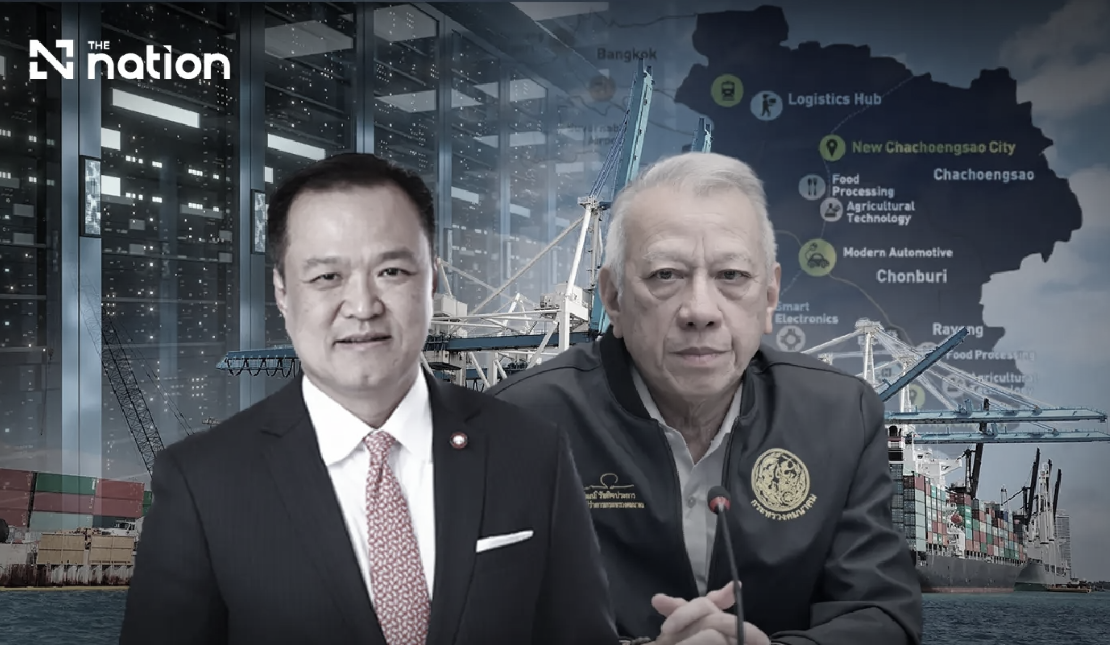
Thailand's Prime Minister Anutin Charnvirakul has consolidated control over the Eastern Economic Corridor, rescinding the oversight held by Deputy Prime Minister and Transport Minister Phiphat Ratchakitprakarn. The restructuring marks a significant strategic pivot for one of Southeast Asia's most ambitious regional development initiatives, with the government now positioning the EEC as a hub for global food security and high-tech data centre operations rather than relying primarily on conventional heavy manufacturing.
The transfer of authority took effect on June 15 following bilateral discussions between the two senior ministers the previous week. Thailand's Cabinet formally acknowledged the administrative orders on Tuesday, terminating Phiphat's supervisory role over the EEC Office and his chairmanship of the Eastern Economic Corridor Policy Committee. Government House officials clarified that the decision reflected strategic realignment rather than factional tension, with Phiphat reportedly proposing the transfer himself after friction emerged between the EEC Office and the Board of Investment.
Anutin's assumption of direct responsibility signals an intention to personally champion the corridor's international marketing efforts, positioning himself as the primary advocate for Thailand's investment opportunities with foreign capital sources. This hands-on approach suggests the government views the EEC's repositioning as sufficiently important to warrant prime ministerial attention, a departure from the previous delegated management structure that had characterised the initiative's recent years.
The strategic reorientation away from heavy industry reflects pragmatic constraints facing the eastern region. Thailand's electricity and water supply infrastructure cannot sustain unlimited expansion of traditional manufacturing sectors, with procurement costs for both resources becoming increasingly prohibitive. Energy-intensive operations that dominated earlier development phases now compete for finite resources, forcing planners to identify alternative economic models that generate comparable investment and employment while operating within infrastructure limitations.
Food security positioning leverages genuine competitive advantages within Thailand's eastern provinces. The region commands substantial capacity in livestock production, commercial fisheries, agricultural commodities, and horticultural export sectors. As global supply chain vulnerabilities and geopolitical tensions sharpen international focus on food self-sufficiency, Thailand's government recognises an opportunity to market the EEC as an essential source for nations seeking diversified agricultural and protein sourcing. This reframing transforms the corridor from a manufacturing hub into a strategic asset for countries navigating evolving trade dynamics and climate-related production uncertainties.
Data centre development represents the other pillar of the revised investment strategy. The government acknowledges data centres as a sector requiring sophisticated cross-agency coordination because of extreme infrastructure demands across electrical supply, water resources, and supporting utilities. Thailand's competitive positioning within Southeast Asia—combining relative political stability, established telecommunications infrastructure, and geographic proximity to major Asian markets—makes the EEC a plausible location for regional data centre operations serving multinational technology companies.
The Energy Ministry is simultaneously establishing a new electricity consumer classification, designated Type 9, specifically for data centre operators. This category imposes higher tariffs than other industrial users, reflecting the exceptional power consumption inherent to data centre operations. The tariff structure acknowledges that data centres represent a different economic model than traditional manufacturing, where electricity costs represent a smaller proportion of operational expenses. By creating this specialized classification, Thailand signals both willingness to accommodate the sector and intent to capture additional revenue from high-consumption operators.
Phiphat's public response suggested surprise at the administrative timing, as he claimed advance notification did not precede the Cabinet announcement. However, his subsequent statements distanced himself from any suggestion of political conflict or diminished standing within the Bhumjaithai Party, his political home. His willingness to characterise the transfer as Anutin's prerogative rather than resisting the decision suggests either genuine alignment with the strategic rationale or calculated restraint regarding factional positioning within coalition governance.
Government sources explicitly denied the restructuring stemmed from disagreement over the contested Don Mueang-Suvarnabhumi-U-Tapao high-speed rail project. The three-airport rail connection has languished since the 2019 concession agreement with Asia Era One, facing repeated disputes over contract amendments. Phiphat had resisted proposals to shift from a build-before-payment model to a construct-and-compensate arrangement pegged to construction milestones. Officials insisted Anutin himself prohibited contract modifications, with the Prime Minister unwilling to assume risks associated with renegotiating the original terms. The denial's specificity suggests sensitivity regarding perception that the EEC reshuffle masked unresolved tensions over the rail project.
The timing also involves the proposed Disneyland development within the EEC zone. Official sources indicate Anutin questioned Phiphat regarding the project's advancement prospects, noting that no comprehensive feasibility analysis had examined whether potential returns would justify capital expenditure. This scrutiny suggests the Prime Minister's direct assumption of EEC authority includes evaluating which development initiatives merit continued prioritisation, potentially signalling reduced enthusiasm for entertainment-focused projects in favour of economically productive sectors.
For Malaysian observers and regional investors, Thailand's EEC repositioning carries several implications. First, it signals Thailand's continued investment in competing for regional capital flows alongside Malaysia's own economic corridors and development zones. Second, the emphasis on food security and data centre infrastructure reflects sector-specific investment trends likely to influence competition for foreign direct investment across Southeast Asia. Third, the apparent organisational fluidity suggests Thai policymakers remain willing to restructure development frameworks when strategic circumstances warrant, potentially creating both opportunities and uncertainties for investors evaluating long-term commitments.
The broader significance extends beyond administrative reshuffling. Thailand's decision to reframe the EEC away from conventional manufacturing represents recognition that traditional development models face obsolescence within shifting global economic conditions. By emphasising food security alongside digital infrastructure, the government acknowledges that future competitiveness requires addressing both fundamental resource concerns and technological advancement simultaneously. Whether this repositioned strategy successfully attracts the envisioned investment and achieves developmental objectives will significantly influence other Southeast Asian nations' approaches to regional economic zone management.