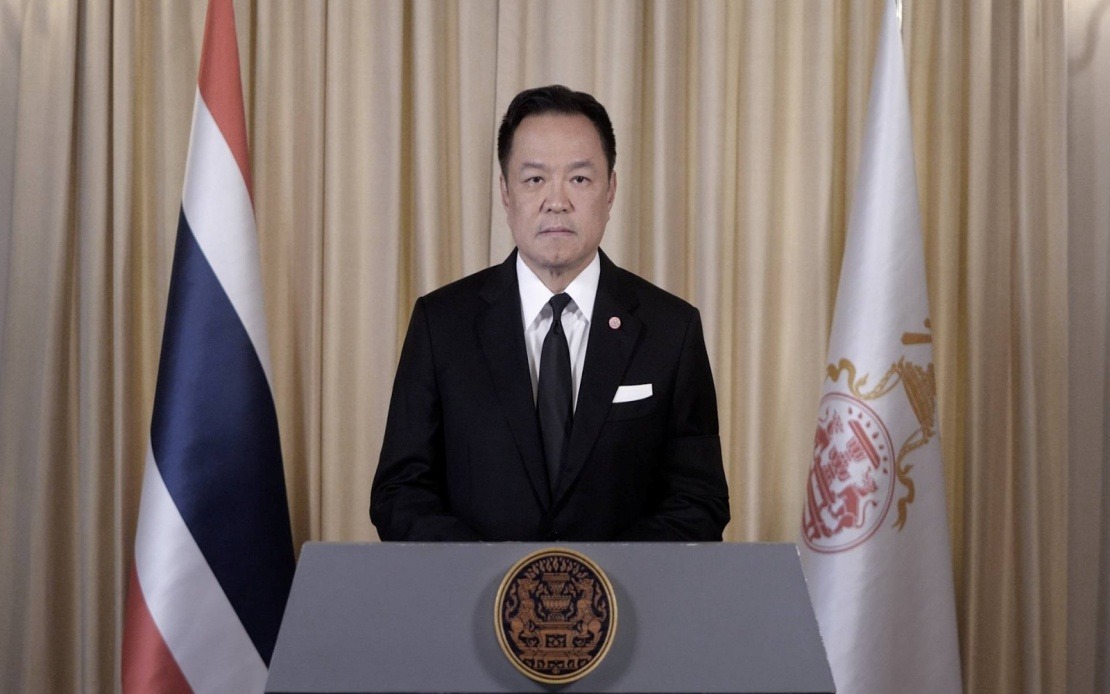
Thailand's leadership has signaled strong approval for emerging reports of a ceasefire agreement between the United States and Iran, viewing the development as a potential catalyst for regional stability and economic improvement. Prime Minister Anutin Charnvirakul told journalists on Monday that Bangkok remains well-positioned to absorb external shocks, but underscored that any breakthrough in West Asia would meaningfully contribute to resolving pressing global challenges and buttressing economic resilience. His remarks came after US President Donald Trump announced that a deal with Iran had been concluded, which would involve reopening the Strait of Hormuz and lifting a naval blockade that has complicated international commerce.
Anutin framed the potential agreement within Thailand's broader economic strategy, emphasizing that the government operates from a foundation of long-term strategic foresight rather than reactive policymaking. This positioning reflects Thailand's experience navigating supply chain disruptions that have rippled across global markets in recent years. The kingdom has demonstrated adaptive capacity in managing these shocks, suggesting that officials believe any stability gains from West Asian de-escalation would amplify rather than drive Thailand's economic performance.
Deputy Prime Minister Ekniti Nitithanprapas, who also holds the finance portfolio, offered more concrete economic reasoning behind official enthusiasm for the ceasefire prospect. He articulated how terminating the conflict would generate tangible benefits through moderation of energy prices, a crucial consideration for an energy-importing nation like Thailand that bears direct exposure to global oil and gas market volatility. Lower energy costs would ripple through manufacturing, transportation, and service sectors that form the backbone of Thailand's economy, potentially reducing inflationary pressures that have weighed on household purchasing power and constrained smaller enterprises.
The finance minister's commentary suggests that government planners see the ceasefire as removing a significant upside risk to inflation projections. Thailand's central bank and economic team have grappled with imported inflation stemming partly from elevated global energy prices, which feed through to production costs across diverse industries. A genuine reduction in geopolitical risk premiums embedded in crude oil prices could ease this transmission mechanism, allowing monetary and fiscal authorities more room to focus on supporting growth rather than containing price pressures.
Ekniti signaled that improved global conditions stemming from a West Asian settlement could exceed current economic growth forecasts, presenting an upside scenario for Thailand's planning. This optimism stands in contrast to the caution that has characterized many official growth projections over the past eighteen months, during which multiple uncertainties—from global trade tensions to banking sector concerns—have constrained expansion. A ceasefire would eliminate one significant downside tail risk, potentially unlocking consumer and business confidence that has been dampened by geopolitical anxiety.
Notably, the finance minister revealed that Thailand intends to proceed with a 200-billion-baht energy transition programme regardless of where oil prices ultimately settle. This commitment represents an important signal that officials view the energy transition as a strategic imperative disconnected from near-term commodity price fluctuations. The investment reflects Bangkok's recognition that Thailand remains structurally dependent on imported petroleum and natural gas for both electricity generation and transportation fuels, making long-term diversification essential regardless of current market conditions.
The government's dual approach—welcoming lower energy costs while maintaining transition investments—demonstrates sophisticated economic thinking. Rather than viewing lower oil prices as eliminating the urgency for renewable energy and efficiency improvements, Thai policymakers appear to understand that a ceasefire would represent a temporary reprieve rather than a permanent solution to energy security vulnerabilities. The 200-billion-baht programme addresses fundamental structural exposure that transcends any single geopolitical settlement.
For Malaysia and other Southeast Asian economies, Thailand's perspective carries regional weight and signals how the broader region interprets the ceasefire's implications. Thailand's manufacturing sector, agricultural exports, and logistics hub functions all face similar exposure to global energy costs and geopolitical disruption risks. The official Thai response suggests that regional policymakers generally view the ceasefire positively while maintaining realistic assessments that structural challenges require sustained strategic investment.
The ceasefire's potential benefits for Thailand extend beyond direct energy cost savings to encompassing broader supply chain normalization. Disruptions in global shipping, insurance costs for maritime transport, and logistical delays through crucial choke points like the Strait of Hormuz have created friction costs throughout trade networks. Resolution of West Asian tensions promises to reduce these friction costs, potentially improving efficiency across the manufacturing and export sectors that employ millions of Thais and contribute substantially to government revenues.
Ekniti's emphasis on monitoring inflationary impacts on households and small businesses reflects official awareness that ceasefire benefits would need to translate into tangible improvements for ordinary Thais. While global energy price moderation would help at the macro level, the transmission mechanism to household budgets and small enterprise input costs requires functioning price competition and efficient market mechanisms. Government monitoring suggests policymakers understand this transmission is not automatic and requires active attention.
Thailand's cautious optimism also implicitly acknowledges the ceasefire's uncertainties. While Trump announced the agreement's completion, implementation challenges, regional skepticism, and political pressures could still derail or delay benefits. Thai officials appear to be preparing for improvement while avoiding overcommitment to assumptions that may not materialize fully or immediately.
The broader context reveals how even large developing economies like Thailand operate within constrained choice sets shaped by global geopolitical developments. Bangkok cannot control whether a US-Iran ceasefire holds, yet its economic prospects hinge significantly on such outcomes. This structural reality underscores why Thai policymakers maintain strategic flexibility through investments in energy transition and supply chain resilience—recognizing that stability cannot be assumed and must be actively prepared for through diverse, long-term initiatives.