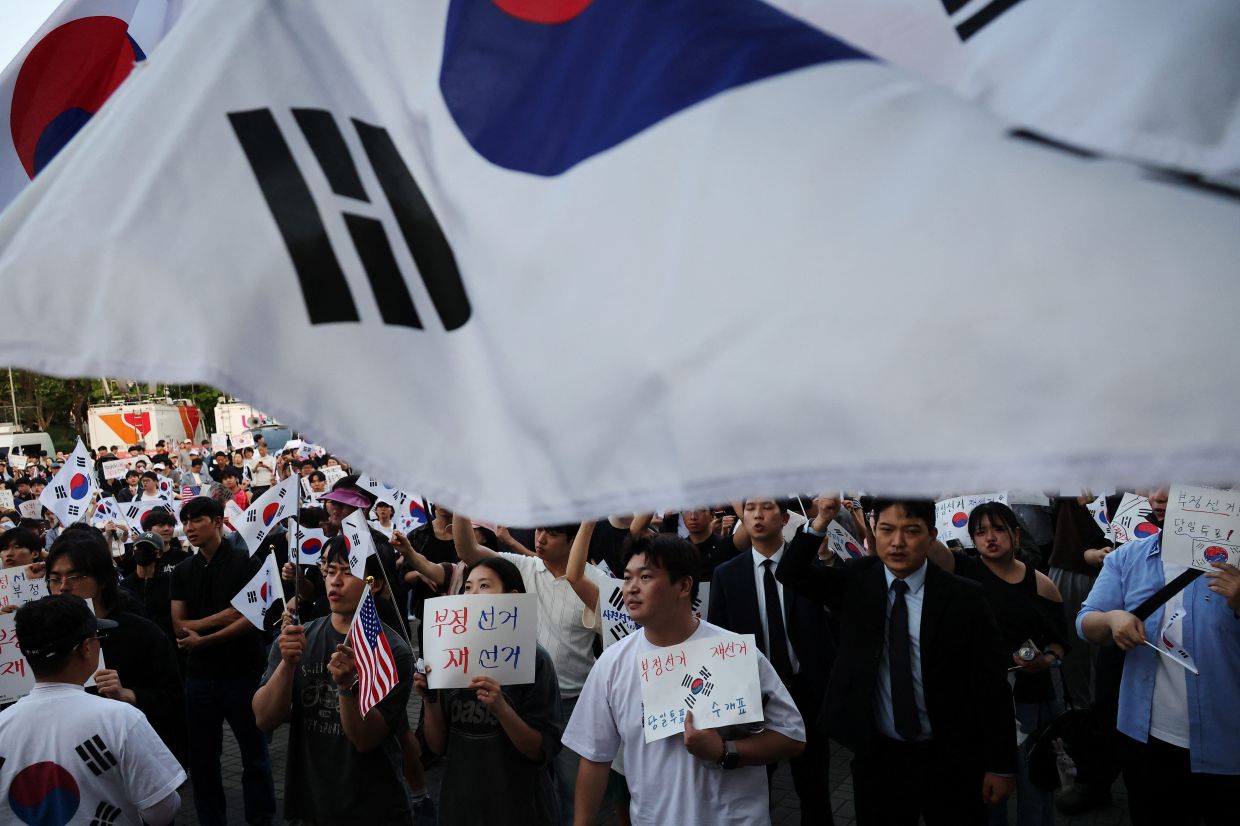
South Korean President Lee Jae Myung has called for restraint among protesters gathering over ballot shortages that marred the June 3 local election, issuing a statement that attempts to balance acknowledgment of legitimate grievances with warnings against unsubstantiated claims of electoral fraud. In a June 15 post on social media platform X, Lee emphasised that while citizens possess the right to protest, such expression must not encroach upon the freedoms of others—a statement that comes as demonstrations around Olympic Park's handball arena, which served as the vote-counting centre, have begun to disrupt public facilities and administrative operations.
The controversy centres on the National Election Commission's acknowledged failures to distribute sufficient ballot papers on election day, a logistical breakdown that forced temporary halts and delays to voting at multiple polling stations across the country. Lee, speaking from Vatican while presiding over a video meeting with senior aides, characterised these management failures as constituting a grave infringement of democratic voting rights—the bedrock principle upon which electoral systems depend. His acknowledgment of public concern represents a recognition that the incident has struck at the heart of democratic legitimacy and that citizen frustration is understandable and justified.
However, Lee drew a firm distinction between legitimate criticism of the election commission's operational inadequacy and what he termed baseless conspiracy theories alleging systematic election rigging. He warned that certain groups were instrumentalising the genuine procedural failures to advance unfounded claims of electoral manipulation, a rhetorical move designed to discredit more radical elements within the protest movement. This demarcation becomes particularly significant in the context of South Korean politics, where electoral integrity remains a sensitive issue given the country's historical experiences with disputed elections and questions about administrative impartiality.
Concrete evidence of protest disruptions has begun accumulating, with sports organisations located within the Olympic Park complex reporting substantial work interruptions caused by demonstrators blocking access to facilities. These obstructions have created practical complications for South Korean athletic bodies attempting to manage international competition preparations and administrative requirements essential for the country's sporting participation globally. Lee's invocation of these disruptions serves to illustrate how the exercise of protest rights, when unchecked, can themselves infringe upon the legitimate activities and interests of ordinary citizens and organisations.
In response to the escalating situation, Lee has instructed law enforcement to conduct thorough investigations into individuals who have obstructed work through force, including those who have blocked facility access, as well as those who may have conspired to organise such obstruction. This prosecutorial direction targets both direct participants and potential organisers, signalling an intent to hold multiple layers of responsibility accountable. Significantly, Lee's framework applies legal consequences uniformly regardless of political motivation, insisting that democratic principles require adherence to established legal frameworks even when pursuing legitimate grievances.
Part of Lee's statement specifically addressed incidents involving threats directed at police officers and citizens, unauthorised searches, and obstruction of official duties. These characterisations paint the protest movement as having moved beyond peaceful demonstration into territory that law enforcement regards as criminal conduct. By itemising these specific allegations, Lee creates a narrative in which some protesters have transgressed the bounds of legitimate civil action, thereby forfeiting the moral high ground and opening themselves to legal liability.
The president has simultaneously demanded that parliamentary and prosecutorial investigations into the election commission's failures proceed with transparency and speed, explicitly calling for responsibility determination without any institutional exemptions or protections. This dual approach—cracking down on illegal protest activity while demanding accountability for administrative failures—attempts to position Lee as defending the overall democratic system rather than simply suppressing dissent. His emphasis on parliamentary investigation involvement suggests an intent to ensure that multiple institutional branches participate in fact-finding, potentially enhancing public confidence in the process.
Lee's statement reflects a broader strategic calculation within South Korean political discourse. By defending the integrity of electoral systems while rejecting unproven fraud narratives, he seeks to preserve public confidence in democratic institutions themselves. The underlying concern appears to be that permitting unfounded rigging claims to gain widespread acceptance could generate lasting damage to public trust in electoral processes, a consequence that might prove more corrosive to democracy than the actual ballot distribution failures. This framework positions Lee as defending institutional legitimacy and democratic norms against both administrative incompetence and conspiratorial thinking.
The incident carries implications extending beyond South Korea's immediate political situation. As electoral administration challenges and public trust in institutions face scrutiny across democratic systems globally, South Korea's response to this particular crisis may signal how established democracies navigate the tension between acknowledging genuine procedural failures and resisting delegitimisation narratives. The country's handling of this balance—whether investigation processes ultimately restore public confidence, whether prosecutions proceed judiciously, and whether reforms actually prevent recurrence—will likely influence regional and international assessments of South Korean democratic resilience.
Lee has called upon the National Election Commission to provide complete cooperation with the parliamentary investigation process, expected to commence within days, while simultaneously requesting that joint prosecutor-police investigative teams accelerate their efforts. This multi-institutional approach recognises that electoral legitimacy depends not merely on determining what occurred, but on demonstrating through transparent, rigorous investigation that accountability mechanisms function effectively. The president's invocation of young people's justified anger, while calling for responsible societal response, suggests an attempt to channel legitimate frustration toward constructive institutional reform rather than toward intensifying confrontational protest dynamics that risk further polarisation.