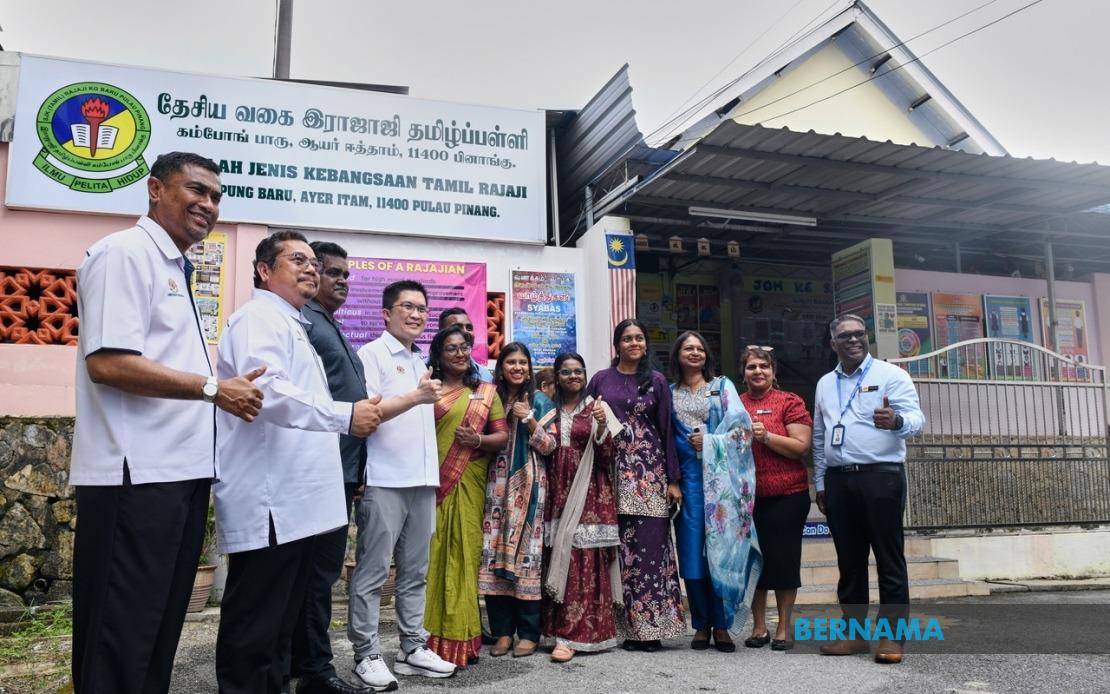
The Education Ministry has green-lit a major development programme for one of Penang's oldest Tamil-medium primary schools, approving an RM8 million construction project that will see Sekolah Jenis Kebangsaan Tamil (SJKT) Rajaji relocated to purpose-built facilities in the Farlim neighbourhood. Deputy Education Minister Wong Kah Woh formally presented the approval letter in George Town on June 15, marking a turning point for the institution that has operated at its current George Town site for 76 years while contending with severe spatial constraints.
The 2.3-acre plot designated for the new campus, located approximately 500 metres from the school's existing premises in Bandar Baru Ayer Itam, was formally approved by the Penang state government in 2022. The relocation effort gained momentum when the school's board of governors submitted an application to the Education Ministry in 2023. After working through coordination issues with local authorities, ministry officials cleared the project for commencement, setting the stage for what educators and administrators view as essential infrastructure renewal for a declining enrolment situation.
Currently housing around 100 pupils, SJKT Rajaji has suffered from physical constraints that limit its ability to provide modern teaching spaces, recreational facilities, and adequate room for student activities. The congestion has become particularly acute given Malaysia's broader demographic shifts affecting Tamil-language education streams. The completion of the new building by the 2029 academic session would finally provide the school with contemporary infrastructure aligned with national educational standards, including dedicated spaces for specialised learning, sports, and cultural activities.
Construction is projected to take 18 months from commencement, suggesting a launch date sometime in late 2027 or early 2028 to meet the 2029 deadline. The tight timeline reflects both the ministry's commitment to the project and the urgency surrounding facility improvements across Tamil schools nationwide. State Housing and Environment Committee chairman and Penang Tamil Schools Special Committee chairman Datuk Seri S. Sundarajoo attended the approval ceremony, underscoring state-level engagement with the initiative.
A particularly notable aspect of the development involves its funding structure. Rather than drawing entirely on government coffers, the RM8 million project will be fully underwritten by a private developer operating under its corporate social responsibility (CSR) mandate. This public-private partnership model reflects a broader strategy within Malaysia's educational landscape to leverage commercial sector participation in infrastructure development, particularly for schools serving minority language communities where state budgets face competing demands.
The Rajaji school project sits within a larger modernisation campaign affecting Penang's Tamil education sector. According to Sundarajoo, the state currently operates 28 Tamil national-type schools, several of which are undergoing simultaneous development initiatives aimed at securing permanent campuses and rolling out phased facility improvements. At least three additional SJKT projects across Penang are slated to hold groundbreaking ceremonies within the current year, signalling acceleration in what has historically been a gradual process of infrastructure renewal.
Beyond Rajaji, other institutions including SJKT Sungai Bakap and SJKT Juru are experiencing revived development momentum after years of limited progress on expansion or relocation plans. These concurrent initiatives suggest that state and federal authorities have recognised the critical infrastructure gap affecting Tamil-medium schools in Penang, where several institutions operate in similarly constrained physical environments. The coordinated approach differs markedly from the ad-hoc improvements that characterised previous decades.
For Tamil-speaking communities in Penang and across Malaysia more broadly, such developments carry symbolic weight beyond mere bricks and mortar. Educational facilities directly shape learning outcomes, student retention, and community confidence in mother-tongue education systems. When schools operate in cramped, aging buildings, they transmit an implicit message about societal valuation of linguistic minority education. Conversely, investment in contemporary facilities signals institutional commitment and can help reverse enrolment declines by attracting families concerned about educational quality.
The Rajaji relocation also illustrates evolving approaches to Tamil school administration in Malaysia. Rather than consolidating struggling institutions through closure or merger—approaches sometimes mooted in policy discussions—stakeholders are pursuing targeted renewal that preserves individual school identities while modernising their operational capacity. This preservation-plus-improvement strategy aligns with federal government commitments to protecting vernacular education streams, even as overall student populations in Tamil schools have contracted significantly since the 1980s.
From a broader Southeast Asian perspective, Malaysia's continued investment in Tamil-medium primary education distinguishes it within the region, where linguistic minority schooling often receives marginal policy attention. The Rajaji project exemplifies how targeted infrastructure development, particularly when coupled with private sector partnerships, can sustain minority-language education without imposing unsustainable fiscal burdens on governments navigating competing resource demands across primary, secondary, and tertiary sectors.
The transition to the Farlim campus will require careful planning around student adjustment, staff relocation, and community engagement. Educational continuity during construction will likely necessitate temporary arrangements or phased transitions, particularly given the school's modest enrolment and limited operational flexibility. State education authorities will need to coordinate closely with school leadership to ensure that infrastructure improvements translate into enhanced pedagogical outcomes rather than merely expanding physical space without corresponding curriculum development or teacher support improvements.
Looking ahead, the success of the Rajaji relocation will likely serve as a template for addressing infrastructure challenges across Penang's remaining Tamil schools. If the project delivers improved facilities on schedule and within budget while demonstrating positive impacts on student learning and community engagement, it could justify similar interventions elsewhere in the state. The RM8 million investment thus represents not merely a facility upgrade for one historic institution but potentially a proof-of-concept for scaling infrastructure solutions across Malaysia's Tamil education landscape.