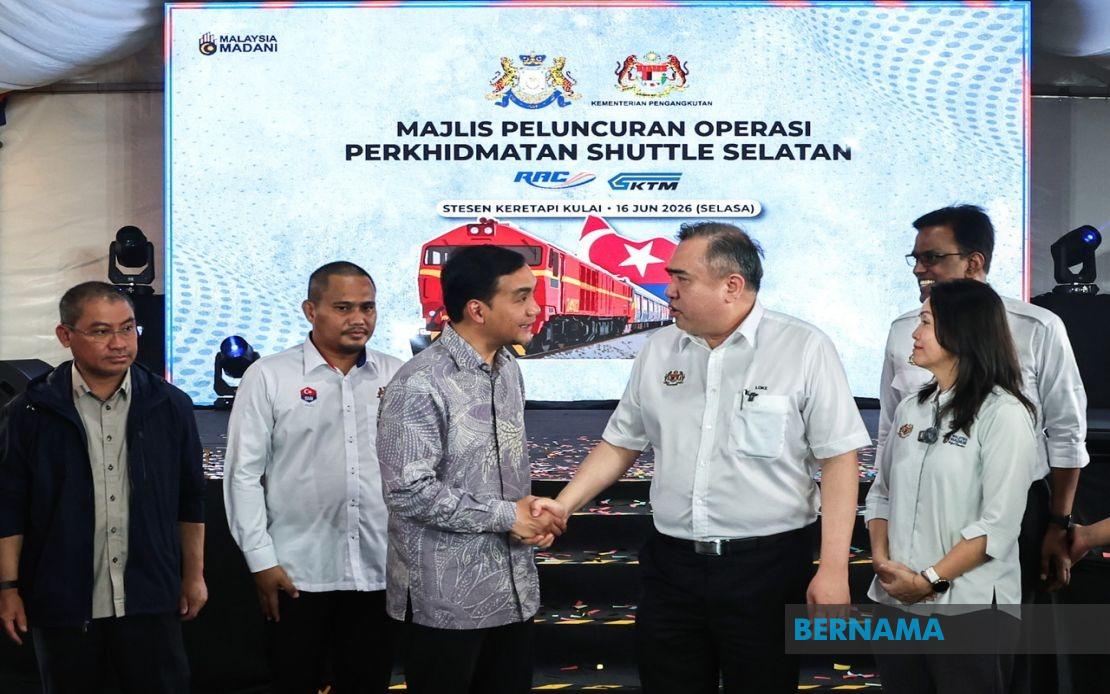
Malaysia's new Shuttle Selatan service has commenced operations, marking a significant infrastructure milestone for Johor's rapidly expanding economy. The rail-based public transport initiative was officially launched at Kulai KTM station and will directly serve more than two million residents across Kulai, JB Sentral and Pasir Gudang. Transport Minister Anthony Loke unveiled the service alongside Johor Menteri Besar Datuk Onn Hafiz Ghazi and state officials, signalling strong commitment from both federal and state authorities to address the region's growing transportation demands.
The inaugural phase of Shuttle Selatan operates along two primary corridors: Kulai-JB Sentral-Kulai and Kempas Baru-Pasir Gudang-Kempas Baru. These routes have been strategically designed to connect residential neighbourhoods with commercial and industrial zones, addressing the gap between where people live and where they work. Journey times are competitive for regional standards, with passengers travelling from Kulai to JB Sentral in approximately 40 minutes, while the Kempas Baru to Pasir Gudang leg requires 40 to 45 minutes. This efficiency improvement reflects modern rail standards and offers a genuine alternative to private vehicle use during peak commuting periods.
Looking ahead, the government has articulated an expansionist roadmap to maximise the network's reach and utility. Plans are underway to extend service from Paloh to Kulai via Kluang, Renggam and Layang-Layang stations, substantially increasing geographic coverage. Additionally, three new stations—Taman Daya, Bandar Baru Sri Alam and Pasir Putih—will be constructed to ensure more households and businesses have convenient access to the rail corridor. These developments suggest that authorities view Shuttle Selatan as foundational infrastructure for Johor's future growth rather than a temporary solution.
Integration with complementary transport modes underpins the service's practical viability. The government has implemented what amounts to a comprehensive first- and last-mile connectivity strategy, recognising that rail services alone cannot serve all journeys. Feeder bus services have been coordinated with the broader Bas.My network, dedicated shuttle operations serve Kempas Baru, and park-and-ride facilities at AEON Bandar Dato' Onn allow drivers to leave vehicles and transition to rail. This multi-modal approach acknowledges Malaysian travel patterns and maximises the network's accessibility for users across different income levels and geographic locations.
To stimulate adoption during the critical launch phase, the government introduced the Commuter MADANI Shuttle Selatan Card, a subsidised travel instrument designed to lower barriers to trial. The Railway Assets Corporation allocated more than RM150,000 in incentives, with 3,000 cards distributed free to Johor residents. Each card—valued at RM50—permits unlimited rides for a specified period, effectively removing cost concerns that might otherwise deter commuters from switching transport modes. This incentive mechanism reflects lessons learned from earlier public transport initiatives and demonstrates an understanding of behavioural economics in transit adoption.
The strategic rationale for Shuttle Selatan reflects Johor's transformation into a diversified economic powerhouse. The state ranks among Malaysia's fastest-growing, with expansion across industrial manufacturing, logistics operations, port activities, educational institutions and trade sectors. Each expansion necessitates reliable commuting infrastructure to support workforce mobility and talent retention. Without efficient public transport options, companies operating in dispersed Johor locations face recruitment challenges, and traffic congestion increasingly undermines productivity. Shuttle Selatan addresses these economic imperatives while supporting broader sustainability objectives.
Connectivity between residential areas, commercial city centres and industrial zones represents the core value proposition of Shuttle Selatan. Residents of established neighbourhoods like Taman Daya and Bandar Baru Sri Alam gain access to employment opportunities and services concentrated in JB Sentral and Pasir Gudang, whilst workers in logistics and manufacturing clusters can reach residential areas without lengthy commutes. This bidirectional connectivity supports labour market efficiency and potentially reduces pressure on property prices in central locations by making peripheral areas more accessible.
The service represents culmination of institutional cooperation between the Ministry of Transport, Keretapi Tanah Melayu Berhad and the Railway Assets Corporation, demonstrating how coordinated policy implementation can translate ambitions into tangible outcomes. Such coordination requires aligned incentives, shared targets and transparent communication among agencies—elements that have historically proven challenging in Malaysian infrastructure development. Success of Shuttle Selatan may therefore establish a template for future multi-agency transport projects across other states.
For Southeast Asia's broader regional context, Shuttle Selatan exemplifies how middle-income economies can deploy rail infrastructure to manage urbanisation pressures without replicating expensive mass rapid transit systems. The relatively modest scale compared to Klang Valley's LRT network makes it replicable in secondary cities across the region, potentially appealing to policymakers in Thailand, Vietnam and Indonesia seeking affordable public transport solutions. As these nations grapple with traffic congestion, air quality degradation and economic disruption from inadequate transportation, Malaysia's incremental rail expansion offers a pragmatic development pathway.
Implementation challenges will likely emerge as the service matures. Demand forecasting uncertainties mean service frequency and capacity may require adjustment as usage patterns crystallise. Maintenance protocols must ensure reliability exceeds that of competing private transport modes, or commuters will revert to personal vehicles. Fare sustainability requires balancing revenue needs against affordability objectives—a tension that subsidies initially mask but cannot resolve indefinitely. The government's demonstrated willingness to invest in supporting infrastructure and absorb initial losses through incentive schemes suggests commitment, but long-term operational viability ultimately depends on achieving service reliability and customer satisfaction that justifies public expenditure.
Sector observers will monitor Shuttle Selatan as an indicator of Malaysia's transport policy direction and investment capacity. Success would justify expansion to other growth corridors, particularly in Selangor, Negeri Sembilan and Perak where similar connectivity gaps exist. Disappointment or logistical failures would reinforce scepticism about public sector transport management and shift investor confidence toward private toll road and logistics networks. For Malaysian residents in the three Johor areas served, Shuttle Selatan represents immediate practical benefit—faster commutes, reduced driving stress and improved air quality—alongside broader implications for regional development patterns and sustainability trajectories.