The Selangor State Secretary's Office has cautioned residents across the state to exercise heightened vigilance against unsolicited short message service communications and online materials relating to the KitaSelangor Voucher initiative. The warning comes as scammers appear to be capitalising on public anticipation of the assistance programme by sending fraudulent messages that attempt to trick recipients into revealing personal information or downloading malicious content. Authorities stress that residents should immediately discard any such communications from unverified sources and refrain from interacting with embedded hyperlinks that may compromise their digital security.
The advisory represents a significant step in helping Selangor residents navigate the growing threat landscape of financial fraud targeting vulnerable populations. As programmes designed to alleviate economic hardship become more prevalent across Malaysia, criminals have increasingly turned their attention to impersonating government services and aid initiatives. The KitaSelangor Voucher programme, announced as a centrepiece of the state's economic support strategy, has apparently attracted the attention of sophisticated fraudsters seeking to exploit public awareness and urgency around the scheme.
Critically, the Selangor State Secretary's Office has clarified that the formal application process for the KitaSelangor Voucher Programme remains closed to the general public at present. This distinction is essential for residents to understand, as it means any current messages claiming to offer immediate access to the programme or requesting upfront payment or personal verification details are inherently fraudulent. The state government emphasises that genuine communications will only emanate through its official digital platforms and designated government channels, ensuring residents can distinguish legitimate information from criminal impersonation.
Officers have established a clear timeline for legitimate programme rollout beginning June 22, when the state government will issue an official public announcement. Eligible beneficiaries will subsequently receive authentic notification via SMS starting June 23, at which point they can proceed to verify their personal information and lodge applications through the dedicated KitaSelangor Voucher Portal. This staged approach allows authorities to manage the volume of applications while providing residents with a transparent schedule against which they can authenticate any messages they receive.
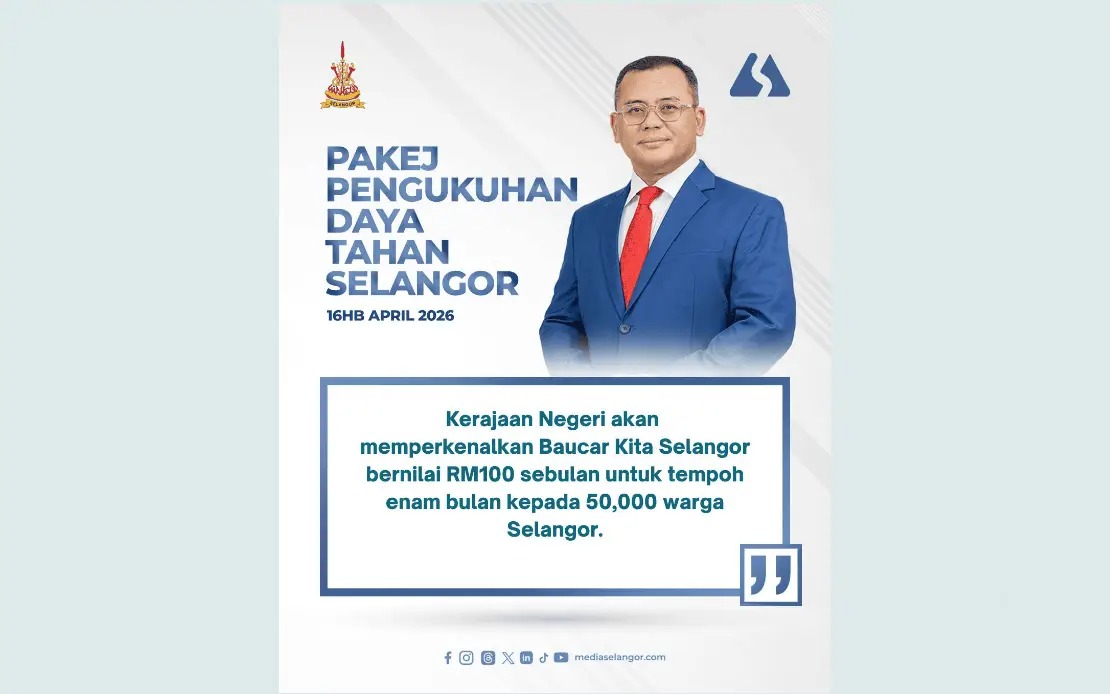
The programme targets approximately 50,000 low-income households across Selangor, each eligible to receive RM100 monthly across a six-month disbursement period commencing June 30. This substantial financial commitment forms part of the broader RM140 million Selangor Resilience Strengthening Package Phase 1, a comprehensive intervention unveiled in April designed to cushion residents against compounding economic pressures including elevated living costs, global supply chain disruptions, and macroeconomic uncertainty. Understanding the genuine scope and structure of the programme helps residents identify red flags in fraudulent communications that may reference incorrect benefit amounts, compressed timelines, or unusual procedural requirements.
The recipient population encompasses four distinct vulnerable groups identified through existing government databases and departmental records. Households classified as impoverished within the eKasih system form the primary cohort, supplemented by workers who have experienced recent retrenchment, individuals registered with the Social Welfare Department as belonging to particularly vulnerable populations, and single mothers satisfying the scheme's established eligibility criteria. This means legitimate applications will not require residents to re-establish their socioeconomic status through unsolicited requests, as the state government has already compiled participant lists based on verified administrative data.
The mechanics of fraudulent SMS schemes targeting such programmes typically involve creating artificial urgency, requesting verification of banking credentials, demanding small upfront fees purportedly for processing, or directing recipients to counterfeit portals designed to harvest personal identification details. Residents should recognise that legitimate government assistance programmes never request payment from beneficiaries prior to disbursement, nor do they solicit sensitive banking information via SMS or unsecured messaging channels. The state government's explicit guidance to await the June 22 announcement provides residents with an authoritative checkpoint against which to evaluate any messages they receive in the interim period.
For Malaysian consumers increasingly vulnerable to digital fraud as online services proliferate, this situation underscores the importance of maintaining healthy scepticism toward unexpected communications, regardless of apparent legitimacy or official branding. Scammers have demonstrated sophisticated capability in mimicking government logos, adopting official terminology, and replicating communication patterns, making visual or stylistic assessment an unreliable verification method. The only secure approach involves independently confirming programme details through official government websites, calling verified agency hotlines, or visiting physical government offices, rather than trusting information embedded within unsolicited digital messages.
The state government's preemptive public advisory represents a recognition that fraud prevention must be communicated proactively rather than reactively. By alerting residents before the legitimate application period commences, authorities hope to establish clear public understanding of authentic programme procedures, legitimate communication channels, and red flags that should trigger immediate suspicion. This approach proves particularly vital given that victims of financial fraud often experience not only direct financial loss but also secondary harm including compromised personal data, unauthorised credit accounts, and diminished trust in government assistance mechanisms.