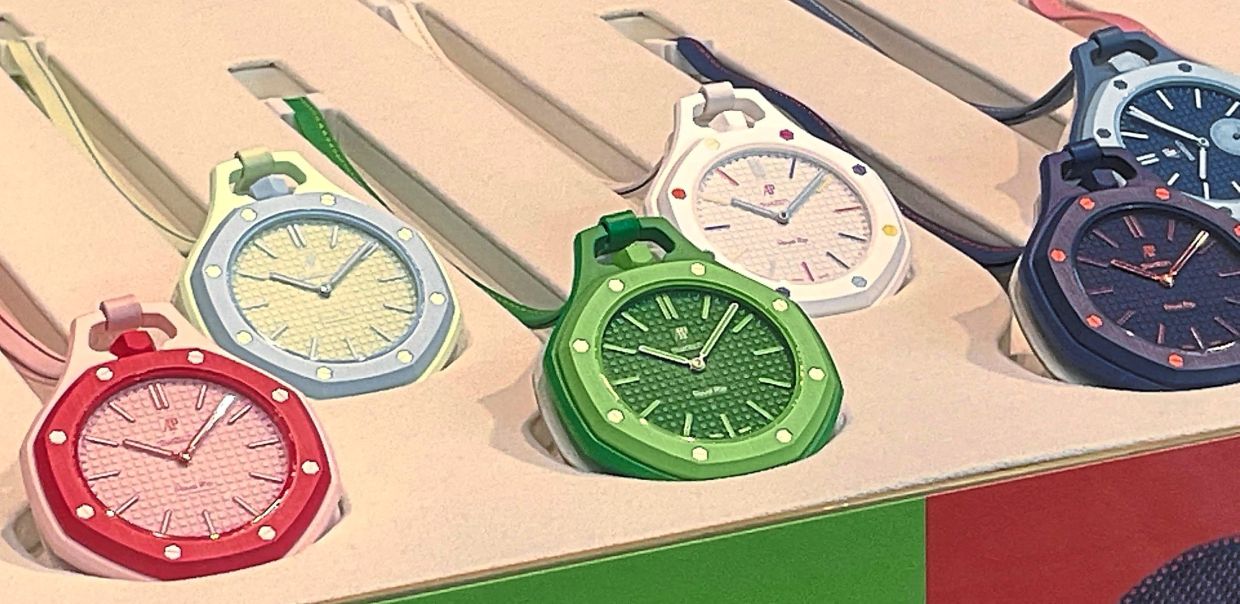
The global watch community experienced a seismic moment when Swatch and Audemars Piguet unveiled Royal Pop on May 16, unveiling a collaboration that transformed one of haute horlogerie's most prestigious designs into pocket watches retailing for less than RM1,800. The partnership represented far more than a simple co-branded release—it crystallised a fundamental shift in how ultra-premium brands approach market expansion, consumer engagement and the very definition of luxury in an era where scarcity and cultural relevance often outweigh exclusivity alone.
The months preceding the official announcement demonstrated masterful restraint in controlling narrative. Cryptic advertisements dotted newspapers and social platforms, teasing something both "iconic" and "unexpected," yet offering no concrete details. This deliberate opacity created a vacuum that the watch community eagerly filled with speculation, generating countless artificial intelligence mock-ups circulating through Reddit, Instagram and niche horological forums. The engineering of mystery proved remarkably effective—strict non-disclosure agreements, compartmentalised teams and a near-total absence of leaked materials meant that authentic information remained elusive until the moment of reveal.
When the wraps finally came off, the offering confounded expectations. Rather than wristwatches challenging Audemars Piguet's core business, Swatch and AP introduced eight vividly coloured bioceramic pocket watches that distilled the most recognisable visual language of Gerald Genta's legendary Royal Oak design into an entirely different format. The octagonal bezel, distinctive "Petite Tapisserie" dial pattern and eight exposed hexagonal screws immediately anchored the collection to its horological pedigree, yet the execution—pocket watches in playful bioceramic rather than precious metal wristwatches—established clear daylight between Royal Pop and Audemars Piguet's main line.
The collection's technical specifications underscored this strategic separation. Two configurations emerged: Lepine models with traditional crown placement at twelve o'clock, and Savonnette pieces featuring the crown repositioned at three o'clock alongside a small seconds subdial. Both housed hand-wound SISTEM51 movements—mechanically engaging in their minimalist construction but philosophically distant from the complex complications and artisanal finishing that define Audemars Piguet's reputation. This deliberate positioning as a cheeky reinterpretation rather than an "affordable Royal Oak" proved crucial to the collaboration's success. Had Swatch introduced a wallet-friendly wristwatch borrowing the Royal Oak's proportions, it would have posed existential threats to a brand where entry-level models command prices approaching RM94,881.
The pocket watch format itself offered sophisticated brand protection. This category, steeped in nostalgia and increasingly peripheral to contemporary horological practice, occupied a cultural space entirely distinct from Audemars Piguet's contemporary wristwatch dominance. By channelling the Royal Oak's DNA into pocket watches—objects that appeal to collectors and enthusiasts rather than primary watch-wearing consumers—Audemars Piguet preserved its exclusivity whilst simultaneously expanding its cultural reach. The bioceramic material further reinforced the playful, almost toy-like character of the collection, signalling to discerning consumers that this was pastiche and homage rather than direct competition.
For Swatch, Royal Pop represented the logical continuation of its transformative 2022 collaboration with Omega on the MoonSwatch. That earlier partnership demonstrated with crystalline clarity the commercial and cultural power of pairing mass-market accessibility with prestigious horological heritage. Long queues materialised at retailers globally; law enforcement deployment became necessary in several cities to manage surging crowds; and secondary market resellers rapidly escalated prices well beyond retail. The phenomenon proved that engineered scarcity, even at price points below RM1,265, could generate disproportionate cultural momentum, commercial returns and brand elevation that far exceeded the watches' intrinsic technical merit.
Royal Pop amplified these lessons whilst introducing novel complexity. Unlike the MoonSwatch collaboration, where Omega remained tethered to the Swatch Group corporate structure, Audemars Piguet operates as an independent entity. This independence transforms Royal Pop from a mere corporate co-branding exercise into something more significant—evidence that Swatch has successfully positioned itself as a platform through which elite, independent luxury houses can achieve demographic expansion without diluting their core product lines or brand prestige. The partnership signals a new model for luxury marketing in which accessibility and exclusivity coexist through careful product segmentation and scarcity management.
Pat Law, founder of Goodstuph, a Kuala Lumpur-based social marketing agency, articulates the psychological mechanics underlying such collaborations with precision. From Swatch's perspective, the partnership delivers immediate cultural elevation—a mass-market plastic watch instantaneously inherits decades of horological craftsmanship, heritage and the kind of technical snobbery that typically remains locked behind Audemars Piguet's rarefied walls. The association transforms Swatch's brand positioning from accessible commodity to legitimate participant in luxury discourse, a psychological shift that carries profound implications for consumer perception and retailer positioning.
For Audemars Piguet, the calculus differs markedly. The collaboration grants the independent watchmaker relevance and visibility at significant scale without requiring dilution of its primary product offerings. Most young consumers would never cross the threshold of an Audemars Piguet boutique; the financial and psychological barriers remain insurmountable. Yet through Royal Pop, the brand achieves what marketers term "cultural rent-free residing"—Audemars Piguet gains durable presence in the consciousness of potential future clients years before they possess the wealth to purchase authentic pieces. The brand establishes emotional connection and familiarity that may eventually translate into purchase intention when those younger consumers attain the financial capacity to invest in genuine luxury timepieces.
Yet this democratisation strategy carries legitimate risks that academic luxury marketing research has extensively documented. Short-term hype and initial sales momentum frequently mask longer-term brand erosion when excessive accessibility dilutes a luxury house's core cachet. Studies consistently demonstrate that overexposure to a brand's visual identity, when distributed too broadly across price-accessible products, can fundamentally compromise its exclusivity perception. The challenge facing Audemars Piguet and Swatch involves maintaining the delicate equilibrium between cultural accessibility and aspirational exclusivity—broadening appeal without triggering the perception among core high-net-worth clientele that the brand has abandoned its heritage or compromised its standards.
The Royal Pop phenomenon also reflects broader shifts in how luxury operates within contemporary consumer culture, particularly among Southeast Asian markets where watch collecting commands passionate engagement. Scarcity, often engineered rather than inherent, has become a primary driver of value perception and desirability. The watches' technical specifications matter far less than their cultural positioning, the narrative surrounding their release and the competitive friction generated by limited availability. This represents a notable departure from earlier luxury frameworks where craftsmanship, materials and mechanical complexity formed the primary value propositions.
Looking forward, Royal Pop's success will likely inspire additional independent luxury collaborations with accessible mass-market brands, potentially reshaping how premium houses approach demographic expansion. The pocket watch category may experience unexpected revival, as Audemars Piguet and Swatch have demonstrated its viability as a cultural and commercial vehicle. For Malaysian watch enthusiasts and collectors, the collaboration offers a fascinating case study in contemporary luxury marketing—one that suggests the most powerful luxury goods increasingly derive their value not from intrinsic properties but from carefully curated scarcity, narrative control and strategic brand positioning that maintains prestige whilst achieving unprecedented accessibility.