The Royal Malaysian Air Force has embarked on a significant infrastructure upgrade by deploying air defence and surveillance radar systems at multiple strategic locations nationwide, marking a tangible step toward modernising the nation's aerial security posture. Speaking at the RMAF's 68th Anniversary Parade in Subang on June 18, Chief of Air Force General Tan Sri Muhamad Norazlan Aris announced that the force is establishing radar installations in Bintulu, Sarawak; Bukit Puteri, Terengganu; Bukit Lunchu, Johor; and Pulau Layang-Layang in the South China Sea, representing a coordinated effort to enhance detection capabilities across the country's vast airspace.
The initiative forms part of the RMAF's broader Capability Development Plan 2055, commonly referred to as CAP55, which articulates the force's ambitions to sustain technological relevance and operational effectiveness through the coming decades. By distributing radar assets across geographically dispersed locations, the air force aims to eliminate surveillance blind spots that have historically constrained Malaysia's ability to monitor its airspace comprehensively. The selection of these particular sites reflects strategic thinking about coverage priorities, balancing the need to oversee the peninsula's interior regions with critical maritime zones and peripheral territories.
Muhamad Norazlan emphasised that these radar capabilities serve as vital infrastructure for early warning systems, allowing the RMAF to detect potential threats at greater distances and respond with enhanced lead time. The significance of such systems extends beyond conventional air defence considerations; they provide crucial situational awareness in an increasingly complex and contested regional environment. For a nation whose geographic position places it at the intersection of major shipping lanes and geopolitical currents, this investment in detection infrastructure addresses longstanding vulnerabilities that previous budgetary constraints had left unresolved.
The air force chief contextualised this modernisation within broader regional security dynamics, specifically drawing lessons from the ongoing West Asian conflicts. He highlighted how disruptions to the Strait of Hormuz, a critical chokepoint for global energy flows, have cascading effects across international commerce, supply chains, and price stability. These disruptions underscore the interconnectedness of regional security and economic resilience—a reality with direct implications for Malaysia, which relies heavily on maritime trade corridors for its prosperity and energy security.
Malaysia's own strategic waterways—particularly the Strait of Malacca and the South China Sea—constitute equally vital arteries for the nation's economic survival. The Strait of Malacca alone handles a substantial portion of global maritime trade, making it essential for Malaysian economic interests. The placement of surveillance radar on Pulau Layang-Layang specifically addresses growing concerns about operational visibility in the South China Sea, a region where multiple territorial claims, military activities, and economic competition have intensified scrutiny of air and maritime domains. This positioning allows Malaysia to maintain better awareness of activities within its claimed zones and surrounding waters.
Muhamad Norazlan's remarks underscore an implicit strategic calculation: maintaining robust air defence and surveillance capabilities has become non-negotiable for safeguarding national sovereignty and economic interests. Regional volatility, whether stemming from Middle Eastern tensions or South China Sea assertiveness, creates security environments where early warning systems and rapid response capabilities offer tangible advantages. For Malaysia, which has historically sought to balance its strategic autonomy with pragmatic engagement, investing in these defensive capabilities represents a sensible middle path—demonstrating resolve without provocative posturing.
The CAP55 initiative reflects recognition that air forces must evolve continuously to remain credible. Legacy systems become obsolete as threats proliferate and sophistication increases, requiring sustained investment cycles. By anchoring modernisation within a long-term strategic framework extending to 2055, the RMAF signals commitment to institutional planning beyond electoral cycles and budget seasons. This temporal horizon acknowledges that meaningful capability development requires patience, sustained funding, and consistency across multiple administrations.
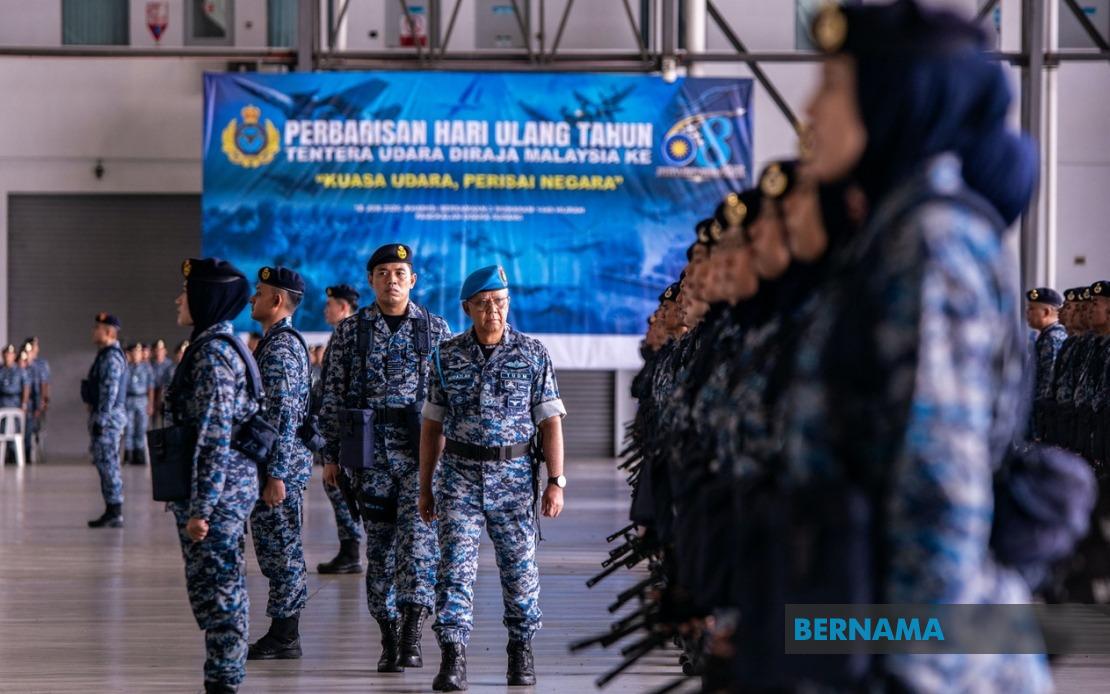
The anniversary parade itself, themed 'Kuasa Udara, Perisai Negara' (Air Power, National Shield), served as both celebration and statement of purpose. The participation of 16 officers and 272 personnel across four distinctive flights—including the Special Forces unit PASKAU, the Ground Defence Force HANDAU, the Women's Composite Flight, and the Multi-Trade Composite Flight—demonstrated the breadth of the air force's operational structure. The parade commander, Lieutenant Colonel Mohd Nazree Mansor, oversaw the ceremonial review with General Muhamad Norazlan receiving the traditional general salute, affirming established hierarchies and institutional traditions.
Beyond the ceremonial aspects, the awarding of service medals to 17 recipients during the parade reflected the air force's institutional culture of recognising sustained contribution and exemplary performance. The Pingat Perkhidmatan Am, Pingat Perkhidmatan Setia, and Chief of Air Force Commendation Certificates represented formal acknowledgement of professional commitment, matters of significance within military cultures where recognition reinforces standards and motivates continuity.
The radar deployment programme carries implications extending beyond military-technical domains. For Malaysian defence planners, it represents tangible investment in capabilities that can provide strategic insurance against unpredictable contingencies. For the broader region, it signals that Southeast Asian nations continue investing in self-help measures to preserve operational autonomy. As external powers maintain or expand regional presence, smaller nations like Malaysia strengthen domestic capabilities to avoid excessive dependence on alliance arrangements for basic security functions.
The South China Sea placement deserves particular attention, as it addresses one of Asia's most contested maritime zones. Malaysian installations there assert presence, extend surveillance reach, and create documentary evidence of operational activity—factors relevant to broader debates about regional entitlements and sovereignty claims. While Malaysia has deliberately avoided taking maximalist positions in South China Sea disputes, maintaining credible surveillance and defensive capabilities reinforces its legitimate interests without aggressive escalation.
Looking ahead, the success of this radar deployment phase will likely determine the trajectory of subsequent CAP55 initiatives. These projects typically encounter delays, cost overruns, and technical challenges requiring adaptive management. If the RMAF executes this phase effectively, it establishes momentum for additional modernisation tranches. More fundamentally, it demonstrates that Malaysian defence planning can translate strategic concepts into operational reality—a capability not uniformly evident across Southeast Asian militaries.