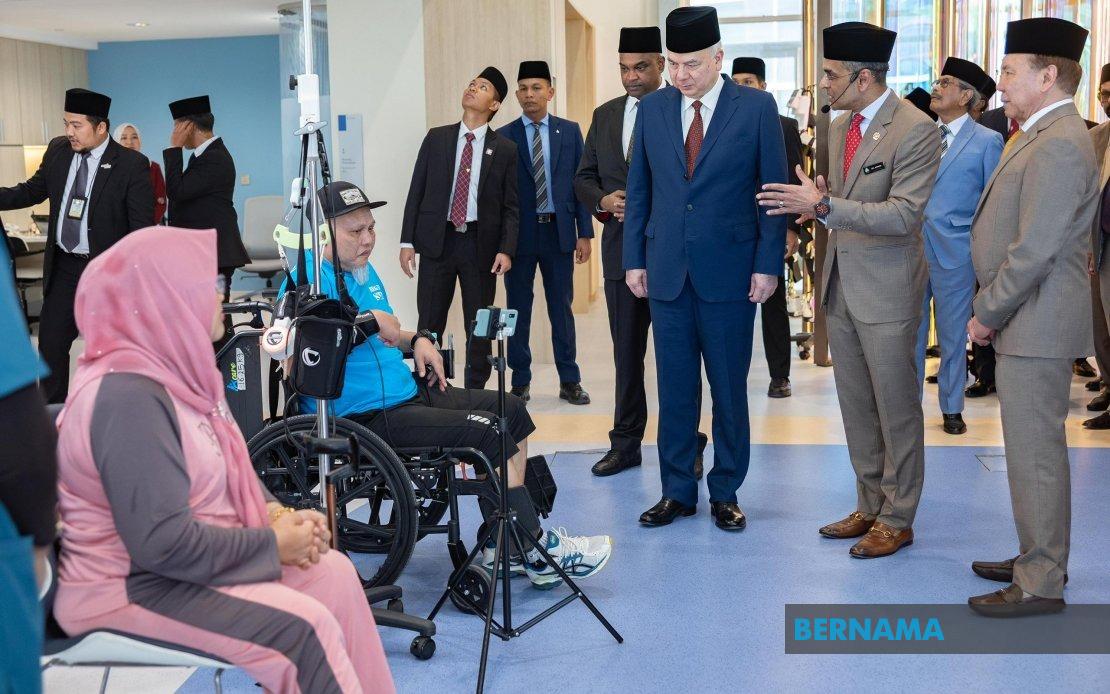
Perak's Sultan Nazrin Shah has officially inaugurated the Social Security Organisation's (PERKESO) Neuro-Robotics and Cybernetics Rehabilitation Centre in Meru Raya, a development that signals Malaysia's commitment to upgrading its rehabilitation infrastructure. The ceremony, held in Ipoh on June 16, saw the facility formally named "Pusat Rehabilitasi Perkeso Sultan Nazrin Shah" in recognition of the royal patron. The inauguration was attended by Raja Muda Perak Raja Jaafar Raja Muda Musa, Raja Di Hilir Perak Raja Iskandar Dzulkarnain Sultan Idris Shah, Menteri Besar Datuk Saarani Mohamad and Minister of Human Resources Datuk Seri R. Ramanan, underscoring the significance of the occasion for both state and federal authorities.
In his keynote address, Sultan Nazrin emphasised that the centre transcends the conventional understanding of a modern medical facility. Rather than viewing it merely as a repository of advanced machinery and technology, the Sultan characterised the institution's essential value as residing in the professional competence and human compassion of the healthcare practitioners who operate within it. This framing reflects a philosophical approach that positions technology as an enabler rather than the primary agent of healing, a distinction that carries considerable weight in contemporary debates about healthcare modernisation.
The centre brings together an interdisciplinary team spanning multiple specialised domains including medical specialists, assistants versed in adaptive and assistive technologies, physiotherapists, occupational and vocational rehabilitation experts, social workers and mental health professionals. This constellation of expertise enables comprehensive, patient-centred treatment protocols that address not merely the physical dimensions of recovery but equally the psychological, vocational and social aspects of rehabilitation. Such integration represents a departure from compartmentalised approaches that have historically characterised rehabilitation services in the region.
The Sultan articulated a broader vision for how the nation conceptualises rehabilitation and worker protection. He described the centre as emblematic of a fundamental philosophical shift, one that envisions rehabilitation services as simultaneously sophisticated, technologically advanced and grounded in humanistic values. This positioning addresses a tension often present in developing healthcare systems, where the pursuit of technological sophistication can inadvertently erode the personal, dignity-affirming dimensions of care. By explicitly endorsing both modernity and compassion as compatible objectives, Sultan Nazrin provided important legitimacy to an integrated approach.
The facility was originally conceived during the tenure of Ipoh Barat Member of Parliament M. Kulasegaran as Minister of Human Resources between 2018 and 2020. This continuity of vision across different administrations and political cycles suggests that rehabilitation modernisation enjoys cross-party support, a favourable indicator for sustained funding and policy consistency. The architectural design of the building draws inspiration from the traditional Malaysian art of gold-thread embossing, a choice that grounds the modern facility within cultural heritage, thereby reinforcing the notion that progress need not entail cultural displacement.
Sultan Nazrin articulated specific scenarios demonstrating how the centre's interventions translate into tangible life changes. For stroke patients, the facility offers pathways toward restoring motor function and mobility. Workers recovering from neurological injuries gain access to programmes designed to rebuild both physical capacity and mental resilience. Individuals contending with traumatic brain injury receive supportive environments conducive to recovering memory, communication abilities and psychological confidence. These examples illustrate that rehabilitation outcomes extend beyond physiological recovery to encompass restoration of agency and reintegration into functional social roles.
A particularly innovative dimension involves PERKESO's collaboration with 7-Eleven, whereby individuals completing rehabilitation programmes receive workplace training with realistic prospects for subsequent employment. This partnership model addresses a critical gap in the rehabilitation ecosystem: the transition from clinical recovery to economic self-sufficiency. By securing commitments from commercial enterprises to provide post-rehabilitation employment opportunities, the initiative transforms rehabilitation from a medical intervention into a pathway toward restored dignity and financial independence. Sultan Nazrin appealed to additional private sector organisations to adopt comparable corporate social responsibility frameworks.
The Sultan's address included an explicit call for societal transformation regarding attitudes toward disability. He articulated that eliminating prejudice against persons with disabilities constitutes a collective responsibility requiring sustained cultural change. This rhetorical emphasis reflects recognition that infrastructural and technological advances, whilst necessary, prove insufficient without concurrent shifts in social attitudes and employer practices. The integration of employment pathways into rehabilitation programming signals an understanding that dignity restoration requires not merely healing but genuine economic participation.
Broadly, Sultan Nazrin positioned rehabilitation modernisation within a framework of national development that extends beyond conventional metrics. He contended that authentic national progress should be assessed not solely through physical infrastructure development or aggregate economic indicators, but rather through the nation's capacity to implement social programmes that preserve human dignity, protect vulnerable populations and extend genuine second chances to individuals confronted by illness, injury or disability. This philosophical articulation provides intellectual justification for substantial public investment in rehabilitation services, positioning such expenditure as central to national identity rather than peripheral welfare provision.
For Malaysia and the Southeast Asian region, this facility represents a notable investment in worker protection systems. Given the region's manufacturing and construction sectors' reliance on labour-intensive processes, workplace injuries constitute a significant public health and economic burden. By establishing advanced rehabilitation capacity anchored to employment pathways, Malaysia signals commitment to protecting its workforce beyond the immediate post-injury period. The model, should it prove successful and scalable, could inform policy approaches across the region, particularly in neighbouring countries developing their social security infrastructures.
The emphasis on technology and specialist expertise reflects Malaysia's positioning as an upper-middle-income nation capable of deploying sophisticated medical technology. However, the explicit integration of vocational rehabilitation and employment facilitation distinguishes this approach from technology-centric models that emphasise clinical excellence whilst neglecting economic reintegration. For Malaysian workers and their families, the centre represents a tangible institutional commitment that workplace injuries need not constitute permanent economic displacement.
The naming of the facility after Sultan Nazrin Shah elevates rehabilitation within Perak's symbolic order, positioning worker protection as a matter of royal concern. This ceremonial dimension, whilst seemingly peripheral to operational questions, carries significance in Malaysian governance contexts where royal patronage provides both political legitimacy and sustained attention to policy domains. The inaugural ceremony thus serves communicative functions extending beyond the immediate gathering, signalling across government and society that rehabilitation modernisation constitutes a priority worthy of sustained resource allocation and institutional development.