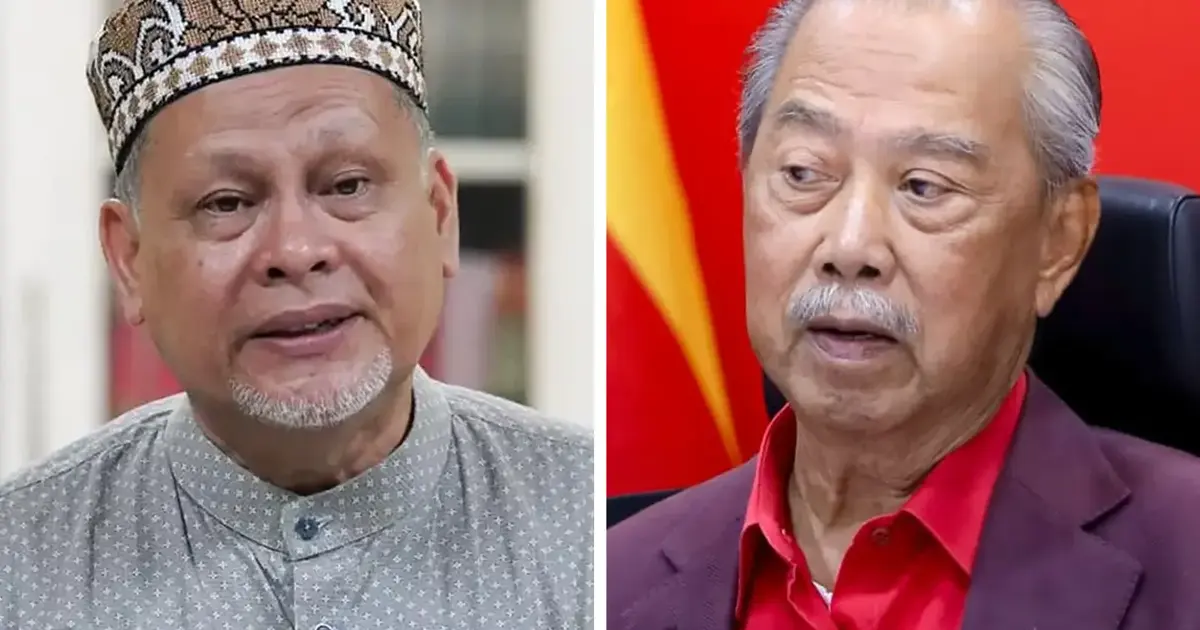
The relationship between PAS and Bersatu within the Perikatan Nasional coalition has come under strain following comments by Bersatu president Muhyiddin Yassin about contesting against PAS in elections, prompting a sharp rebuke from the Islamic party's leadership. PAS vice-president Amar Abdullah has characterized the prospect of running opposed candidates whilst maintaining coalition unity as logically inconsistent and politically untenable, raising fresh questions about the stability of the three-year-old opposition alliance.
The tension reflects deeper anxieties within Perikatan Nasional about seat allocation, electoral strategy, and the distribution of political gains across member parties. Amar Abdullah's intervention signals that PAS, one of the coalition's core pillars with substantial representation in parliament and state assemblies, will not silently accept scenarios where its coalition partner seeks to undermine its electoral position. The statement carries particular weight given PAS's critical role in anchoring the coalition through its 43 parliamentary seats and controlling several northern states including Kedah, Terengganu, and Kelantan.
Muhyiddin Yassin, who has helmed Bersatu since the party's formation in 2016 and previously served as prime minister under the Perikatan government from 2020 to 2021, has positioned himself as a vocal advocate for challenging PAS's electoral dominance in certain constituencies and state-level contests. His comments suggest frustration with existing power-sharing arrangements within the coalition, particularly regarding seat allocations that some Bersatu figures perceive as tilted towards PAS's favour. This friction exposes a persistent vulnerability in Perikatan's architecture: the difficulty of maintaining cohesion between parties with competing territorial and political ambitions.
PAS's ultimatum fundamentally reshapes the terms of the debate by demanding clarity and commitment. Rather than accepting Muhyiddin's electoral posturing as mere political maneuvering, Amar Abdullah has reframed it as incompatible with genuine coalition membership. The implicit message is unambiguous: parties cannot simultaneously enjoy the structural benefits of coalition partnership—shared campaign resources, coordinated campaign messaging, mutual support during parliamentary votes—while simultaneously plotting to displace their partners in elections. Such an approach would render coalition discipline meaningless and invite reciprocal challenges.
This confrontation carries implications extending beyond the immediate Bersatu-PAS relationship. Opposition parties throughout Malaysia and the region have struggled with the fundamental tension between maintaining strategic alliances and preserving internal autonomy. The Pakatan Harapan coalition, which governed Malaysia from 2018 to 2020, fractured partly due to similar pressures and disagreements over seat-sharing. Perikatan Nasional's leadership now faces comparable tests: whether the coalition can resolve territorial disputes internally through negotiation, or whether grievances will explode into open competition that damages all involved parties.
For Malaysian voters and political observers, the PAS-Bersatu friction underscores a critical vulnerability in opposition politics. Effective challenges to incumbent governments require stable, functioning coalitions capable of coordinating campaign strategies and maintaining legislative unity on crucial votes. When major partner parties openly discuss running against each other, the coalition's credibility as a unified governing alternative diminishes. This dynamic arguably strengthens the position of the governing Barisan Nasional coalition, which can present itself as a more stable, cohesive choice despite its own internal differences.
The timing of Amar Abdullah's statement is also significant. With general elections constitutionally required by September 2025, both national and state-level campaigns will dominate Malaysian politics during the coming months. Coalition partners must finalize seat allocations, agree on candidate selection criteria, and present unified manifestos. Unresolved tensions over electoral competition create dangerous ambiguity precisely when clarity and mutual commitment are most essential. Bersatu faces a choice: either retreat from its electoral ambitions and confirm its secondary role within Perikatan, or exit the coalition and establish itself as an independent political force.
Historically, Malaysian political coalitions have proved surprisingly durable despite persistent internal tensions. Barisan Nasional survived decades despite fierce competition between UMNO, MCA, and MIC over resources and representation. However, opposition coalitions have demonstrated greater fragility, partly because they lack the institutional machinery of government to distribute spoils and discipline members. Perikatan's challenge is managing ambitions that multiple parties legitimately harbor while preventing destructive defection or internal sabotage.
Bersatu's position has weakened considerably since the party's 2020 peak when Muhyiddin Yassin became prime minister. Subsequent political realignments, defections, and electoral setbacks have reduced Bersatu's parliamentary strength and territorial influence. This decline may explain Muhyiddin's interest in securing additional seats through electoral contests previously conceded to coalition partners. However, PAS's response demonstrates that such aspirations cannot be pursued unilaterally without confronting the logical contradictions they entail.
Moving forward, Perikatan Nasional's leadership must determine whether the coalition functions as a binding electoral and governing alliance, with members respecting agreed territorial arrangements, or as a looser coordination mechanism where parties retain freedom to compete wherever they choose. The practical reality of Malaysian politics suggests hybrid arrangements are inevitable—some constituencies will be contested, others protected—but explicit ground rules become essential. Without clarifying these terms, Perikatan faces escalating recriminations that could spiral into coalition-threatening fractures.
For Malaysia's broader political landscape, the PAS-Bersatu dispute highlights recurring themes: the tension between unity and autonomy, the challenge of distributing limited electoral opportunities fairly across coalition members, and the perpetual instability afflicting opposition politics. These issues will likely persist regardless of how the immediate Bersatu-PAS situation resolves, suggesting that Malaysia's opposition remains structurally vulnerable to the kind of fragmentation that has repeatedly destabilized its political alternatives to Barisan Nasional.