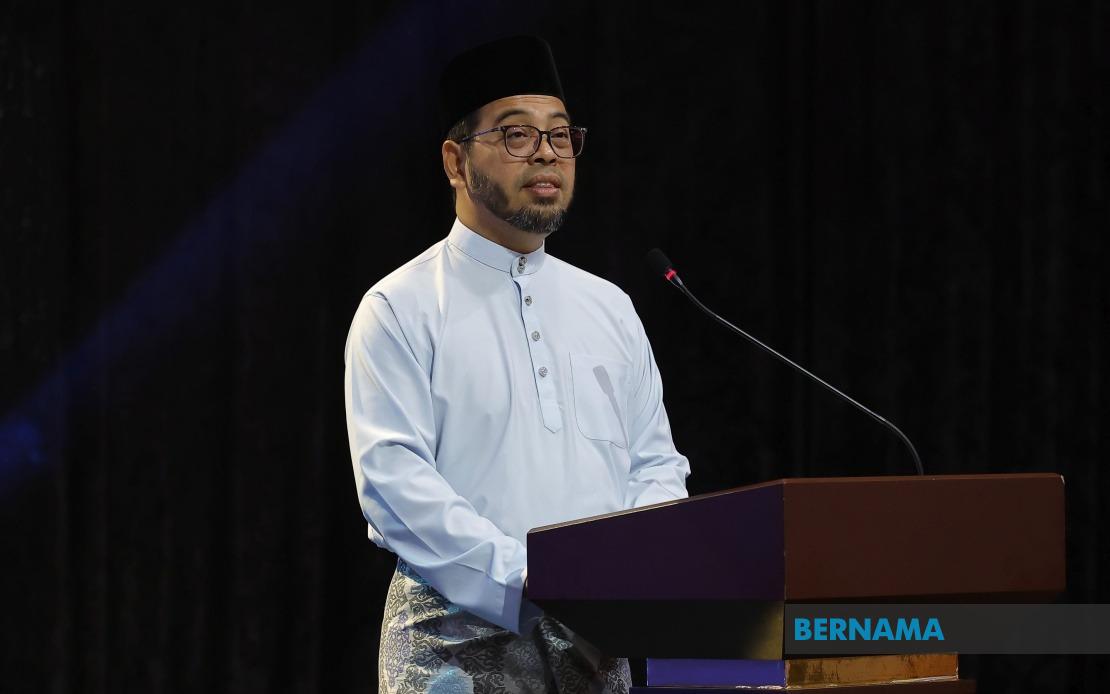
At a national Maal Hijrah celebration in Putrajaya on June 17, Dr Zulkifli Hasan, Minister in the Prime Minister's Department (Religious Affairs), delivered a stark message about the necessity for Malaysia's Muslim population to transcend factional divisions and foster genuine communal cohesion. Speaking at the Putra Mosque during the ceremony marking the Islamic New Year 1448H/2026M, Zulkifli underscored that persistent hostility and unresolved disputes within the ummah represent obstacles not merely to spiritual development but to the nation's capacity to withstand mounting external pressures. The event, which took place under the theme "MADANI Dihayati, Ummah Diberkati" and was attended by Sultan Nazrin Shah of Perak and Deputy Prime Minister Datuk Seri Fadillah Yusof, provided a platform for the government to reinforce its vision of a unified Muslim community capable of navigating contemporary challenges.
Zulkifli's remarks centred on a fundamental premise: that meaningful societal transformation cannot occur without corresponding individual development encompassing intellectual capacity, spiritual depth, and moral integrity. He articulated a view increasingly common among Malaysian policymakers—that national progress depends not on external policy initiatives alone but on the internal transformation of citizens themselves. By positioning personal moral development as prerequisite to community strength, the minister connected individual agency with collective welfare, suggesting that the fragmentation observed within Malaysian Muslim society stems partly from insufficient internal reflection and spiritual commitment among believers. This framing carries particular significance in the Malaysian context, where diverse Islamic schools of thought, generational divides, and socioeconomic differences have occasionally fractured the appearance of monolithic Muslim unity.
The minister presented community cohesion as fundamentally economically prudent. In an environment marked by global supply chain disruptions and widespread economic uncertainty affecting nations across the world, Zulkifli contended that Malaysia cannot afford the luxury of internal fragmentation. A strategically unified Muslim community, in this logic, represents a significant asset in the nation's armoury against international economic volatility. Malaysia's exposure to global market fluctuations, particularly given its integrated role in regional and world trade networks, renders it vulnerable to shocks originating beyond its borders. Against this backdrop, Zulkifli's emphasis on domestic unity acquires practical resonance—discord within the Muslim majority, he suggested, compounds vulnerability to external economic pressures by depleting the nation's social capital and cohesive capacity.
Crucially, Zulkifli articulated a vision of hijrah—traditionally understood as the Prophet Muhammad's migration from Mecca to Medina—that extends far beyond historical religious narrative. Rather than interpreting the concept as confined to a singular historical event, he proposed understanding it as an ongoing spiritual and moral trajectory. In this reconceptualisation, every Muslim engagement represents a hijrah of sorts—a movement away from harmful practices, destructive behaviours, and corrosive attitudes, and simultaneously a journey toward virtues and character traits that fortify rather than fracture community bonds. This innovative theological framing makes the Maal Hijrah celebration not merely a commemoration of distant history but an annual prompt for contemporary self-examination and recommitment to collective wellbeing. For Malaysian Muslims navigating complex plural societies and globalised economies, this reframing of hijrah as continuous internal migration offers a framework for understanding religious obligation as integral to nation-building.
The practical emphasis Zulkifli placed on strengthening community unity before attempting to elevate Islamic values represents a sequencing argument of considerable importance. He maintained that without first achieving robust internal cohesion, attempts to promote Islamic values remain fragmentary and less effective. This subordination of value-promotion to community-building suggests that the minister views sectarian disputes and internal discord as undermining the very Islamic principles the government seeks to advance. In Malaysian context, where Sunni-Shia differences, varying interpretations of Islamic law, and generational disputes over Islamic practice occasionally surface in public discourse, this call for unity carries specific contemporary relevance. By insisting that internal harmony must precede or accompany value promotion, Zulkifli attempts to foreclose arguments that Islamic advancement requires victory of one theological position over others.
Simultaneously, Zulkifli attempted to balance his appeal to Muslim unity with an inclusive national message. He emphasised that despite variations in religious belief and cultural background, all Malaysian citizens share collective responsibility for preserving peace, stability, and prosperity. This rhetorical move—invoking Muslim unity while simultaneously gesturing toward broader national unity—reflects the delicate balance Malaysian governments must maintain when addressing the Muslim-majority population without alienating significant religious minorities. By framing stability and prosperity as shared national projects rather than exclusively Islamic concerns, Zulkifli positioned Muslim community strength not as parochial advancement but as contribution to national flourishing benefiting all Malaysians.
The award presentations during the ceremony reinforced the government's commitment to elevating Islamic scholarship and moral leadership. The National Tokoh Maal Hijrah award, presented to Prof Emeritus Datuk Dr Osman Bakar of International Islamic University Malaysia, recognised indigenous Islamic intellectual leadership, while the International Tokoh Maal Hijrah award to Moroccan Islamic scholar Dr Ahmad Al-Raysuni acknowledged transnational Islamic learning and cross-regional scholarly exchange. These selections suggest the government's interest in positioning Malaysia as part of a broader Islamic intellectual community while also nurturing local Islamic thought leadership. For regional readers, the inclusion of Moroccan scholarship indicates Southeast Asian engagement with North African Islamic traditions, reflecting the interconnected nature of contemporary Islamic intellectual networks.
The attendance of Sultan Nazrin Shah, as constitutional protector of Islam in Perak and member of the Malaysian royal hierarchy that collectively holds custodianship of Islam throughout the nation, lent institutional weight to Zulkifli's message. The Sultan's presence signalled that the call for Muslim unity carries not merely ministerial authority but also the symbolic authority of the monarchy, which constitutionally represents Islamic leadership within the Malaysian framework. This ceremonial conjunction of executive governmental authority and constitutional Islamic guardianship underscored the official nature of the appeal, presenting it not as partisan political messaging but as counsel emerging from the highest institutional levels of Malaysian Islamic governance.
For Malaysian readers and broader Southeast Asian observers, Zulkifli's address represents a significant articulation of how one Muslim-majority nation's leadership conceptualises the relationship between internal religious community cohesion and national capacity for managing contemporary challenges. The speech implicitly acknowledges that Malaysia's Muslim population, despite constituting the demographic majority, faces fragmentation—whether doctrinal, generational, or class-based—that diminishes collective strength. By reframing hijrah as continuous personal and communal migration toward greater virtue and unity, Zulkifli offers a theological vocabulary for addressing observable discord without appearing to privilege particular Islamic schools or interpretations. Whether this call for unity will substantially influence Malaysian Muslim community trajectories remains uncertain, but it clarifies how governmental and institutional leadership understands the stakes of internal Muslim cohesion in an era of accelerating global economic and security challenges.