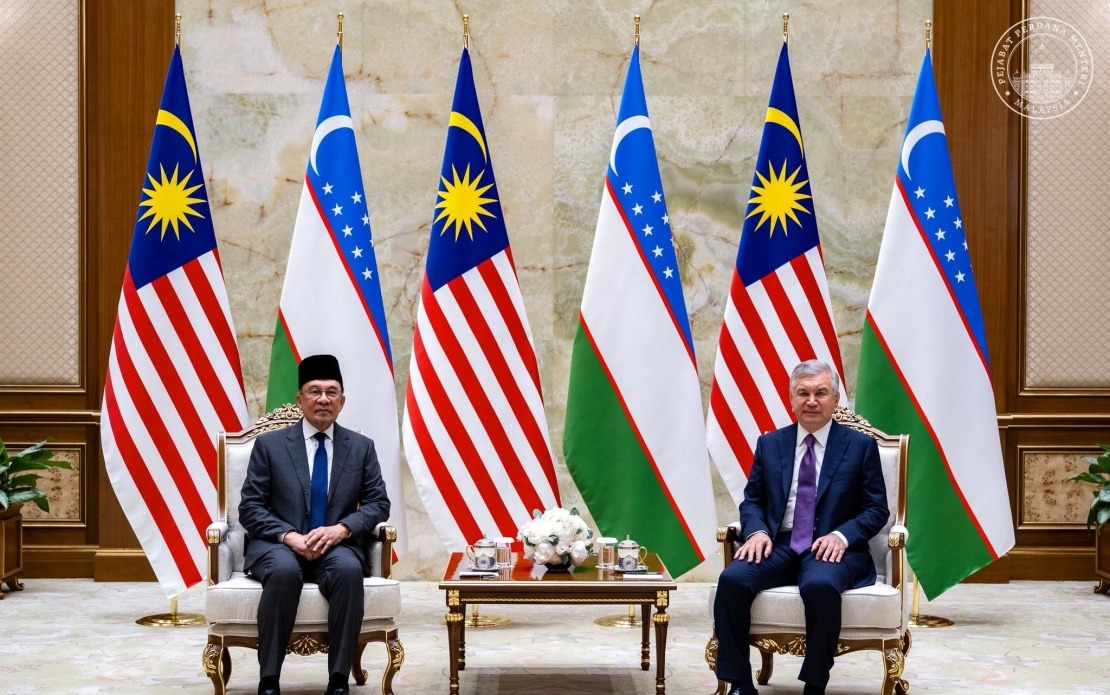
Prime Minister Datuk Seri Anwar Ibrahim has signalled Malaysia's readiness to deepen strategic engagement with Uzbekistan across multiple economic and cultural sectors, with both nations identifying substantial room for collaboration in energy, commerce, education and the halal ecosystem. The commitment emerged from a bilateral meeting between Anwar and Uzbekistan President Shavkat Mirziyoyev during a transit stop in Tashkent on June 17, as the Malaysian delegation proceeded to Kazan for the ASEAN-Russia Commemorative Summit scheduled for June 17-18.
The encounter, though conducted as a brief stopover discussion, addressed substantive areas where Malaysian and Uzbek interests converge. According to Anwar's account, the leaders explored mechanisms to elevate ongoing bilateral initiatives that already demonstrate measurable momentum across several domains. The Prime Minister identified trade, investment and educational exchanges as immediate priorities, reflecting a pragmatic focus on commerce and human capital development that typically underpins durable diplomatic relationships in the region.
Energy cooperation emerged as a cornerstone of the proposed framework, with particular emphasis on gas and petroleum industries. For Malaysia, a nation with established expertise in energy extraction and liquefied natural gas processing, collaboration with Uzbekistan represents an opportunity to leverage Central Asian resources while strengthening supply chain resilience. Conversely, Uzbekistan gains access to Malaysian technical knowledge and market expertise. Such partnerships carry significance beyond bilateral economics, as reliable energy corridors contribute to broader Asian stability and reduce regional dependency on volatile global markets.
The halal industry represents an increasingly prominent axis for Malaysia-Uzbekistan engagement. As a Muslim-majority nation with growing interest in Sharia-compliant commerce, Uzbekistan aligns naturally with Malaysia's position as a global halal certification and standards hub. This sector encompasses not merely food production but pharmaceuticals, cosmetics, financial services and tourism infrastructure, creating cascading economic opportunities. Malaysian enterprises operating in halal certification, logistics and retail distribution could tap into Central Asian demand while establishing competitive advantages in emerging markets.
Educational cooperation and scholarly exchange formed another substantive element of the discussion. Anwar emphasised the mutual benefit of strengthening academic partnerships and knowledge transfer, particularly concerning Islamic civilisation and its historical contributions to human advancement. This framing situates the relationship beyond transactional commerce, positioning it as a civilisational dialogue that resonates with Malaysia's long-standing commitment to positioning itself as a centre for Islamic learning and scholarship in the contemporary world.
Tourism featured prominently in the conversation, reflecting growing interest from Malaysian travellers seeking alternative destinations beyond traditional circuits. Uzbekistan's rich architectural heritage, particularly in Samarkand and Bukhara, holds considerable appeal for Malaysian visitors, while Kuala Lumpur and Malaysian cultural attractions present reciprocal draws for Uzbek tourists. Expanded tourism cooperation typically requires harmonisation of visa procedures, enhanced air connectivity and coordinated marketing initiatives—elements that governments can facilitate through bilateral frameworks.
Anwar's acknowledgement of Uzbekistan's commitment to strengthening relations with ASEAN countries signals appreciation for Central Asian engagement with Southeast Asia at a moment when regional geopolitics increasingly emphasises multi-vector foreign policies. Uzbekistan's strategic position along historical Silk Road corridors and its influence within Central Asian governance structures make it a valuable partner for ASEAN's broader outreach ambitions. This context suggests Malaysia views the bilateral relationship partly as a gateway to broader Central Asian engagement, potentially creating spillover benefits for ASEAN's developing partnerships in that region.
The emphasis on cooperation that elevates human dignity and promotes equitable development reflects aspirational language increasingly common in Malaysian diplomatic discourse. Beyond rhetorical flourish, however, such framing indicates intent to structure partnerships around inclusive growth principles rather than extractive models that concentrate benefits narrowly. For emerging markets like those in Central Asia, this positioning appeals to nationalistic sentiments around sovereignty and equitable benefit-sharing.
The timing of the meeting, coinciding with Malaysia's attendance at an ASEAN-Russia summit, underscores the interconnected nature of contemporary Asian diplomacy. While major bilateral relationships receive sustained attention, crucial secondary partnerships often crystallise during transit opportunities or multilateral gatherings. Tashkent's position as a transit hub made the Anwar-Mirziyoyev encounter logistically practical, yet the substantive discussion suggests both governments view the relationship with genuine strategic weight.
Practical implementation of expanded cooperation will require institutional mechanisms beyond political declarations. Bilateral chambers of commerce, trade missions, joint working groups on energy and education standards, and enhanced consular presence typically facilitate the transition from ministerial statements to tangible commercial activity. Malaysia's established experience establishing such frameworks positions it well to lead institutional development.
For Malaysian businesses, particularly those in energy, financial services, halal certification and construction, the trajectory outlined offers concrete prospects. Central Asian markets, though smaller than traditional Southeast Asian destinations, present less saturated competition and growing purchasing power, making them attractive for medium-sized enterprises seeking diversification beyond domestic and regional markets.
The relationship also reflects broader Malaysian foreign policy trends emphasising South-South cooperation and diversification of strategic partnerships beyond traditional Western and regional alignments. By strengthening ties with Central Asian nations, Malaysia reinforces its positioning as a connector between worlds—Islamic, Asian, and increasingly, Central Asian—a diplomatic identity that enhances its utility as a partner for multiple constituencies.