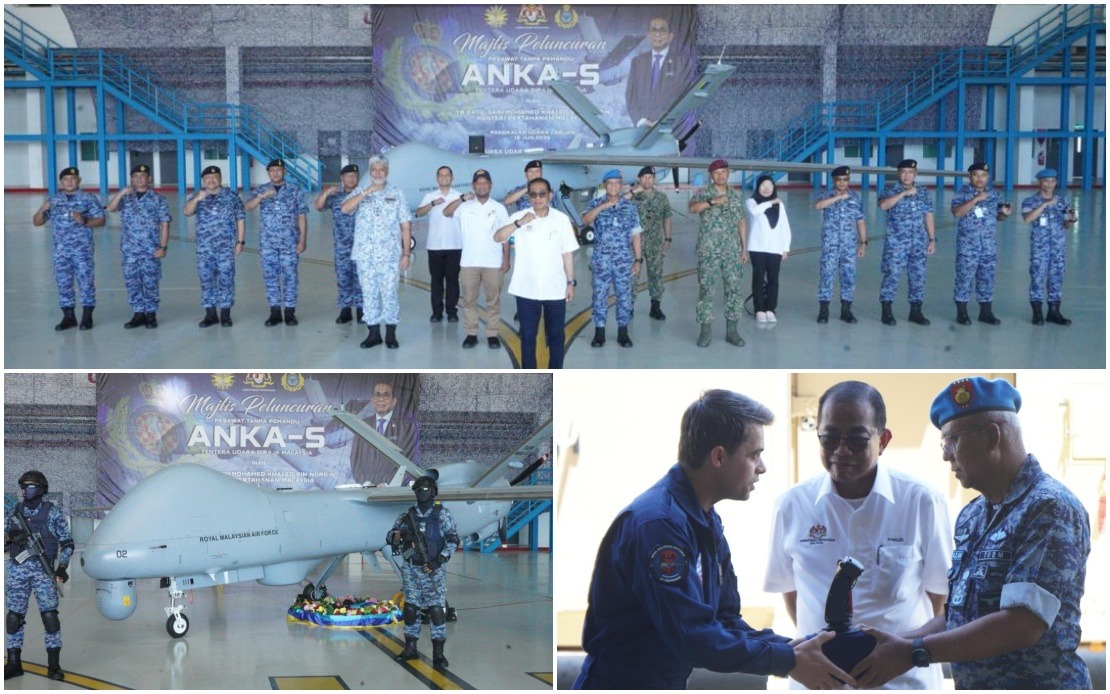
Malaysia has taken a significant step in modernising its defence infrastructure with the operational deployment of the ANKA-S Unmanned Aircraft System by the Royal Malaysian Air Force, Defence Minister Datuk Seri Mohamed Khaled Nordin announced at Labuan Air Base on June 16. The introduction of this advanced surveillance platform represents a watershed moment in the country's ability to monitor and protect its extensive maritime interests, particularly across one of the world's most strategically vital and contested waterways.
The acquisition and deployment of the ANKA-S represents Malaysia's recognition that traditional maritime patrol methods—whether relying on fighter jets or large naval vessels—are increasingly insufficient for comprehensive coverage of the nation's vast ocean territories. At a total investment of RM423.8 million for three aircraft, including ground control stations and two years of personnel training, the project underscores the government's commitment to leveraging cutting-edge technology for national defence. This capital expenditure reflects the critical importance placed on establishing a credible surveillance presence in waters where Malaysia's economic interests and territorial claims converge with those of multiple regional powers.
The ANKA-S platform operates as a Medium Altitude Long Endurance system, capable of sustaining flight for more than 24 hours at operational altitudes reaching 30,000 feet. These technical specifications translate to unprecedented capability for continuous monitoring without the need for frequent aircraft rotation or the enormous operational costs associated with conventional surveillance methods. The system's ability to function across varying weather conditions and maintain positions that are difficult to detect ensures that Malaysia can maintain consistent intelligence gathering even during monsoon seasons or adverse meteorological conditions that would ground conventional patrol aircraft.
Beyond raw surveillance capacity, the ANKA-S system offers Malaysia a crucial advantage in precision maritime domain awareness. The aircraft can accurately identify and track vessel profiles, enabling the air force to distinguish between routine commercial traffic and potentially problematic incursions. This capability addresses a persistent challenge facing regional naval and air forces: the sheer volume of maritime traffic makes undirected patrols inefficient. With intelligence gathered through the ANKA-S, Malaysian defence assets can deploy strategically to verified intrusion locations rather than conducting resource-intensive sweeps across vast ocean areas. This efficiency gain has substantial implications for a defence budget that must balance numerous competing priorities.
The economic argument supporting the ANKA-S deployment cannot be overstated for Malaysian defence planners. Operating unmanned systems proves substantially cheaper than maintaining continuous patrols by fighter aircraft or large maritime patrol vessels, which consume considerable fuel and require extensive maintenance. For a nation managing defence expenditures across land, sea, and air domains while addressing multiple security challenges, this cost differential permits greater operational tempo and broader geographic coverage without proportionate increases in defence spending. The system essentially multiplies Malaysia's effective surveillance reach across the South China Sea without the massive infrastructure and personnel requirements of conventional approaches.
A particularly significant aspect of Malaysia's deployment strategy involves the deliberate decision not to arm the ANKA-S platforms despite their technical capability to carry weapons. This choice carries substantial diplomatic weight, signalling to regional powers and the international community that Malaysia's defensive posture remains strictly protective rather than aggressive. In the fraught environment of the South China Sea, where rising tensions and competing claims create a volatile equilibrium, this messaging proves valuable. Malaysia positions itself as a nation strengthening legitimate surveillance and sovereignty protection rather than pursuing militarisation, a distinction that carries weight in international forums and maintains space for Malaysia to engage in regional diplomacy.
The Labuan Air Base deployment location itself holds strategic significance beyond mere administrative convenience. Labuan's position relative to key maritime routes and contested waters makes it an ideal hub for sustained surveillance operations. The establishment of a Data Exploitation Centre at the base indicates Malaysia's commitment not merely to collecting raw intelligence but to processing, analysing, and operationalising that information to enhance situational awareness across government agencies responsible for maritime security, environmental monitoring, and law enforcement. This institutional integration ensures that the ANKA-S investment translates into tangible improvements in actual maritime domain awareness rather than generating data that sits unused.
For Malaysian policymakers, the ANKA-S acquisition demonstrates a pragmatic approach to asymmetric capability development. Rather than engaging in expensive naval or air force expansion that would require sustained high defence spending, Malaysia leverages unmanned systems to achieve disproportionate surveillance gains. This approach particularly suits a nation operating within the constraints of regional power balances, where overt militarisation could provoke diplomatic complications but enhanced surveillance capabilities serve straightforward national interests in understanding activity within claimed maritime zones.
The government's indication that it is considering acquisition of three additional ANKA-S aircraft under a second phase suggests confidence in the initial deployment and recognition that six systems would provide more comprehensive coverage across Malaysia's maritime responsibilities. The proposal for expansion through established national development planning frameworks indicates that policymakers view this programme not as a temporary response to particular events but as foundational infrastructure for sustained maritime security. This long-term commitment signals that Malaysia is building institutional capacity for persistent intelligence gathering rather than fluctuating responses to periodic crises.
From a regional perspective, Malaysia's ANKA-S deployment contributes to the technical sophistication of Southeast Asian maritime surveillance capabilities. As nations throughout the region grapple with similar challenges around sovereignty protection and maritime awareness, Malaysia's experience with this system may establish patterns for other countries considering similar investments. The transparency around operational capability, deployment philosophy, and non-armament choices creates a model that other regional states might reference in their own defence modernisation planning, potentially contributing to stabilising patterns of defensive rather than offensive capability development across Southeast Asia.
The presence of senior military leadership at the Labuan launch—including the Chief of Navy, Chief of Air Force, and Joint Forces Commander—underscored the institutional significance assigned to this capability across Malaysia's defence establishment. The inter-service participation suggests that the ANKA-S system is conceived not as an air force asset alone but as a critical element of integrated maritime security operations involving naval, air, and joint command structures. This integration proves essential for translating surveillance data into coordinated responses, whether those involve naval asset deployment, air force interdiction, or cooperative operations with coast guard and maritime enforcement authorities.
Looking forward, the ANKA-S deployment marks Malaysia's entry into a technological tier of maritime surveillance that positions the nation comparably to more militarily advanced regional actors. This capability gap reduction strengthens Malaysia's negotiating position on maritime issues and reinforces its credibility when articulating sovereign interests in waters where multiple claimants operate. The system does not resolve underlying territorial disputes, but it substantially improves Malaysia's capacity to document activity, establish patterns of usage, and maintain contemporaneous records of maritime activities within claimed zones—all elements that carry potential weight in international arbitration or diplomatic negotiations over maritime rights and responsibilities.